Key Highlights
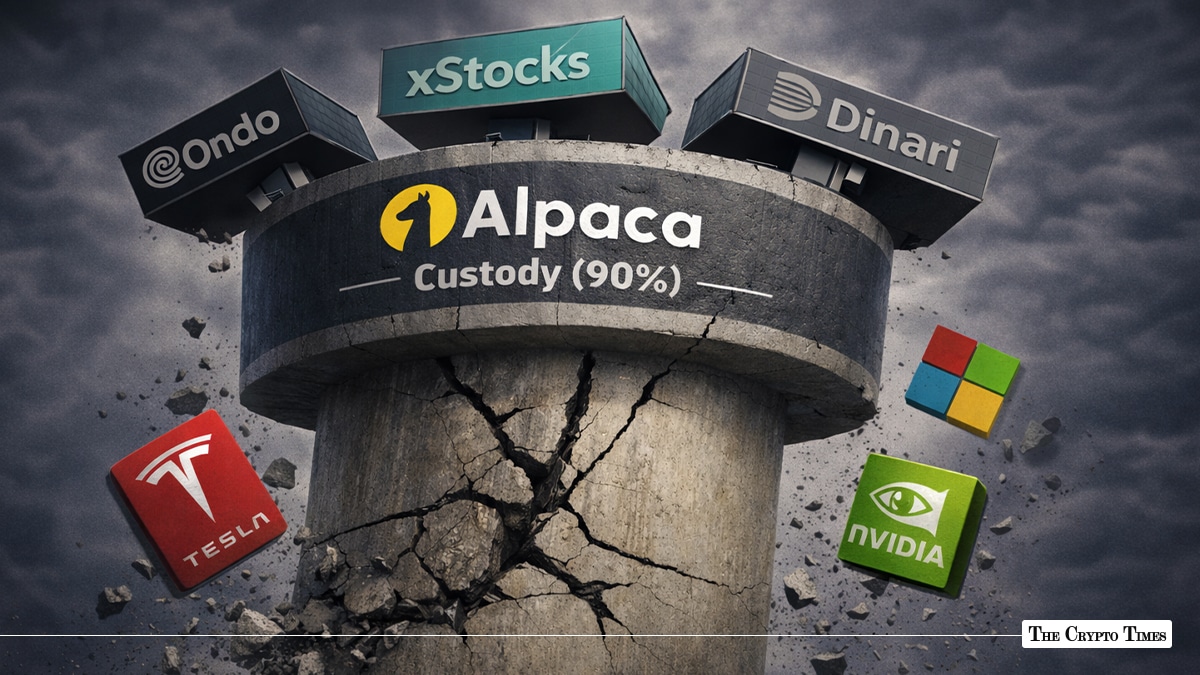
- Alpaca Securities dominates the tokenized U.S. stocks market with roughly 94% share as of December 2025, serving as the primary custodian for major platforms like Ondo Finance, xStocks, and Dinari.
- Despite tokens trading on decentralized blockchains, real-world settlement and custody rely on traditional finance infrastructure, exposing the ecosystem to regulatory scrutiny from the SEC, compliance challenges, and geographic restrictions that could disrupt the entire market.
- The tokenized equities sector has grown rapidly, with Alpaca’s assets under custody nearing $670 million by early 2026 and leading issuers like Ondo ($546M) and xStocks ($209.5M).
While tokenized U.S. stocks are expanding rapidly, a closer examination over it reveals a significant irony: the tokens themselves trade on decentralized protocols, but the underlying settlement and custody processes remain profoundly centralized.
As noted by The Information with December 2025 data, nearly 94% market share of the tokenized stocks and exchange traded funds (ETFs) remains in the hands of Alpaca Securities, a California-based stock broker and dealer. Platforms like Ondo Finance, Kraken’s xStocks (via Backed Finance), and Dinari are all collectively using Alpaca as their go-to tokenized stock broker.
From Alpaca’s perspective, the growth is a phenomenon, but the heavy reliance on one broker introduces notable vulnerabilities in a sector that champions decentralization. A disruption at Alpaca–whether from operational issues, cyberattacks, or heightened regulatory scrutiny–could affect a vast portion of tokenized equities.
This can be compared to past centralized failures in crypto, where single chokepoints amplified risks. A prime example is the 2022 Terra/Luna collapse, where the centralized design of the UST stablecoin peg led to a rapid death spiral and over $40 billion in market value destruction. Comparatively, the tokenized stocks market is currently a toddler but risk remains the same regardless of the market valuation.
On top, regulatory bodies like the U.S. Securities and Exchange Commission (SEC) increasingly view tokenized assets as securities subject to existing rules, potentially targeting key infrastructure providers. One blue eye from them could shake the whole sector as it is already fragile due to its nature. The real-world settlements of tokenized stocks (trade execution, clearing, and share custody) depend on traditional systems. This hybrid model exposes the ecosystem to traditional finance (TradFi) frictions, including compliance hurdles and geographic restrictions.
Alpaca’s dominance in tokenized stocks management
Initially known for its developer-friendly APIs, Alpaca has become the go-to provider for tokenized stock issuers. Early reports indicated that Alpaca held custody for nearly 75% of tokenized U.S. stocks in a market exceeding $1 billion. However, as the industry matured, Alpaca’s dominance rose and it currently sits on the top; apparently the only position.

Latest data from RWA.xyz indicates that Ondo Global Markets’ $546 million in issuances, followed by xStocks with $209.5 million, further solidified Alpaca’s position. By early 2026, reports cited tokenized assets under management (AUM) climbing toward $670 million under Alpaca’s custody.
The concentration stems from Alpaca’s willingness to engage where others hesitate, providing self-clearing custody and APIs tailored for tokenization via its Instant Tokenization Network.
Explosive growth in tokenized stocks
These digital tokens, backed by real shares in companies such as Tesla and Nvidia, promise 24/7 trading, fractional ownership, and global accessibility without traditional intermediaries.
Tokenized stocks function by linking blockchain-based tokens to actual U.S. equities held in custody. These issuers purchase the underlying shares through a broker and mint corresponding tokens on blockchains such as Solana or Ethereum.
The sector has experienced explosive growth. By late January 2024, the valuation of total tokenized assets under custody (AUC) remained at $963.04 million, with over $2.11 billion in monthly transfer volume—as per RWA.xyz data.

Popular tokens include EXOD, TSLA, SPY (S&P 500 ETF), QQQ, NVDA, and IVV—all having millions in on-chain value. This boom reflects broader interest in real-world assets (RWAs) as a bridge between TradFi and decentralized finance (DeFi).
Looking ahead: Expansion and challenges
An optimistic point is that as the AUM in tokenized stocks reach new heights, Alpaca continues to invest aggressively in its role. In January 2026, the company secured $150 million in Series D funding at a $1.15 billion valuation, alongside a $40 million credit line. This capital is said to be used for global expansion, additional licenses, and enhanced tokenization infrastructure.
Proponents view this phase as transitional, with Alpaca serving as essential bridge infrastructure until more diversified or fully on-chain solutions emerge. Critics, however, argue that true decentralization requires reducing such dependencies to avoid undermining the sector’s foundational promises.
As tokenized equities grow from a niche experiment to a meaningful market segment, the tension between innovation and centralization persists. For now, Alpaca’s quiet dominance underscores a key reality: even in blockchain-powered finance, critical backend processes often remain firmly in centralized hands.
Also read: Tokenized Securities Face Same Rules as Traditional Assets, Says SEC