Key Highlights
- Nansen launches an AI-powered execution, letting users trade on Solana and Base while keeping full control.
- The new feature allows users to chat with the AI to generate signals and execute trades instantly, leveraging Jupiter (Solana) and OKX DEX (Base) for liquidity.
- AI crypto tokens show mixed results; some gain traction, while others face big price swings due to weak real-world use cases.
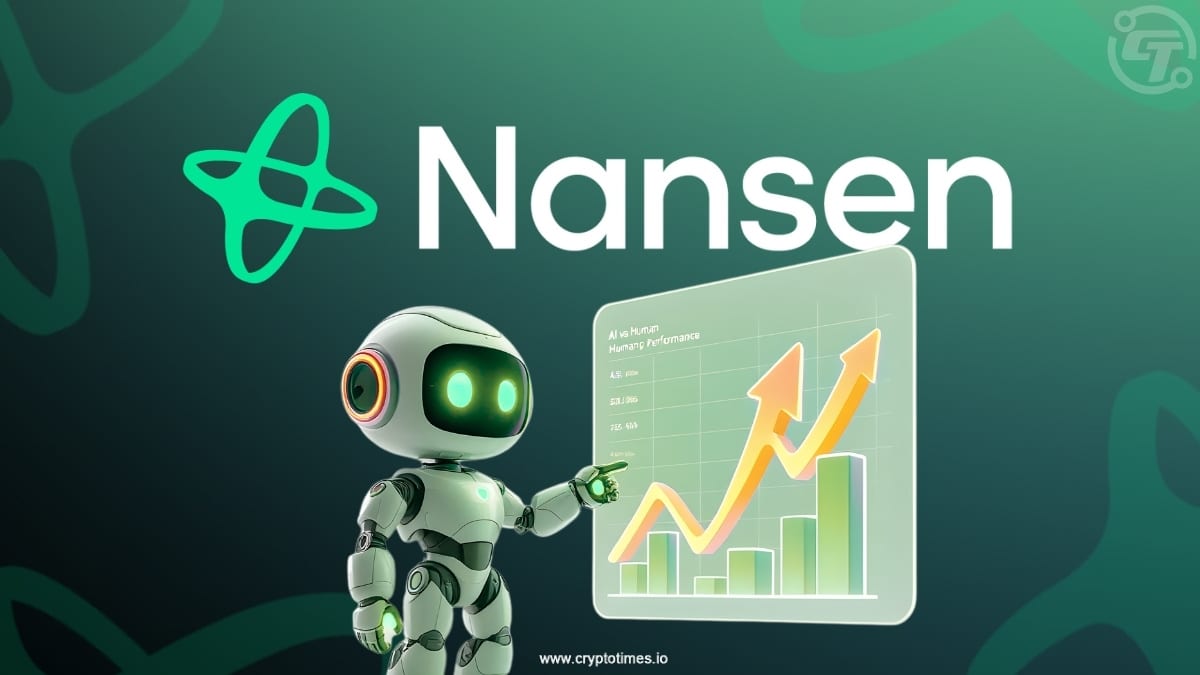
On-chain analytics provider Nansen has unveiled an AI-powered trading solution, giving crypto traders a seamless platform that combines market analysis and execution, starting with Solana and Base networks.
With its proprietary dataset of more than 500 million labeled wallet addresses, Nansen aims to make on-chain trading workflows seamless. According to the firm, users can engage the AI agent via its web terminal or mobile app to gain recommendations backed by data, all while retaining full control of each and every transaction.
The solution, called Nansen AI, allows for what the firm has labelled as “vibe trading,” where analysis and execution happen in the same chat window. The platform operates under user-defined rules and does not take custody of funds. Nansen confirmed the launch on X thread, stating, “Today, we’re opening up a new way to trade for 𝒂𝙡𝒍 users.”
Besides simplifying trading, the platform integrates liquidity from Jupiter on Solana and OKX DEX on Base. Cross-chain transactions are routed via LI.FI, and the embedded Nansen Wallet uses Privy infrastructure to ensure self-custody for users.
AI integration in crypto trading
This launch is part of a bigger trend of AI tools in crypto. As part of them, Coinbase’s Payments MCP, announced in October 2025, lets AI handle money directly on the blockchain. Now, AI can create wallets, move funds, and send stablecoins—all without needing any coding skills. This means AI can manage financial tasks safely while keeping everything transparent for users.
Each wallet features set limits on spending, approval, and usage. In addition, Payments MCP is paired with various platforms for artificial intelligence, including Anthropic’s Claude, Google’s Gemini, OpenAI’s Codex, and Cherry Studio, which indicates that crypto platforms and artificial intelligence solutions are starting to integrate better.
However, Binance CEO Changpeng Zhao (CZ) has warned earlier that many AI projects focus too much on launching their own tokens. He said, ‘While crypto is the currency for AI, not every agent needs its own token. Agents can take fees in an existing crypto for providing a service.’ CZ’s point is that projects should focus on useful services instead of creating tokens just to raise money
He stressed that projects should focus on real use cases instead of just raising money with tokens. Otherwise, they often lose investor trust. As a result, some AI tokens experience big ups and downs in their prices.
Mixed performance among AI tokens
Data from CoinMarketCap supports some of this community caution as it shows uneven performance for AI-focused crypto tokens. At the time of writing, Superintelligence Alliance (FET) was trading at $0.2390, down 17.86% over the week, while Virtuals Protocol (VIRTUAL) declined 23.27% weekly to $0.8197. OriginTrail (TRAC) showed a minor 0.09% hourly gain but fell 9.19% over the week.
Although, in contrast, Kite (KITE) rose 11.03% weekly to $0.1050, and Unibase (UB) gained 3.22% over 24 hours to $0.03617. These figures indicate that while some AI-driven projects gain traction, others struggle to generate sustainable market confidence.
Nansen’s AI trading tool is reflective of how crypto trading is becoming simpler and smarter. It makes trading faster, combines multiple tools in one place, and lets users stay in full control of their money.
Also Read: Solana Mobile Unveils SKR Token Airdrop for Seeker Phone Users