Key Highlights
- Securities and Exchange Commission Chairman Paul S. Atkins said public blockchains are more transparent than any traditional financial system.
- Atkins warned that blockchain transparency can help oversight but could also lead to mass surveillance.
- He highlighted privacy tools like zero-knowledge proofs and selective disclosure to protect users’ privacy.
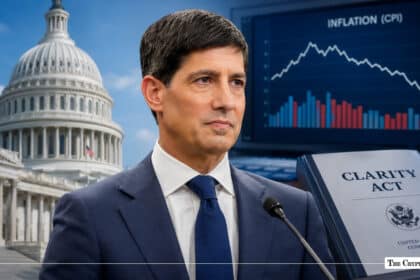
Public blockchains are “more transparent than any legacy financial system ever built,” Securities and Exchange Commission (SEC) Chairman Paul S. Atkins said at the agency’s Crypto Task Force roundtable on December 15.
Every transaction on these blockchains is recorded on a ledger that can be viewed by anyone. While this ledger-based visibility assists law enforcement, Atkins used the forum to issue a stark warning: without deliberate privacy protections, the technology could be co-opted for mass financial surveillance.
“Pushed in the wrong direction, crypto could become the most powerful financial surveillance architecture ever invented,” he said. He cautioned that if the government’s instinct is to treat every wallet like a broker, every software as an exchange, and every transaction as a reportable event, the ecosystem could become a “financial panopticon,” constantly monitoring Americans’ financial activity.
He stressed that this level of transparency could also disrupt traditional market functions. Having real-time visibility into trades, hedges, and portfolio changes could lead some individuals to engage in activities like front-running. Such actions and other market abuses can make market-making and underwriting less attractive and less profitable.
Rebalancing the “surveillance appetite”
Atkins pointed to the SEC’s own history with tools like the Consolidated Audit Trail (CAT) and Form PF, acknowledging that while they were built for investor protection, their expanded scope has often trended toward bulk surveillance with diminishing returns for actual market safety.
He stressed that real-time transparency isn’t just a privacy issue—it’s a market efficiency issue. Having real-time visibility into trades and portfolio changes could lead to front-running and “pile-on” dynamics. Such exposure makes market-making and underwriting far less attractive, as inventory imbalances would be immediately exposed to the marketplace.
Privacy tools as the solution
Atkins pointed out that blockchain technology provides the means for protecting the privacy of users, which was not possible within the former financial system.
“Zero-knowledge proofs, conditional disclosure, and privacy-focused wallets enable users to prove compliance without sharing the full history of financial transactions and personally identifying information,” he noted. This might affect platforms that are regulated and enable user screening without creating individual “maps” for all transactions.
“The challenge is to shield the lawful activity of our citizens from bulk surveillance while still allowing the government to perform essential functions,” Atkins said. Such an approach balances national security and civil liberties while giving room for innovation to flourish, he noted.
This approach—shielding lawful activity while still allowing the government to perform essential functions—is the core of Atkins’ “Project Crypto” initiative. It seeks to balance national security obligations with the preservation of individual liberty.
Privacy and policy implications
SEC Commissioner Hester Peirce, speaking at the roundtable, said that tokenized securities and other crypto assets let people make transactions without going through traditional middlemen, which reduces the amount of information available to government surveillance.
She added that while public blockchains are very transparent, they also offer ways to protect privacy and could help the U.S. rethink how financial privacy has eroded over time.
Atkins concluded by saying that there was a lot on the line regarding the implications, and he was convinced that policymakers had to make sure that progress in technology and finance is not achieved through the sacrifice of individual liberties.
Although Atkins could not attend the rest of the roundtable, he was confident that the discussion would help shape a future where privacy and innovation, and security could thrive together in the US.