Key Highlights
- IMF warns tokenized markets boost speed and efficiency but could trigger flash crashes if automation and linked programs fail.
- Tokenized assets grow fast, yet regulators and investors must balance efficiency with risks from automated and interlinked trading systems.
- Rapid tokenization cuts costs and speeds trades, but sudden crashes and fragmented markets remain key concerns, says IMF and WFE.
Tokenized financial markets are growing rapidly, but the International Monetary Fund (IMF) has warned these innovations may amplify market volatility and deepen flash crashes. In a recently shared video on X, the IMF described how converting traditional assets into digital and programmable tokens makes trading easier, but any new technology can introduce hidden risks.
Tokenization enables faster and cheaper buying, selling, and management of assets such as stocks, bonds, and Treasuries with the use of blockchain technology. However, the IMF warned that the use of automation and interlinked programs might lead to cascading failures in case of crises.
According to the IMF, tokenization can eliminate intermediaries such as clearinghouses and registrars. These institutions typically ensure transactions settle correctly and dividend rights transfer safely. By reducing these steps, tokenized markets cut costs and speed up processes.
Besides efficiency, tokenization also enables “programmable money,” allowing assets to follow rules encoded in software. Nevertheless, these benefits come with potential volatility. Automated programs executing trades instantly could worsen flash crashes, with multiple chains of programs interacting unexpectedly.
Rapid growth in tokenized assets
Tokenized markets have become a multibillion-dollar industry. BlackRock’s BUIDL fund now leads the sector as the world’s largest tokenized Treasury fund. In addition, Ondo Global Markets crossed $300 million in tokenized equities within a month of its launch, bringing the total fund size to roughly $1.4 billion.
Data from rwa.xyz shows the tokenized U.S. Treasury market grew from very low levels in early 2023 to around $10 billion by late 2025. Specifically, growth rose from $3.5 billion at the start of the year to $7 billion mid-year, and reaching nearly $10 billion by the end of the year.
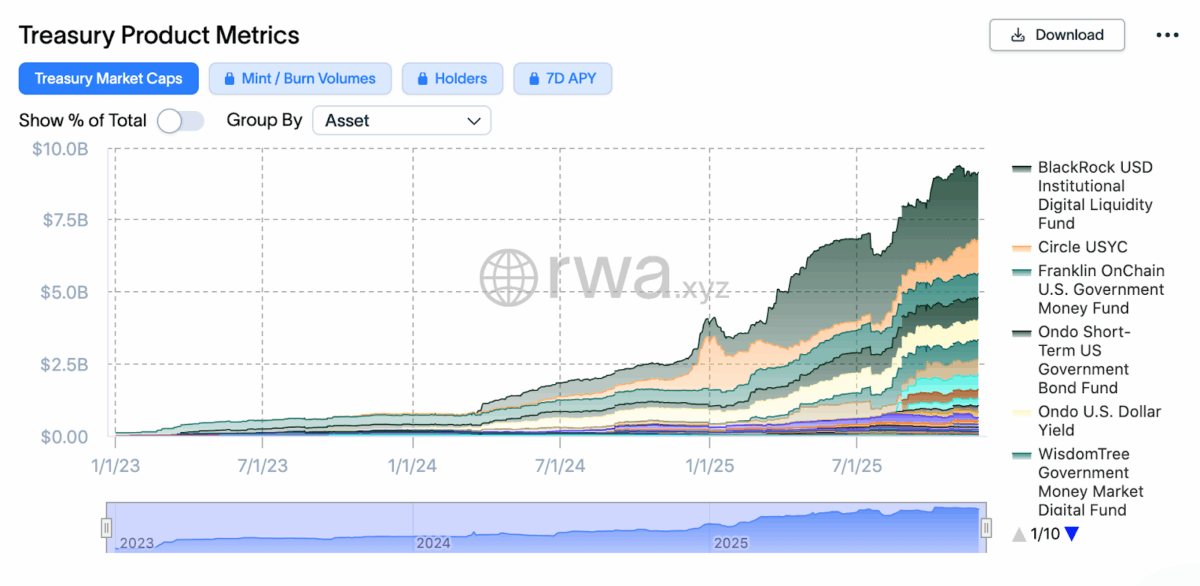
The largest share is in BlackRock’s USD Institutional Digital Liquidity Fund, which is at $7 billion by late 2025, as per the data. Other significant contributors included Circle’s USYC product at $2 billion, Franklin OnChain U.S. Government Money Fund around $800 million, and Ondo Short-Term U.S. Government Bond Fund at $600 billion. WisdomTree Government Money Market Digital Fund added a smaller portion of about $100 million.
Regulatory and market risks
Alongside growth, regulatory scrutiny intensifies. The World Federation of Exchanges (WFE) warned the U.S. Securities and Exchange Commission (SEC) about tokenized stock offerings. In a November 21 letter, the group stated, “These products are marketed as stock tokens or the equivalent to stocks when they are not. This development poses multiple and interconnected risks.”
Many crypto platforms seek to offer tokenized stocks, allowing investors exposure to public companies without owning shares. However, companies not registered as broker-dealers require SEC exemptions, and Chair Paul Atkins has suggested limited approvals.
The IMF’s past actions show it approaches digital assets cautiously. In July, it challenged El Salvador’s claim of buying new Bitcoin, saying the country only moved coins between wallets, highlighting the fund’s careful oversight of crypto and tokenized markets.
Tokenized markets make trading faster and cheaper, but they can increase price swings. Investors and regulators need to balance efficiency with caution. Clear rules and compatible systems will be important as these markets grow.
Also Read: Polygon Exec Flags Stablecoin ‘Super Cycle’ Set to Disrupt Banks