Key Highlights
- Satoshi Nakamoto’s Bitcoin fortune dropped by over $42 billion after BTC fell more than 30% from its peak.
- The value of Satoshi’s 1.1 million BTC slid from $138.9B in October to about $96.1B today, pushing him down global wealth rankings.
- The sharp decline renews debate over Satoshi’s dormant coins, ownership mystery, and future risks like quantum computing threats.
Satoshi Nakamoto, the mysterious creator of Bitcoin, has seen an estimated $42 billion wiped out from his digital fortune after Bitcoin tumbled more than 30% from its recent all-time high.
The sharp correction dragged the value of Satoshi’s long-dormant Bitcoin stash from $138.92 billion in early October to around $95.83 billion today.
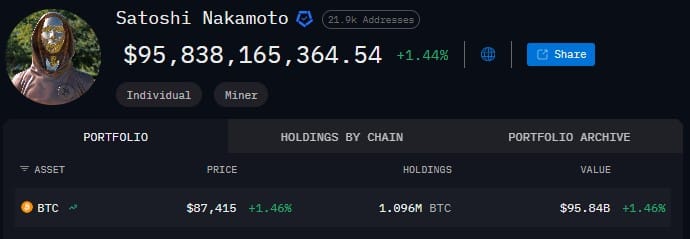
The dramatic fall has pushed Nakamoto’s estimated ranking among the world’s richest individuals from around 11th to roughly 20th, positioned just below Bill Gates, according to wealth calculations based on BTC market price.
Although these rankings remain hypothetical, the drop highlights how Bitcoin’s volatility continues to reshape global wealth narratives.
How much bitcoin does Satoshi control?
For years, blockchain researchers have used the Patoshi Pattern, a discovery by cryptographer Sergio Lerner, to estimate Satoshi’s early mining activity. The pattern recognizes over 22,000 addresses that are suspected to be owned by a single person, which is probably the inventor of Bitcoin.
These wallets collectively hold around 1.1 million BTC, making them one of the most transparent yet untouched fortunes in modern financial history. Despite public curiosity, not a single one of Satoshi’s coins has moved in more than a decade.
Analysts from Arkham Intelligence and other firms continue to track these addresses, but none have found evidence of activity since Bitcoin’s earliest years.
This long silence has fueled endless speculation about Satoshi’s identity and the status of the coins, whether they are deliberately preserved, lost forever, or locked away under unknown security constraints.
Why bitcoin fell and why It matters now
Bitcoin’s correction comes after its October 7, 2025 peak of $126,000, driven by profit-taking, macroeconomic uncertainty, and declining risk appetite among institutional traders.
As of today, Bitcoin circulates near $87,162, a drop of more than 30% from the peak. This decline directly affects Satoshi’s theoretical net worth because all of his known coins remain unmoved.

The drop of more than $42.79 billion in a matter of weeks shows the scale of Bitcoin’s influence on global wealth measurements, even when the assets remain inactive. The fall also reignites concerns about the concentration of Bitcoin’s early supply.
Satoshi’s 1.1 million BTC represents nearly 5% of the asset’s total maximum supply, a figure that still raises questions about long-term economic and network security implications.
Why wealth trackers don’t count Satoshi
Although Satoshi’s estimated fortune regularly surfaces in global wealth comparisons, Forbes and other billionaire trackers do not list the Bitcoin founder. The reasons are simple but significant, Satoshi’s identity has never been confirmed.
It is unclear whether Satoshi is one person or a group. The coins have never moved, leaving ownership legally unresolved. A Forbes spokesperson previously explained that the magazine cannot verify whether Satoshi is a “living individual.”
Without such confirmation, the world’s most famous anonymous fortune remains excluded from official rankings, despite being visible on the blockchain.
Some crypto analysts argue that modern wealth lists should include pseudonymous wallets due to blockchain transparency. However, others note that dormant coins should not influence rankings if the owner cannot be confirmed or reached.
Quantum computing and the fear of a future ‘Q-Day’
The rapid development of quantum computing technology has brought up the question of the safety of ancient Bitcoin wallets, including that of Satoshi. Many early bitcoin addresses are based on the use of public-key cryptography which may be susceptible to future advanced quantum attacks.
Some industry experts suggest that Bitcoin may eventually need a network fork or temporary freeze of vulnerable addresses if a quantum threat becomes real.
Such proposals remain controversial, but they highlight a rare scenario where Satoshi might be forced to come out or perform in order to defend the initial supply of Bitcoin.
Interest in the Bitcoin creator will increase even more in 2026 when the film Killing Satoshi is released, examining the political tensions, conspiracy theories and international intrigue of dormant Bitcoin wealth. The film is an indicator of how far the mystery of Satoshi has infiltrated popular culture.
What comes next for Satoshi’s wealth?
For now, Satoshi’s fortune remains unchanged, untouched, and visible to the world. If Bitcoin eventually surges to $320,000–$370,000, analysts estimate Nakamoto could become the richest person on Earth, surpassing all modern billionaires without moving a single coin.
But with Bitcoin’s recent downturn, Satoshi’s wealth has contracted sharply, reminding the world that even the most mysterious fortunes are not immune to market swings.
Until those early coins move, or are proven lost, the identity and intentions of Bitcoin’s creator will remain crypto’s greatest unsolved mystery.
Also Read: LeverageShares To Launch First 3x Bitcoin and Ether ETFs in Europe