It is a story as old as Bitcoin itself, yet it happens to new investors every single day. You see a new token launch. It is trending on X, influencers are calling it “the next Solana,” and the price is skyrocketing. You buy in, excited to be early. But then, for the next two years, the price slowly bleeds out, dropping 90% even though the project is technically “building” and “shipping code.”
You didn’t lose money because the project failed. You lost money because you were fighting a mathematical battle you couldn’t win. You were fighting Tokenomics.
What is Tokenomics?
Simply put, tokenomics (a portmanteau of Token and Economics) is the study of the supply, demand, distribution, and valuation of a cryptocurrency. It answers the critical questions: Who owns the coins? When can they sell them? And how many new coins are being minted every day?
In the stock market, regulations prevent founders from dumping shares on retail investors immediately. In crypto, the rules are written in code, and if you don’t read them, you become the “exit liquidity.” This guide will teach you how to read those rules.
The basics: The “supply” trifecta
Before you buy a single token, you must understand the three different ways to measure supply. Misunderstanding these is the main reason beginners lose money.
1. Circulating supply
This is the number of tokens currently in public hands and available for trading. If a project has 10 million tokens trading on exchanges, that is its circulating supply. This determines the current Market Cap (Price × Circulating Supply).
2. Total supply and max supply
- Max Supply: The absolute hard cap. Bitcoin, for example, has a max supply of 21 million. No more can ever exist.
- Total Supply: The amount of tokens that currently exist on the blockchain, including those that are locked up, vesting, or held in reserve.
3. The valuation Trap: Market cap vs. FDV
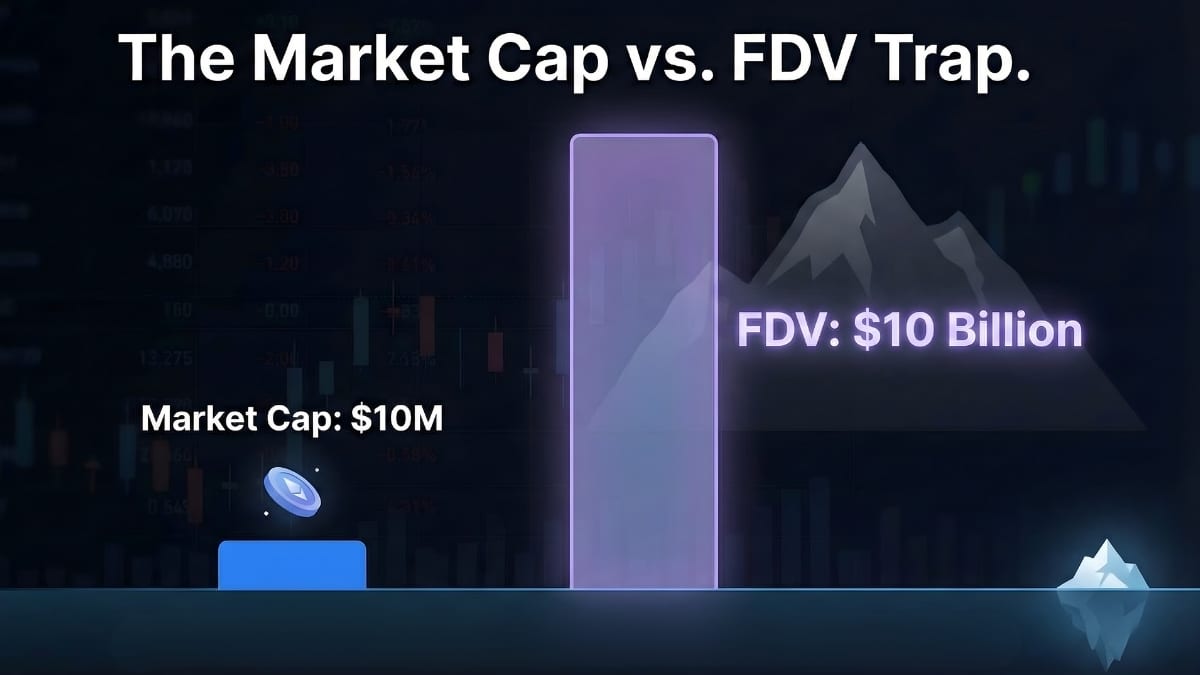
- Market Cap: The value of the current circulating tokens.
- FDV (Fully Diluted Valuation): The theoretical value of the project if all tokens (Max Supply) were in circulation today.
The Danger Zone Example: Imagine a new project, “CoinX,” launches at $1.00.
- Circulating Supply: 10 Million
- Max Supply: 10 Billion
The Market Cap is $10 Million. This looks “cheap” and like a “hidden gem” compared to massive coins. However, the FDV is $10 Billion (10 Billion tokens × $1). This means CoinX is actually valued as highly as a major established protocol, but 99% of the tokens are hidden, waiting to be released. As those tokens unlock, the supply floods the market. If demand doesn’t increase by 1000x (which is rare), the price must collapse to absorb the new supply.
Rule of Thumb: Always look at the ratio of Market Cap to FDV. If the Market Cap is only 5% of the FDV, you are investing in a “high inflation” asset.
Allocation: Who owns the network?
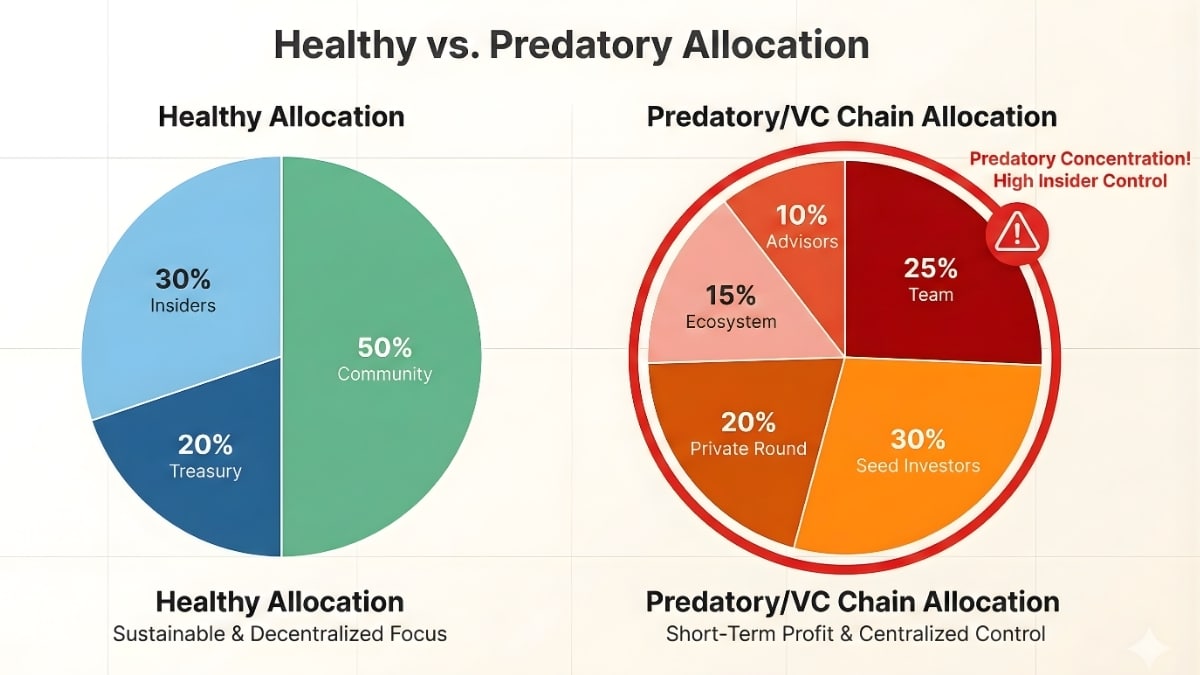
Once you know how many tokens there are, you need to ask: Who owns them? This is often displayed as a pie chart in the project’s whitepaper. This is the single most important factor to check.
1. Insiders (Team + VCs)
Every project needs funding (VCs) and builders (Team). They deserve to be rewarded. However, the percentage matters.
- Healthy: Team (15-20%) + Investors (15-20%). Roughly 30-40% total insider ownership is standard.
- Red Flag: If Insiders + Team own >50% of the supply, the project is highly centralized. They have the power to crash the market or manipulate governance votes.
2. Community and the ecosystem
This slice of the pie is for you, the public. Look for allocations labeled “Airdrops,” “Community Treasury,” or “Liquidity Mining.”
- Warning: Be skeptical of vague labels like “Ecosystem Fund” or “Strategic Reserve.” Often, these are just slush funds controlled by the team to pay for marketing or sell OTC (Over-The-Counter) to raise more cash. A true community allocation usually has a DAO (Decentralized Autonomous Organization) controlling it.
3. Public sale
Is there a way for normal people to buy in early? Or was the entire early supply sold to private venture capital firms? Projects with no public sale are often called “VC Chains,” where retail investors are only allowed to buy once the price is already marked up on exchanges.
The release schedule: Vesting and cliffs
Knowing who owns the tokens isn’t enough; you need to know when they can sell. This is defined by the Vesting Schedule.
The Cliff
A “Cliff” is a period of time where tokens are completely locked.
- Example: “1-year cliff, followed by 2-year linear vesting.”
- Meaning: For the first year, investors get zero tokens. This protects the price during the early hype phase.
The Danger of the “Cliff Drop”: Beginners often buy a token 11 months after launch, thinking, “Wow, the price has been so stable!” They don’t realize the cliff ends in one month. On the 12th month, millions of dollars worth of tokens unlock instantly. Investors, who might be profitable on their initial investment, will often book profit immediately. This can cause a flash crash of 30 to 50% in days.
Vesting: Linear vs. Lump Sum
- Lump Sum: 20% of tokens unlock on day 1 of the month. This creates massive volatility on that specific day every month.
- Linear: Tokens unlock second-by-second or daily. This creates a constant “sell pressure” (inflation) but avoids massive single-day crashes.
How to Analyze: Use tools like TokenUnlocks or Dropstab. Look at the “Next Unlock” date. If a massive unlock (e.g., >20% of daily trading volume) is nearby then, it might be wise to wait before buying.
Supply dynamics: Inflation vs. Deflation
How does the supply change day-to-day?
Inflationary tokens (The silent tax)
Most Proof-of-Stake (PoS) blockchains (like Solana or Ethereum pre-merge) are inflationary. They print new tokens to pay validators (emissions).
- The Concept: If you hold a token with 10% annual inflation, and the market cap stays exactly the same, your token price will drop by roughly 9% in a year.
- Real Yield: If a staking protocol offers you 20% APY (Annual Percentage Yield), but the token inflation is 30%, you are technically losing purchasing power. This is called “dilution.” Always look for “Real Yield,” which is revenue paid in stablecoins or ETH, not just printed tokens.
Deflationary tokens
These projects have mechanisms to reduce supply, usually via a Burn mechanism.
- Burns Mechanism: When a user pays a fee, a portion of the tokens are sent to a “dead wallet” and removed from existence (e.g., BNB or ETH via EIP-1559).
- The Myth: “Burns make the price go up.” This is false. Burning supply only matters if there is demand. If you burn 50% of a supply that nobody wants, the price is still going to be the same. Demand is the engine; deflation mechanism is just the turbocharger.
Case study: The “low float” wars (Monad vs. HYPE)
To illustrate these concepts, let’s look at two theoretical models based on recent controversial market narratives: The “Monad Model” (Traditional VC) vs. The “Hyperliquid/HYPE Model” (Community First).
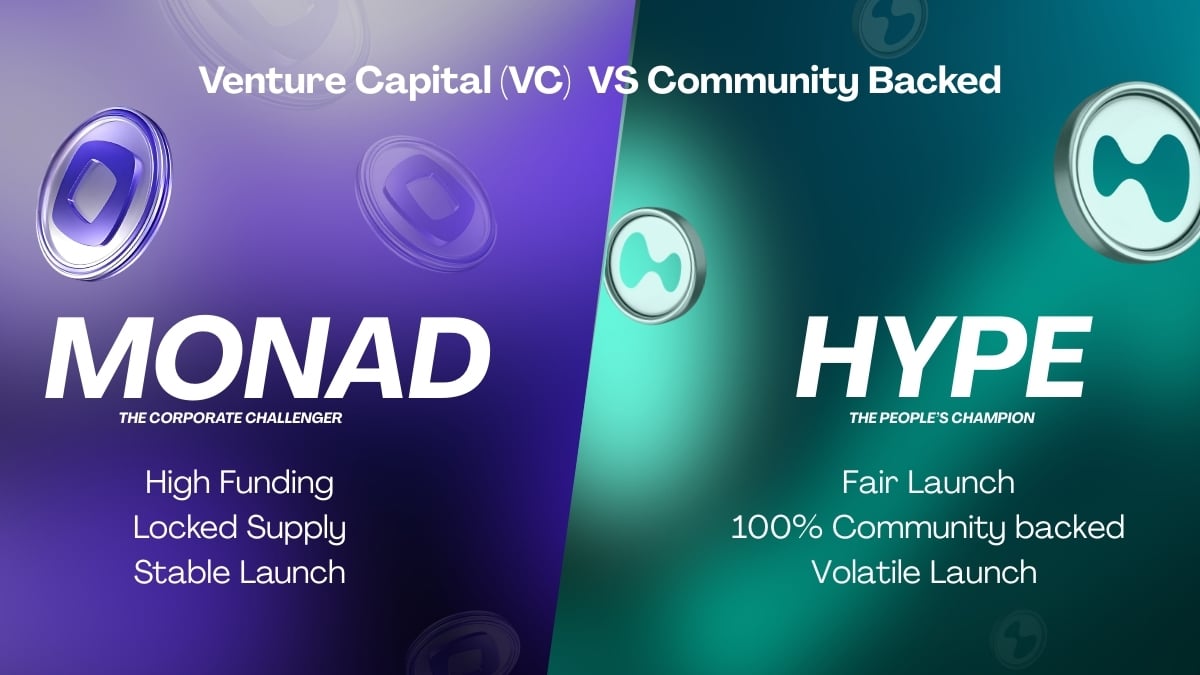
1. The “Monad” model (high FDV, low float)
This represents the classic “VC Chain” approach.
- Structure: The project raises hundreds of millions from VCs at a low valuation.
- Launch: The token launches with a very small circulating supply (Low Float) but a massive FDV.
- The Controversy: Because supply is scarce, the price pumps hard initially. However, retail investors are buying a token valued at $10B FDV that VCs bought at $100M FDV. As the vesting cliff hits, VCs might act as “exit liquidity,” and sell into the demand created by retail.
- Pros: Massive funding allows for top-tier tech development and marketing.
- Cons: The token price often trends down for years (post-launch) as the huge supply unlocks.
Also Read: Monad Hit by Spoofed Token Transfers After Mainnet Launch
2. The “Hyperliquid (HYPE)” model (fair launch)
This represents a pivot toward community-centric tokenomics.
- Structure: Instead of selling tokens to VCs, the project distributes tokens to users who actually used the platform (via Points or Airdrops).
- The Controversy: There is no “Cliff” to protect the price. Farmers who got the airdrop might dump immediately, causing high volatility at the start.
- Pros: The community owns the network. There is no massive “VC Unlock” looming in the future to crush the price.
- Cons: Less upfront cash for the team; highly volatile launch phase.
Also Read: Hyperliquid Introduces HIP-3 Growth Mode With Lower Fees
Comparison: The Monad model is a “Time Bomb” risk—stable now, risky later. The Hyperliquid model is a “Volatility” risk—chaotic now, potentially more stable later.
Utility and governance: Hype vs. Reality
Finally, ask: What does this token actually DO?
The utility checklist
- Gas: Do you need the token to pay for transactions? (e.g., ETH, SOL, MATIC). This is the strongest utility because it creates guaranteed demand.
- Cash Flow: Does the protocol make money? If a decentralized exchange charges a 0.3% fee, does that fee go to token holders? (e.g., MakerDAO burning MKR, or GMX distributing ETH fees).
- Discount: Does holding the token give you cheaper trading fees? (e.g., BNB).
The governance trap
Be very careful with tokens that have “governance” as their only utility.
- The Pitch: “Hold this token to vote on the future of the protocol!”
- The Reality: Unless you own millions of dollars worth of tokens, your vote likely doesn’t matter. Large funds and the team usually control >51% of the voting power. If a token has no cash flow and no gas utility, and is just for “voting,” it is often overvalued.



Conclusion: The 5-point checklist
Before you invest, run the project through this checklist. If it fails more than two points, tread carefully.
- Valuation Check: Is the FDV realistic? (If a newly launched coin has a higher FDV than a major airline, sell).
- Ownership Check: Do insiders (Team/VCs) own less than 40% of the total supply?
- Cliff Check: Is there a major “Cliff Drop” or unlock event happening in the next three months?
- Inflation Check: Is the token inflation rate lower than the user growth rate? (You need more new users than new tokens).
- Utility Check: Does the token capture value (fees/gas), or is it just a “governance” token for a project that makes no revenue?
Price is what you pay. Tokenomics is what you get. Master the latter, and you will stop being the exit liquidity for the former.