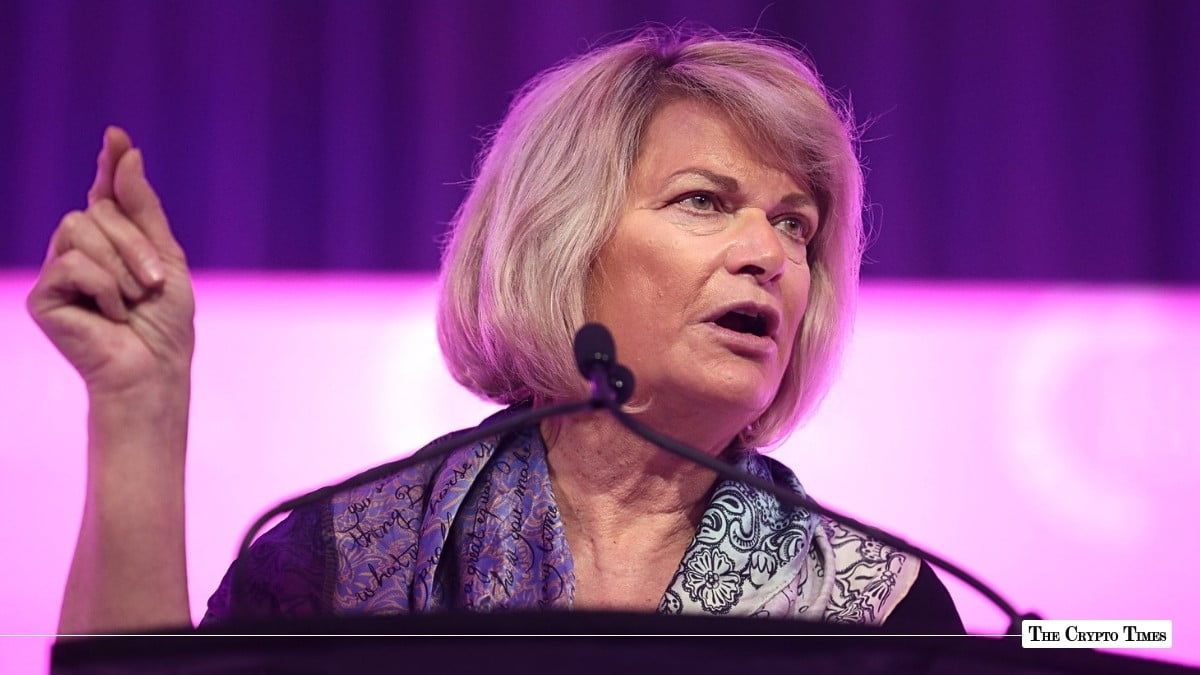
Senator Cynthia Lummis (R-WY) has reframed the stakes around the CLARITY Act as the crypto market structure bill enters one of its most uncertain stretches in the U.S. Senate.
In a post on X, Lummis wrote: “The Clarity Act is not just a crypto bill. It’s a decision about whether America leads the next financial system or watches from the sidelines.”
The statement lands in a moment with no floor vote scheduled, no markup planned, and no major amendment fight on the immediate calendar. With the August recess approaching, Lummis and other proponents are turning to public messaging to keep pressure on Senate leadership during what has become a quiet legislative period for the most significant crypto bill of the year.
Where the CLARITY Act Actually Stands
The Digital Asset Market Clarity Act passed the Senate Banking Committee in a 15-9 vote on May 14, 2026, with all 13 Republicans joined by Democrats Ruben Gallego and Angela Alsobrooks. The bill draws jurisdictional boundaries between the SEC and CFTC, permanently classifies Bitcoin and Ethereum as non-securities, and establishes a comprehensive regulatory framework for digital assets.
But the path from the committee to the Senate floor remains blocked by an unresolved fight over an ethics provision that Democrats have sought to attach—language that would restrict certain crypto holdings and dealings by federal officials. A Van Hollen amendment along these lines was rejected during the May 14 markup, but the issue has not gone away. To clear the Senate floor, the bill needs 60 votes, meaning at least seven Democrats must cross over. The ethics fight is widely viewed as the deciding variable.
In addition, the Banking Committee version must still be merged with a Senate Agriculture Committee version that contains different CFTC jurisdiction provisions before any floor vote can proceed.
The Crypto Times previously reported on the post-committee timeline, with Lummis striking a measured tone immediately after the markup: “Nobody is popping the champagne quite yet. There’s still a lot of work to do.” Asked about a June floor vote, she said directly: “I would love to have this bill on the floor in June. That’s probably pretty optimistic.”
The Pressure Campaign Takes Shape
Lummis is not pushing alone, and her June 1 statement is part of a sustained messaging arc rather than a one-off remark. Just two days earlier, Lummis publicly warned that China would not wait for the U.S. to finalize its crypto rules, framing congressional inaction as a direct gift to Beijing’s ambitions in shaping global digital asset standards. The June 1 ‘lead or watch from the sidelines’ framing extends that argument, sharpening the competitive narrative into something closer to a binary choice for moderate Democrats and undecided senators.
Other proponents are reinforcing the same message. Senator Bernie Moreno (R-OH) has co-warned that failure to advance the bill in the current window could push the next viable legislative opportunity beyond the 2026 midterm elections. Senator Bill Hagerty (R-TN) has consistently characterized the remaining issues as solvable. Treasury Secretary Scott Bessent published a Wall Street Journal op-ed framing the bill as a national security priority, citing the migration of blockchain developers and crypto companies to Singapore and Abu Dhabi as a consequence of sustained U.S. regulatory ambiguity.
Lummis herself has indicated lawmakers are working the bill behind the scenes, attempting to consolidate it with related crypto legislation into a broader framework package that could move as a single vehicle on the Senate floor.
The combined messaging is aimed at one specific audience: the seven Democrats whose votes will decide whether the bill clears 60. By tying CLARITY Act passage to U.S. leadership against China, the EU’s MiCA framework, the UK’s evolving stablecoin regime, Singapore, Hong Kong, and the UAE, proponents are betting that the geopolitical framing makes a no vote politically costlier than the ethics provision concession.
The Calendar Is the Real Constraint
The CLARITY Act’s biggest problem is not opposition — it is floor time.
Senate Majority Leader John Thune has indicated the chamber will be largely consumed by unfinished reconciliation business through June, with disagreements over a Department of Justice funding provision adding further complications. Former Senate aide Anne Kelly told industry observers that “Clarity Act passage before August recess just got more challenging,” noting that the most valuable commodity in Washington is Senate floor time.
The Senate has roughly four working weeks left in June and three more in July before the August recess. The bill competes with budget negotiations, FISA debates, supplemental funding requests, and a housing bill recently advanced by the House. Crypto Council for Innovation CEO Ji Kim estimated in April that the Senate has approximately 9 to 10 working weeks of usable floor time before the August deadline — a window that has narrowed since.
Galaxy Research head of research Alex Thorn currently puts the probability of CLARITY Act passage in 2026 at 75%, with a realistic signing date estimated for the week of August 3. The White House’s original July 4 signing target is now considered ambitious. TD Cowen analysts warn that slippage into 2027 remains possible if the floor calendar does not open up in June.
What Failure Would Cost
Lummis has previously warned that failure to pass the CLARITY Act in 2026 could push the next viable legislative window to 2030 or beyond, as a new Congress would need to restart the entire process and midterm campaign cycles typically consume legislative bandwidth. That long-tail risk is what gives the June pressure campaign its urgency.
The August recess is now the operative hard stop. After that, midterm campaign season effectively closes the window until 2027 at the earliest — and, if the bill is not on a clear path by then, potentially much longer.
For Lummis and other CLARITY Act backers, the June messaging push is less about converting opposition and more about maintaining the political conditions under which Senate leadership decides to allocate scarce floor time. If the bill is perceived as politically alive and high-priority, it competes for that time. If it goes quiet, it gets pushed.