
Polymarket, the world’s largest decentralized prediction market, faced a security incident when on-chain investigators flagged a $700,000 drain of POL tokens from wallets connected to its reward payout infrastructure on the Polygon network.
Within hours, Polymarket’s engineering lead issued a clarification that materially changes the nature of the story: this was not a smart contract exploit. It was a private key compromise of an internal operations wallet — a security failure at the access control level, not in the platform’s core infrastructure.
Polymarket’s UMA CTF Adapter contract on Polygon was exploited, with an attacker draining over $700,000 in POL tokens at a rate of approximately 5,000 tokens every 30 seconds before splitting the stolen funds across at least 15 wallet addresses.
On-chain investigator ZachXBT was first to flag the exploit, identifying the attacker’s address (0x8F98…9B91) and the related contracts being drained. Bubblemaps independently confirmed the ongoing drain and urged users to pause all Polymarket activity.
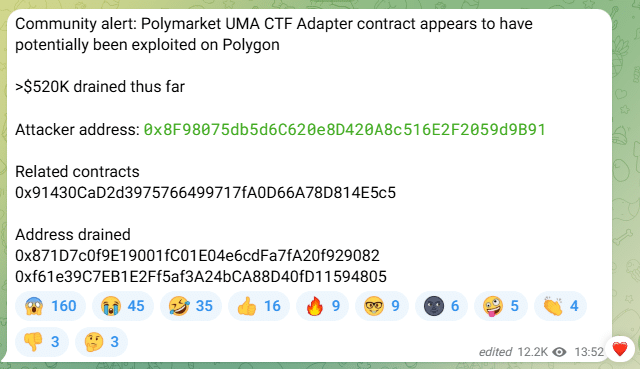
The attacker drained at least two addresses—0x871D…9082 and 0xf61e…4805 — through a related contract (0x9143…e5c5) connected to the UMA CTF (Conditional Token Framework) Adapter, the infrastructure layer that connects Polymarket’s prediction markets to UMA’s optimistic oracle for resolution.
Polymarket: Private Key Compromise, Not a Contract Exploit
Polymarket engineering lead Shantikiran Chanal responded within hours, stating that the incident was narrower than initial reports suggested.
“We’re aware of the security reports linked to rewards payout. User funds and market resolution are safe,” Chanal wrote. “Findings point to a private key compromise of a wallet used for internal operations, not contracts or core infrastructure.”
If confirmed, this distinction is critical. A private key compromise of an operations wallet is a security failure at the access control level — not a vulnerability in the smart contract logic itself. It means the attacker gained signing authority over a wallet that controlled reward distribution funds, rather than exploiting a flaw in Polymarket’s market resolution or settlement contracts.
User deposits, open positions, and market outcomes remain unaffected according to Polymarket’s statement. However, the full scope of the compromise has not yet been independently verified.
The Market Priced It Right
The market reaction provided a real-time demonstration of increasingly sophisticated on-chain risk pricing. Santiment data shows UMA dropped 3.3% during the exploit window—falling from $0.477 at 07:00 UTC to $0.462 by 09:00 UTC—while POL remained essentially flat at approximately $0.092.
The divergence makes sense: the UMA CTF Adapter is the vulnerable component in this incident. UMA’s oracle infrastructure is directly implicated in the exploit pathway, while Polygon’s base layer functioned as designed—the attacker simply used POL as the token being extracted through the compromised adapter.
“When the market correctly discriminates between protocol risk and token mechanics, that’s a sign of a more mature on-chain audience than headline-driven reaction suggests,” Santiment noted.
Funds Already Dispersed
Bubblemaps confirmed the attacker has already split the stolen funds across at least 15 addresses — a standard dispersion tactic designed to complicate tracing and make potential freezing or recovery more difficult. The speed of the dispersion—occurring while the drain was still active—suggests the attacker had pre-planned the laundering infrastructure.
No freeze actions have been announced by Polygon or any exchanges as of publication. The attacker’s primary address and the 15 receiving wallets have been publicly identified, which may aid future recovery efforts or exchange-level blocks.
What Was — and Was Not — Compromised
To understand why Polymarket’s clarification is significant, it helps to understand what the UMA CTF Adapter actually does.
The UMA CTF Adapter connects Polymarket’s prediction markets to UMA’s Optimistic Oracle for resolution. When a market is first created, the Adapter automatically sends a resolution request to the Oracle. Proposers submit answers with a bond, and if no dispute arises within a two-hour challenge period, the resolution data is available to the Adapter. The Adapter then resolves the market condition based on that data.
The reward payout wallet — the wallet that was compromised — is a separate administrative function. It holds POL tokens used to incentivize oracle proposers who participate in market resolution. Draining it does not affect whether markets resolve correctly, whether user USDC deposits are safe, or whether open positions settle at the correct price.
What it does affect is Polymarket’s ability to incentivize the proposer network that keeps its oracle system functioning. If reward wallets are persistently compromised, the economic incentive for UMA proposers to participate in market resolution degrades. That is a longer-term operational risk — not an immediate threat to existing positions, but not a trivial issue either.
Context: Polymarket’s Security Track Record
The exploit arrives at a sensitive moment for Polymarket, which has grown into the dominant prediction market platform with billions in monthly trading volume and has become a frequently cited data source for political, economic, and crypto market forecasting.
The platform faced scrutiny earlier this month when Le Monde exposed a weather sensor manipulation scheme designed to influence prediction market outcomes. In April, the platform banned a French trader who had manipulated physical weather data to profit from temperature-based contracts.
The UMA CTF Adapter specifically has been a recurring point of discussion in the Polymarket community. The adapter translates UMA’s optimistic oracle outcomes into conditional token resolutions — a critical piece of infrastructure that handles the flow between market resolution and user payouts. A compromise at this layer, even via private key rather than contract logic, raises questions about access control standards for infrastructure components handling significant capital flows.
Polymarket has not disclosed the total amount stolen, whether the drain has been fully stopped, or what remediation steps are being taken beyond the initial statement. Further updates are expected.
UPDATE: Portion of Stolen Funds Frozen
Following the breach, swift industry coordination has successfully blocked a portion of the stolen assets. In a collaborative effort led by on-chain sleuth ZachXBT alongside cryptocurrency exchange BitcoinVN and ChangeNOW, security teams managed to freeze $164,000 of the $573,200 that had been transferred from the compromised private key.
The rapid response highlights a major win for ecosystem-wide security coordination, though efforts to track and recover the remaining outstanding funds are still ongoing.
Also Read: Polymarket Faces Scrutiny Over Hidden Influencer Payments