JPMorgan Chase is doubling down on its bet that tokenized assets will reshape institutional finance.
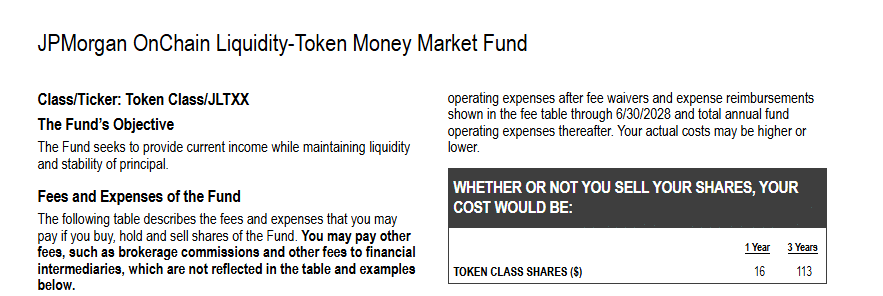
On May 12, 2026, the banking giant filed with the U.S. Securities and Exchange Commission to launch the JPMorgan OnChain Liquidity-Token Money Market Fund, trading under the ticker JLTXX.
The fund, set to operate on Ethereum and powered by JPMorgan’s Kinexys Digital Assets platform, will invest exclusively in short-term U.S. Treasuries and overnight repurchase agreements fully collateralized by government securities or cash.
Its explicit goal is to serve as a compliant reserve asset for stablecoin issuers under the GENIUS Act, the landmark U.S. stablecoin legislation signed into law in July 2025.
“The Fund invests in a manner intended to satisfy the requirements for eligible reserve assets that stablecoin issuers are required to maintain under the Guiding and Establishing National Innovation for U.S. Stablecoins Act (otherwise referred to as the GENIUS Act) and regulations adopted thereunder, to support investment in the Fund by stablecoin issuers seeking to comply with such requirements,” the SEC filing reads.
By limiting investments to short-term U.S. Treasuries with maturities of 93 days or less and fully collateralized overnight repos, JLTXX is engineered to deliver both safety and liquidity while meeting the strict reserve standards mandated by the landmark July 2025 legislation.
Bridging TradFi and Crypto Infrastructure
This marks JPMorgan’s second foray into on-chain money market funds. In December 2025, the bank rolled out its first tokenized offering, MONY (My OnChain Net Yield Fund), also on Ethereum.
While MONY targeted qualified institutional investors for cash management, JLTXX appears positioned for broader utility—particularly among stablecoin issuers seeking high-quality, liquid reserves that can be transferred peer-to-peer with near-instant settlement.
The fund will allow token holders to maintain blockchain-based balances tied to traditional ownership records, enabling 24/7 transfers among approved participants. While traditional settlement delays of T+1 or T+2 vanish; this will enable transactions to clear in minutes. A $1 million minimum investment and a modest 0.16% annual fee (after waivers) keep the product in institutional territory.
The filing underscores a broader Wall Street sprint into tokenization. Rivals like BlackRock have also moved aggressively, but JPMorgan’s scale and focus on stablecoin compliance give it unique positioning.
The Launch Comes Amid JPMorgan’s Major Reshuffle
The launch of JLTXX arrives as JPMorgan prepares a significant leadership overhaul in its investment banking division.
According to Bloomberg, the bank is set to appoint investment banking coverage chief Dorothee Blessing, global head of capital markets Kevin Foley, and global co-head of the financial institutions group Jared Kaye as co-heads of global investment banking.
The changes, expected to be announced to staff on May 13, form part of a broader reorganization of the unit’s upper ranks aimed at sharpening client coverage, streamlining decision-making, and better aligning the business with evolving market dynamics.
This move underscores JPMorgan’s continued efforts to strengthen its traditional banking leadership even as it aggressively expands into blockchain and tokenized finance, highlighting the bank’s dual-track strategy of reinforcing core investment banking while pioneering digital asset innovation.
JPMorgan’s Broader Push in Crypto and Blockchain
JLTXX represents the latest milestone in JPMorgan’s long-term blockchain strategy. The bank has been steadily expanding its Kinexys Digital Assets platform, which now supports tokenized deposits through JPM Coin, programmable payment solutions, and real-time settlement infrastructure via Kinexys Fund Flow.
The move builds on prior launches including the MONY tokenized money market fund and multiple asset tokenization pilots. JPMorgan is actively bridging traditional finance with on-chain rails through cross-border payment experiments, deposit tokenization, and institutional-grade blockchain tools.
This latest filing signals the bank’s intent to capture a central role in the emerging regulated stablecoin ecosystem rather than merely participating on the sidelines.
With the tokenized real-world assets market already surpassing $30 billion, major banks are no longer experimenting—they’re building the rails for the next phase of digital finance.
Industry watchers see this as more than another product launch. By embedding itself in the plumbing that backs stablecoins, JPMorgan is quietly positioning for the expected surge in regulated digital dollar activity.
Also read: Coinbase Deepens Onchain Finance Push With SOL-Backed Loans