
Key Highlights
- Benchmark lifted Coinbase’s price target to $270 from $260 while keeping a Buy rating on COIN.
- Coinbase posted a $394.1 million Q1 net loss as total trading volume fell 50% year-over-year.
- The bull case now leans on derivatives, prediction markets, USDC growth and Base stablecoin activity.
Benchmark has raised its price target on Coinbase Global Inc. (NASDAQ: COIN) to $270 from $260, while maintaining a Buy rating on the crypto exchange operator. The move came days after Coinbase reported first-quarter results marked by weaker trading activity, lower transaction revenue and a GAAP net loss.
The revised target keeps Benchmark on the bullish side of the Coinbase debate even as COIN remains one of the more volatile crypto-linked equities. Coinbase shares recently traded at $206.02, giving Benchmark’s new target roughly 31% implied upside from the latest quote.
Q1 trading slowdown hit Coinbase’s core engine
Coinbase’s Q1 numbers showed how sharply softer crypto market conditions affected exchange revenue. Total revenue fell to $1.41 billion from $2.03 billion a year earlier, while the company posted a $394.1 million net loss, compared with a $65.6 million profit in Q1 2025. Diluted loss per share came in at $1.49.
The pressure was most visible in trading. Coinbase’s total trading volume fell to $202 billion from $401 billion a year earlier, with consumer trading volume down 54% and institutional trading volume down 48%. Total transaction revenue dropped 40% to $755.8 million, reflecting weaker market conditions and lower global crypto spot trading activity.
Reuters reported that Coinbase logged its second consecutive quarterly loss as crypto trading momentum faded, with CFO Alesia Haas noting that total crypto market cap and total crypto trading volume were both down more than 20% quarter-over-quarter.
The bull case shifts to Base, USDC and derivatives
Benchmark’s target raise suggests the firm is looking beyond the immediate Q1 damage and toward Coinbase’s newer growth channels. Coinbase said its crypto trading volume market share reached a new all-time high of 8.6%, while derivatives trading volume over the trailing 12 months grew 169% year-over-year.
The company also highlighted prediction markets as one of its fastest-scaling products, reaching more than $100 million in annualized revenue in less than two months. On the stablecoin side, Coinbase said more than 25% of total USDC in circulation was held in Coinbase products, while Base processed 62% of global onchain stablecoin transaction volume and more than 90% of onchain agentic stablecoin transaction volume.
COIN trades near $203 as Benchmark sees upside to $270
COIN was trading at $203.50 on May 12 at 12:00 p.m. GMT-4, according to the latest Google Market Summary screenshot, up $8.00, or 4.09%, over the past five days.
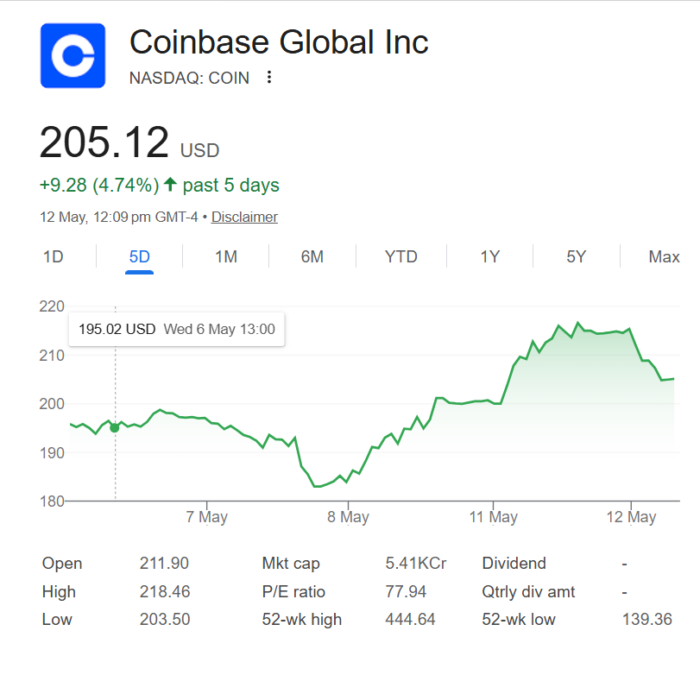
The stock opened at $211.90 and touched an intraday high of $218.46, before sliding to a low of $203.50. Coinbase’s market capitalization stood at 5.42KCr, while its price-to-earnings ratio was listed at 77.33. The stock remains far below its 52-week high of $444.64, but above its 52-week low of $139.36.
Benchmark’s new $270 price target implies further upside from the latest trading level, even after COIN’s recent rebound. The stock has gained over the past five sessions, but remains under pressure on a six-month basis following weaker trading volumes and Coinbase’s first-quarter loss.
COIN remains a high-beta crypto market proxy
The new $270 target does not erase the near-term questions around Coinbase’s earnings sensitivity. Trading revenue still remains tied to crypto prices, volatility and retail participation, and Q1 showed how quickly those metrics can weaken when market sentiment cools.
For investors, the stock now sits at the center of two opposing narratives: Coinbase’s core exchange business is still exposed to crypto trading cycles, but its longer-term valuation case increasingly depends on whether derivatives, stablecoins, Base, payments and prediction markets can reduce that dependence over time.
Also Read: Coinbase’s Brutal Week: 14% Layoffs, $394M Q1 Loss & AWS Outage