Key Highlights
- CZ said the U.S. now leads global crypto policy after years of regulatory pressure on the industry.
- He said American users lack access to the “best liquidity” and floated Binance’s return or Binance.US revival.
- CZ argued BNB is underexposed in the U.S., creating room for institutional catch-up.
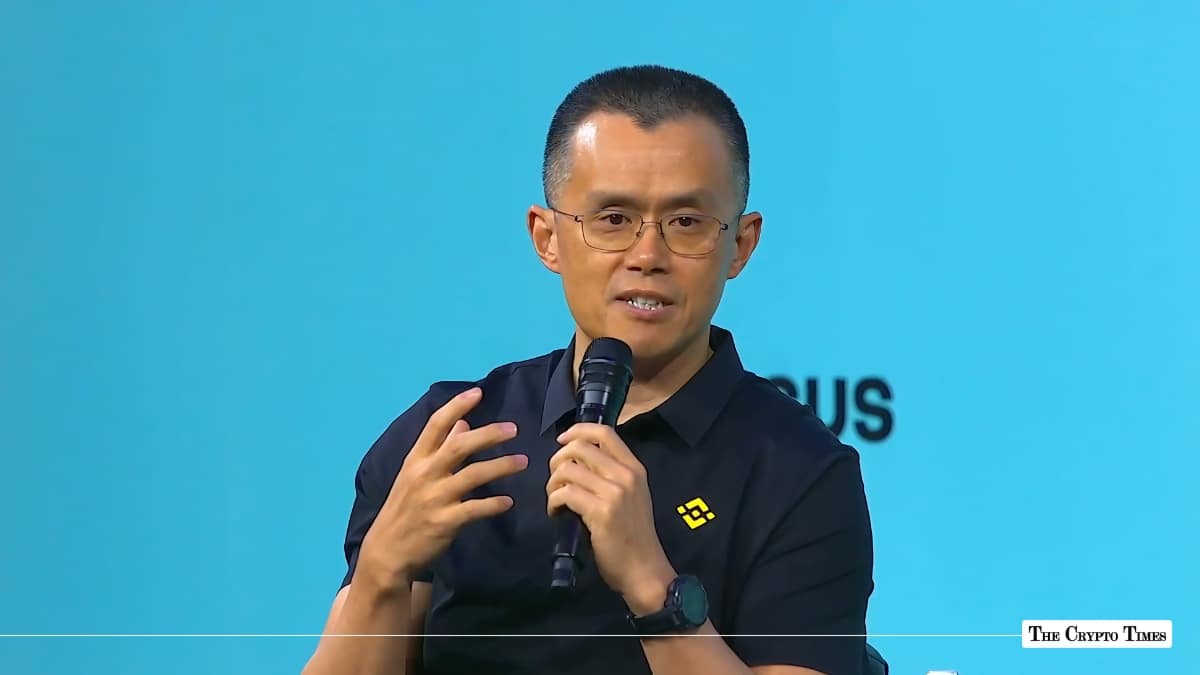
Binance founder Changpeng Zhao, widely known as CZ, said the United States has moved from a market he tried to avoid to one he now sees as leading global crypto policy.
Speaking at Consensus Miami on May 7, CZ said he had spent the last few years staying away from the U.S. “out of sight, out of mind,” but argued that the country’s stance on crypto has changed sharply over the past year and a half.
“Obviously, the U.S. policy towards crypto changed in the last year and a half or so,” CZ said. “So now I have to actually make up for the absence.”
CZ was listed as a May 7 Consensus Miami 2026 speaker, with the agenda initially marking the session as virtual before he appeared in person, according to the event listing and the stage recording.
The Binance founder said the U.S. had suffered from a lack of engagement with crypto builders, communities, regulators, and policymakers, adding that there were “quite a bit of misconceptions” around him, Binance, and the broader ecosystem.
‘The U.S. Is Leading’ on Crypto Policy
CZ gave Washington an unusually positive review, saying the U.S. Constitution gives the country the ability to self-correct quickly when policy turns.
“The U.S. right now is leading in the world in terms of crypto policies,” CZ said. He pointed to the GENIUS Act and the CLARITY Act as examples of legislation moving quickly, while noting that “some minor issues” remain in the debate.
The comment comes after years of legal pressure on Binance in the U.S. In November 2023, Zhao pleaded guilty to failing to maintain an effective anti-money laundering program and resigned as Binance CEO as part of the company’s U.S. resolution, according to the Department of Justice.
CZ did not announce a formal Binance relaunch in the U.S. or any regulatory application. But he framed the market as one where crypto talent, developers, and capital are starting to return after previously moving to hubs such as Abu Dhabi, Hong Kong, and Singapore.
CZ says U.S. Crypto still lacks the best liquidity
The sharpest part of CZ’s remarks came when he argued that the U.S. still does not have access to the best crypto liquidity.
“What’s a little bit lacking in the U.S. right now is the best liquidity,” CZ said. “The best liquidity in crypto is outside of the U.S. The U.S. is one of the very few markets that doesn’t have access to the best prices.”
He then directly linked that gap to Binance.
“In our ecosystem, Binance has the best liquidity in this market, and we would love to be able to provide that in some way, either bring back Binance, or revitalize Binance.US,” CZ said.
That line gives the story its strongest news hook. CZ did not merely praise the U.S. policy shift; he explicitly tied it to the possibility of restoring Binance-linked liquidity access for American users.
BNB has ‘Room to Catch Up’ in America
CZ also said BNB and the BNB Chain ecosystem have been underrepresented in the U.S. because they avoided the market during the earlier regulatory climate.
“BNB Chain has also tried to stay away from the U.S. for the last few years,” he said, adding that the ecosystem now has a builder house in New York, a small presence in San Francisco, and more U.S. events.
He argued that BNB has fallen behind other Layer 1 ecosystems in U.S. marketing, community building, and institutional exposure.
“The BNB token — U.S. institutions did not have access to BNB token until very recently,” CZ said. “BNB is lagging behind on that. But at the same time, the lack of access for institutions to BNB is actually an opportunity for BNB investors.”
CZ described BNB as a broader ecosystem made up of BNB Smart Chain, opBNB, and Greenfield. BNB Chain’s official materials list BNB Smart Chain, opBNB, and Greenfield as its core chains, while opBNB is described as an OP Stack-based Layer 2 and Greenfield as a decentralized storage system.
He also pointed to PancakeSwap, Venus, Lista, Trust Wallet, CoinMarketCap, and Binance as parts of the wider BNB-linked ecosystem, saying the network is popular in Asia and Africa but remains underused by American consumers.
“The U.S. consumers are being left out of it,” CZ said. “So we’re hoping to fix that.”
CZ says BNB Chain should be ‘Money for Agents’
CZ later connected BNB Chain’s future to AI agents, arguing that blockchains must become ready for agentic payments.
He said AI agents will need money to transact with other agents, especially for cross-border services, bookings, subscriptions, and microtransactions. Traditional payment rails, he argued, are not designed for that level of automated, high-frequency interaction.
“The credit cards don’t have an API,” CZ said. “The most native thing for the agent to use is obviously a blockchain.”
CZ said he is “frustrated” that more crypto apps have not yet built simple AI-driven portfolio and trading interfaces, where users could ask an agent to review holdings, scan market news, and execute transactions in the background.
“For the BNB Chain part, BNB Chain should just be the money for agents,” he said.
Why It matters
CZ’s appearance was not only a return to a major U.S. stage. It was also a direct signal that Binance-linked liquidity, BNB institutional access, and BNB Chain’s U.S. developer push may become part of the next crypto market structure debate.
His comments place Binance and BNB inside three live U.S. narratives at once: regulatory thaw, institutional access, and AI-agent payments.
The key line for markets is simple: CZ believes the U.S. has policy momentum, but not yet the deepest crypto liquidity. If Binance or Binance.US becomes part of that fix, the U.S. comeback story could move from regulation to market structure.
Also Read: Today in Crypto: Tokenization Breakthrough, Clarity Act Deadline Set, Miners Pivot to AI Power Plays