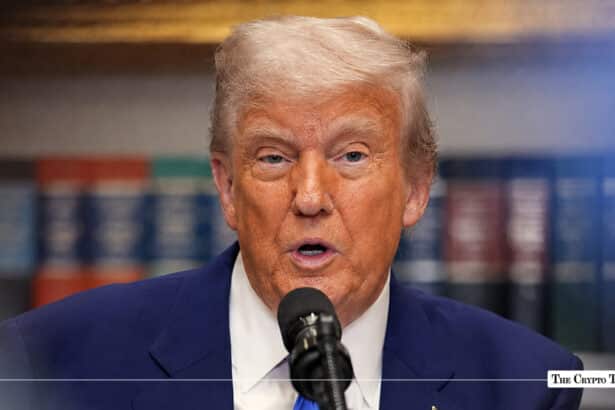
The U.S. Department of Justice (DOJ), alongside the Commodity Futures Trading Commission (CFTC), is investigating at least four suspiciously timed trades in the oil futures market that preceded major announcements by President Donald Trump and a top Iranian official about the war in Iran, sources told ABC News on Wednesday.
Traders placed a combined total of more than $2.6 billion in bets on declining oil prices right before the announcements became public, according to the report. ABC News obtained the trading data from the London Stock Exchange Group (LSEG).
Neither the DOJ nor the CFTC has issued any official public statement or press release confirming the investigation into these oil trades.
The four trades under scrutiny
The timeline of the four trades, according to LSEG data obtained by ABC News, is as follows:
- March 23: Approximately 15 minutes before Trump announced he would delay threatened attacks on Iran’s power grid, traders placed more than $500 million in bets that oil prices would fall.
- April 7: Hours ahead of a temporary ceasefire announced by Trump, traders wagered $960 million on falling oil prices.
- April 17: About 20 minutes before Iran’s Foreign Minister Abbas Araghchi posted on social media stating that the Strait of Hormuz was open, traders bet $760 million on a decline in oil prices.
- April 21: Roughly 15 minutes before Trump announced he would extend the ceasefire, a series of bets totaling $430 million were placed on falling oil prices.
ABC News noted that the trading data from LSEG does not reveal the identities behind these trades and does not prove that anyone was trading on insider information. The series of oil trades was first reported by Reuters.
Regulatory scrutiny so far
While neither the DOJ nor the CFTC has officially confirmed any probe into these specific oil trades, multiple credible reports indicate that regulatory attention is building.
Bloomberg reported on April 15, citing people familiar with the matter, that the CFTC had opened an investigation into the suspicious trading activity on platforms operated by CME Group Inc. and Intercontinental Exchange Inc. Both exchanges were reportedly asked to hand over trading data. The CFTC has not confirmed this publicly.
Congressional pressure through official letters
Several members of Congress have formally demanded investigations through official letters to regulators. These letters are the most concrete, publicly available government documents related to this matter:
Congressman Ritchie Torres (NY-15) sent a series of letters to the SEC and CFTC chairs:
- April 8: Torres wrote to SEC Chair Paul Atkins and CFTC Chair Michael Selig demanding an investigation into the $500 million March 23 trade, calling it “potentially the largest instance of insider trading in history.”
- April 14: Torres sent a second letter calling for a joint investigation into the $950 million trade placed before the April 7 ceasefire announcement.
- April 17: Torres sent a third letter asking the CFTC to expand its investigation to include the $760 million trade and the subsequent $430 million trade.
Separately, Senators Elizabeth Warren and Sheldon Whitehouse sent a formal letter to CFTC Chairman Michael Selig through the Senate Banking Committee. The letter specifically asked whether the CFTC’s Division of Enforcement had opened an investigation into the March 23 and April 7 trades, and requested a response by April 30, 2026. No public response from the CFTC has surfaced.
The only confirmed enforcement action: The Van Dyke case
The only official, confirmed enforcement action connected to the broader pattern of suspicious pre-announcement trading is the case of Gannon Ken Van Dyke, a U.S. Army Special Forces soldier.
On April 23, the DOJ unsealed an indictment charging Van Dyke with using classified intelligence about the military operation to capture Venezuelan President Nicolas Maduro (“Operation Absolute Resolve”) to profit on Polymarket. Van Dyke allegedly placed approximately $33,000 in bets and realized roughly $409,881 in profits.
He was charged with unlawful use of confidential government information, theft of nonpublic government information, commodities fraud, wire fraud, and making an unlawful monetary transaction.
The same day, the CFTC filed a parallel civil complaint against Van Dyke, marking the first time the agency has ever charged insider trading involving event contracts, and the first use of the “Eddie Murphy Rule” (CEA Section 6(c)(3) and CFTC Regulation 180.1(d)) to bring charges based on the misuse of government information.
CFTC Chairman Michael Selig stated in the official release: “I have been crystal clear that anyone who engages in fraud, manipulation, or insider trading in any of our markets will face the full force of the law.”
CFTC Director of Enforcement David Miller added that the Division “will continue to be vigilant in policing the illegal use of inside information in the prediction markets and other markets within the CFTC’s jurisdiction.”
The bigger question
The Van Dyke case involved a prediction market platform and a relatively modest sum. The oil futures trades now under scrutiny are orders of magnitude larger, with $2.6 billion placed across just four instances over a span of roughly four weeks.
The CFTC has the authority to subpoena trading records and conduct surveillance of futures markets, but enforcement investigations of this scale typically take weeks or months to produce public findings. No charges, no identified traders, and no official statements from either the DOJ or CFTC have surfaced in connection with the oil futures trades as of the time of this report.
Oil markets remain volatile as reports of a potential U.S.-Iran peace framework emerged this week. Any further announcements from the White House could trigger additional scrutiny of pre-announcement trading patterns.
This is a developing story.
Also Read: U.S. Traders Get Margin Access as Kraken Goes Regulated