On April 28, 2026, the President of the U.S. Donald Trump’s son Eric Trump did something revealing. Faced with a forensic investigation into his Bitcoin company’s finances, he did not dispute the numbers. Instead, he chose to attack the journalist’s employer.
“Since being acquired by China, Forbes has become a political weapon and an embarrassment to journalism,” he posted on X. “Friends — educate yourselves as to the source of your information. In this case, China!” He then rattled off a list of statistics: 7,000 BTC in treasury, 90,000 miners, 28 exahash of capacity, $78.3 million in Q4 revenue.
Impressive figures — if you don’t ask where the money actually went.
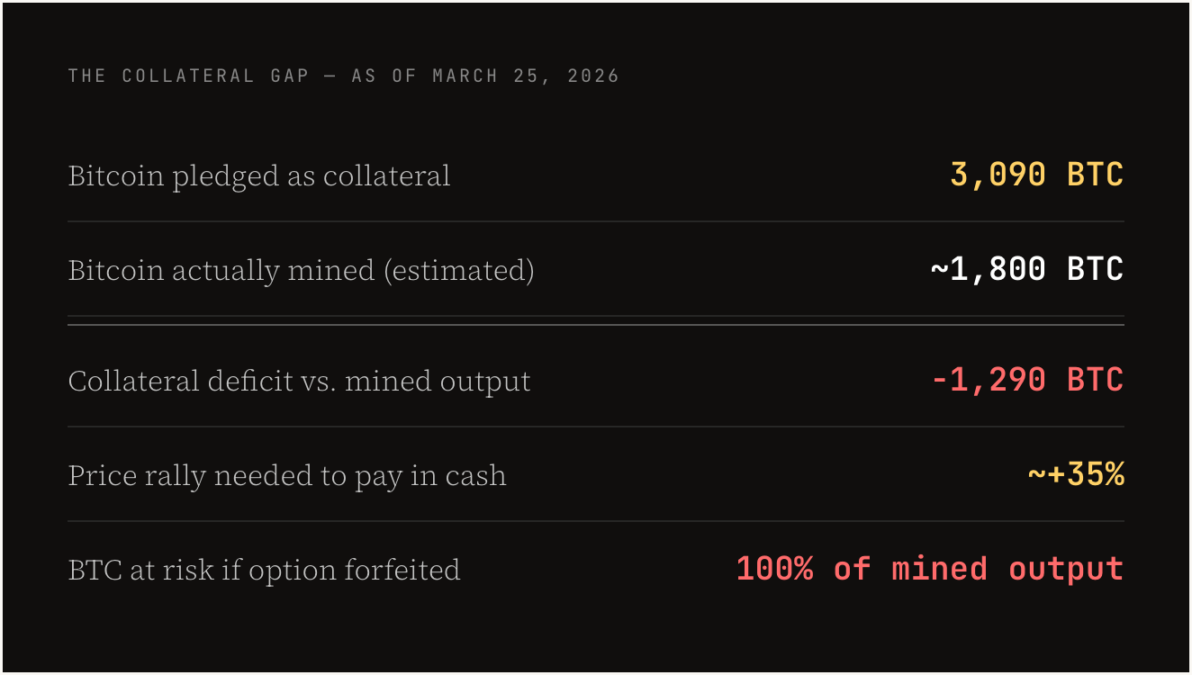
Here is what Eric Trump did not post about: the 3,090 Bitcoin (BTC) his company has pledged as collateral for a $330 million mining equipment deal. The fact that American Bitcoin has only ever mined an estimated 1,800 BTC in its entire history — 1,290 fewer coins than it has already promised away.
The options clause, buried in the U.S. Securities and Exchange Commission (SEC) filings, gives the company until around August 2027 to either pay cash for its machines or forfeit every pledged coin. The $135 million gap between what the company has spent buying crypto and what that crypto is worth today. The $500 million that everyday investors have lost while insiders cashed out.
These core financial risks remain unaddressed in Eric Trump’s rebuttal, which instead focuses exclusively on operational scale and attacks the source rather than engaging the math from the company’s own SEC filings.
Calling the press “Chinese propaganda” is a playbook. Not answering the math is a tell. This investigation is about the math.
The number at the center of it all is 3,090 — the BTC American Bitcoin has pledged as collateral under a put option agreement tied to a $330 million upgrade of its mining fleet. The company has only ever mined an estimated 1,800 bitcoin. That means it has pledged roughly 70% more bitcoin than it has produced. If prices do not rally at least 35% before options begin expiring around August 2027, every coin American Bitcoin has ever mined could be legally forfeited in a single contractual stroke.
This is not a speculative risk buried in fine print. It is the central, load-bearing fact of American Bitcoin’s financial structure — confirmed by the company’s own 10-K filing (March 27, 2026) and DEF 14A proxy statement (April 27, 2026). And it is the one fact Eric Trump’s X post did not touch.
The Deal That Created the Trap
To understand how American Bitcoin ended up in this position, you have to understand the foundational deal that created it.
In early 2025, Eric Trump and his brother Don Jr. were planning to enter the data-center business, riding the artificial intelligence boom. They had attracted attention from UAE developer Hussain Sajwani, who announced a $20 billion U.S. data-center investment at Mar-a-Lago in January. The Trump sons had publicly named their target: American Data Centers.
Then they met Asher Genoot and Mike Ho. The two entrepreneurs ran Hut 8, a Canadian data-center and bitcoin-mining company that already owned the infrastructure the Trumps were trying to build from scratch. Genoot and Ho made an offer: ditch the data-center plan, take a 20% stake in Hut 8’s bitcoin-mining machines, and use the Trump brand to launch a publicly traded hype vehicle built on top of Hut 8’s existing operations.
The Trumps agreed. American Bitcoin was incorporated in Delaware on November 18, 2024 — two weeks after Donald Trump defeated Kamala Harris. The company was structured in a way that will be familiar to anyone who has followed the Trump family’s approach to business: asset-light, brand-heavy, and dependent on third-party infrastructure.
Structure Alert:

Hut 8 retained the real estate, runs the data centers, handles back-office functions, and supplies key executives — including CEO Mike Ho, who simultaneously serves as Hut 8's chief strategy officer. American Bitcoin itself operates with just two full-time employees, per its annual report. It is less a mining company than a branded overlay on Hut 8's existing operations.
The $330 Million Pledge — and What It Actually Means
Between August and September 2025 — the same period American Bitcoin was preparing its Nasdaq debut — the company spent approximately $330 million upgrading its mining fleet to roughly 56,000 next-generation ASIC machines supplied in part through Zephyr Infrastructure, a Hut 8 subsidiary, and Bitmain.
Rather than pay cash up front, American Bitcoin used an options-based financing structure. The company pledged bitcoin as collateral and retained a choice over how it would ultimately settle the bill when the options began expiring around August 2027:
2025
2025
2025
2026
2026
2027
Under the option terms: if Bitcoin’s price surges, American Bitcoin can settle the $330 million debt in cash and retain its pledged Bitcoin. If prices fall or stagnate, the company hands over the pledged crypto instead. With Bitcoin down approximately 30–35% since the deal was struck, the cash-settlement outcome is currently out of reach without a sustained rally of at least 35%.
TL;DR: Eric Trump’s Rebuttal vs. the Filings
Eric Trump’s April 28, 2026 X post directly confirms several positive operational metrics cited in the Forbes investigation and company disclosures: over 7,000 BTC held, nearly 90,000 miners at 28 EH/s, Q4 2025 revenue of $78.3 million (22% QoQ growth), and mining at a claimed 53% discount to spot price. These align with the 10-K and press releases.
However, the post does not reference the pledged collateral, the put option expiry window, the $135 million unrealized loss on purchased BTC, insider share sales totaling hundreds of millions, or the estimated $500 million in retail investor losses from the ~92% stock decline since the September 2025 IPO peak. The rebuttal strategy emphasizes rapid scaling on “clean American energy” while sidestepping the arbitrage-heavy structure (where ~70% of BTC treasury came from share issuances, not mining output) and balance-sheet risks detailed in SEC filings.
The $57,000 Lie (and What the Real Number Is)
When Eric Trump said American Bitcoin mines Bitcoin for $57,000 to $58,000 per coin, he was technically describing one number: the direct cash cost of running the machines — primarily electricity and maintenance. In the mining industry, this is called the “cash cost” or “direct cost.” It is a real metric. It is also profoundly incomplete as a measure of profitability.
It ignores the cost of buying the machines. It ignores depreciation — the fact that mining hardware loses value over time and must eventually be replaced. It ignores amortization, overhead, and the cost of capital. When all of these expenses are included, Forbes estimates the all-in cost of producing one bitcoin at American Bitcoin rises to approximately $90,000 per coin.
Bitcoin’s market price at time of writing is hovering in the range of $76,000–$77,000. That means American Bitcoin is currently mining bitcoin at a loss of roughly $13,000 per coin on a fully-loaded basis — and has been doing so for months.
The Two-Number Problem:

$57,000–$58,000: The "direct cost" Eric Trump publicizes — electricity and machine maintenance only. ~$90,000: The true all-in cost per BTC, including machine depreciation, amortization, overhead, and capital allocation. At ~$77,000 spot price, the company is mining at an estimated loss of ~$13,000 per coin on a fully-loaded basis.
The company has pledged 3,090 Bitcoin as collateral — but has only ever mined an estimated 1,800. If prices don’t recover, every coin it has ever produced could be legally forfeited in a single settlement.
The Crypto Times Analysis, based on Forbes reporting and SEC filings
70% of the Bitcoin Was Never Mined
Perhaps the most consequential fact about American Bitcoin — buried beneath the mining narrative — is where most of its Bitcoin actually came from.
Approximately 70% of the company’s total crypto holdings did not come from mining. They came from selling company shares and using the proceeds to buy Bitcoin on the open market. American Bitcoin’s total treasury has grown to more than 7,000 BTC — but the overwhelming majority of that increase came from stock issuance to retail investors, not from mining output.
The mechanics: American Bitcoin listed on Nasdaq with a Trump-brand premium baked in. With the stock trading at a valuation that bore no rational relationship to the underlying assets — $13.2 billion for a company with $270 million of bitcoin and two employees — the company could sell shares at wildly inflated prices, collect the cash, and use it to buy bitcoin at market rate. The spread between the company’s inflated stock price and the actual price of bitcoin was the profit margin. This is called “NAV arbitrage,” and it is legal. But it is not mining.
Share Sales Timeline — American Bitcoin (Sept 2025 – Mar 2026)
| Period | Shares Sold | Avg Price | Gross Proceeds | BTC Purchased (est.) |
|---|---|---|---|---|
| Sept 3–30, 2025 (first 27 days) | 11 million | ~$8.00 | $90M | ~725 BTC |
| Oct 1 – mid-Nov 2025 | 7 million | ~$6.00 | $44M | est. |
| Late Nov – Dec 31, 2025 | 47 million | ~$2.25 | $106M | est. |
| Jan 1 – Mar 25, 2026 | 84 million | <$2.00 | $111M | ~1,430 BTC |
| Total | 149 million shares | — | ~$351M | BTC now worth ~$390M total |
The New Red Flag: A Reverse Stock Split Proposal
A detail that has gone almost entirely unreported adds a new layer of urgency to the American Bitcoin story.
The DEF 14A proxy statement filed on April 27, 2026 — less than two weeks after the Forbes exposé — reveals that shareholders are being asked to approve a reverse stock split at the company’s June 22, 2026 annual meeting. The proposed range is sweeping: 1-for-5 to 1-for-40, at the board’s discretion.
Hut 8 controls approximately 80% of American Bitcoin’s voting power. The reverse split will almost certainly pass. This is the clearest signal yet that American Bitcoin’s original hype-arbitrage model is under acute pressure.
In public markets, a reverse split is often a signal of distress — a company consolidating its shares to maintain a minimum stock price, often to preserve Nasdaq listing requirements or to make the stock appear less obviously damaged. At 1-for-40, a share that currently trades at under $1 would nominally become a $40 share. Nothing about the underlying business would change.
Who Won, Who Lost
Eric Trump’s estimated net worth rose from $190M to $280M through the venture, despite appearing to have invested little to acquire his stake. Asher Genoot and Mike Ho secured a Trump-brand halo for Hut 8’s operations at minimal cost. Early investors who sold before the lockup expiry captured significant gains.
Everyday investors who bought the pitch are down an estimated $500 million. The stock is off 92% from its peak. The bitcoin they indirectly funded through share purchases now sits under a $330M options pledge that could wipe it out before they can recover a cent.
The UAE Wildcard
There is one scenario that could rescue American Bitcoin’s balance sheet from the 2027 cliff — foreign capital. And there are hints it is being actively pursued.
American Bitcoin CEO Mike Ho was in the UAE in October 2025, speaking with journalists from Arabian Gulf Business Insight. A transcript of that conversation, obtained by Forbes, reveals that Ho discussed potential deals with ADQ and TAQA — two investment entities connected to Sheikh Tahnoon bin Zayed Al Nahyan of the UAE. Both are state-linked. Sheikh Tahnoon’s investment vehicles have already steered an estimated $375 million into separate Trump crypto ventures.
Ho’s comments were direct: “I’ve met with a lot of sovereigns here over Hut and under American Bitcoin. There’s always conversations going on.” When pressed on bitcoin-mining operations in the UAE, he added: “We’ve looked at the portfolio. The UAE has a ton of excess power, and Bitcoin mining is a great way to monetize that excess generation.”
A spokesperson for American Bitcoin told Forbes in October that Ho was referring to pre-launch conversations. But the transcript — and the broader pattern of Trump family crypto fundraising from Gulf state entities — leaves the question open. The UAE is currently seeking U.S. relief amid economic pressure from the Iran war. Whether Gulf sovereign money arrives to backstop American Bitcoin’s options cliff is a thread that deserves close watching.
The Two Paths to 2027
American Bitcoin has approximately 15 months before its options begin expiring. Two scenarios play out from here.
Scenario A — Bitcoin Rallies

If Bitcoin climbs at least 35% from current levels and sustains that gain through the option expiry windows, American Bitcoin can settle its machine debt in cash, retain its pledged BTC, and claim the entire exercise was a calculated long position on crypto. Eric Trump could credibly claim vindication. The $135M trading loss becomes a manageable footnote.
Scenario B — Bitcoin Stagnates or Falls Further

If prices remain flat or decline, American Bitcoin will be forced to forfeit its pledged bitcoin — approximately 3,090 BTC — to cover the cost of machines it already controls. Since the company has only mined ~1,800 BTC total, this means its entire mined stockpile disappears in the settlement. The company would be left holding mining hardware, a diluted shareholder base, no meaningful BTC reserves, and a reverse-split stock that has already lost 92% of its peak value.
Bitcoin is, as its advocates note, a wildly volatile asset. A 35% rally is neither impossible nor historically unusual. But it must arrive in a specific window, at a company that has been consistently burning through shareholder capital, with a collateral structure it has not adequately disclosed to the investors who funded the whole enterprise.
What Investors Should Watch Next
The June 22, 2026 annual meeting is the immediate catalyst. If retail and MAGA-aligned investors vote against the reverse split — an unlikely outcome given Hut 8’s 80% voting control — it would send a significant signal of shareholder revolt. More likely, the split passes, the nominal share price is inflated, and another round of share issuance follows.
Quarterly treasury updates will reveal whether the mining output is tracking toward a viable cash settlement by 2027. Any amendment to the Put Option Agreement — extending the timeline, renegotiating the collateral terms, or introducing a new capital partner — would be a material development.
And any announcement of a UAE-linked investment into American Bitcoin’s operations should be read not just as a business story, but as a geopolitical one: a foreign sovereign wealth fund rescuing the crypto venture of a sitting U.S. president’s son, in exchange for concessions that have yet to be made public.
Eric Trump Fires Back — But Doesn’t Address the Math
Within hours of the Forbes investigation going live on April 28, Eric Trump took to X with a public rebuttal. Rather than address the central financial claims — the 3,090 BTC collateral pledge, the August 2027 options cliff, the $500 million in estimated retail investor losses — he went after the source.
Referencing Forbes’ ownership by Hong Kong-based Integrated Whale Media Investments., Trump stated, “Educate yourselves as to the source of your information — in this case, China!”
Trump cited American Bitcoin’s reported metrics in his rebuttal and called ABTC the 16th-largest public bitcoin company, “built from scratch in just over a year on clean American energy.”
The numbers Trump cited are real. The 7,000+ BTC treasury figure is confirmed by the 10-K. The revenue figure matches the Q4 2025 earnings report. But they answer a different question than the one this investigation raises.
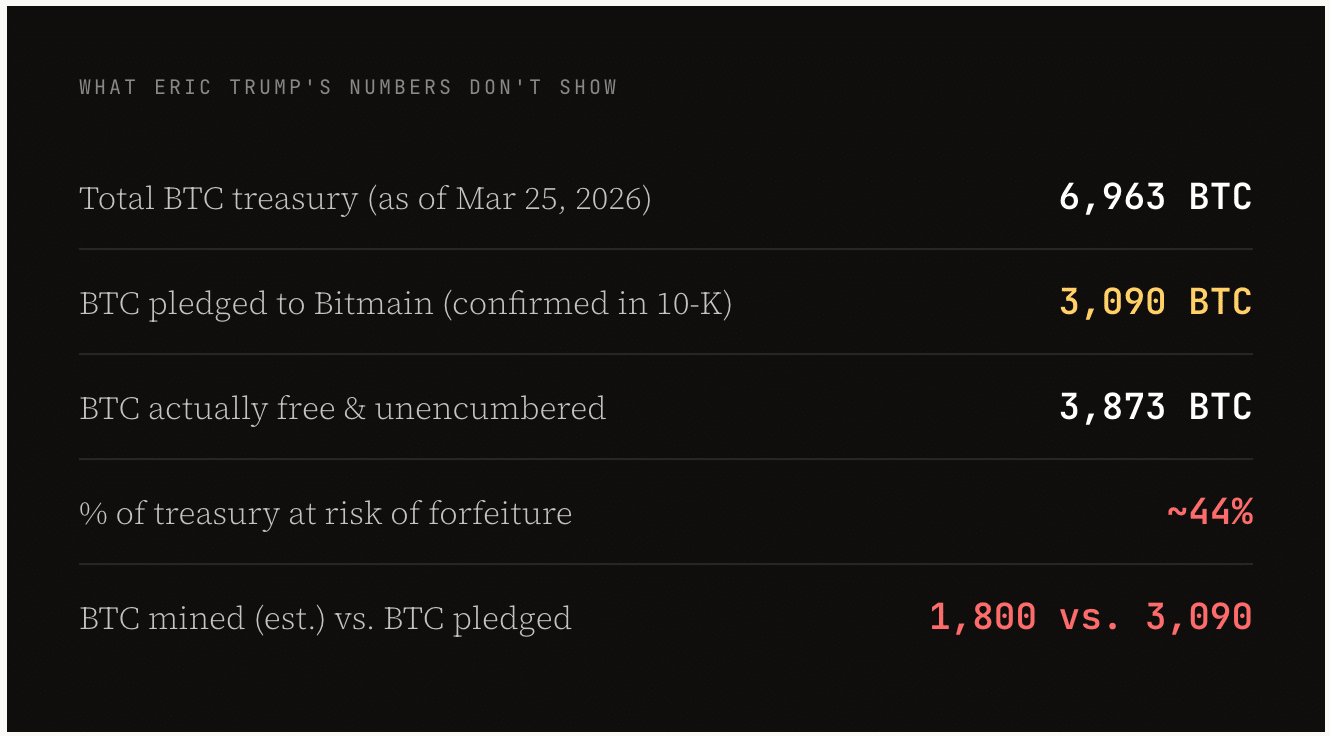
The critical issue is not how much Bitcoin American Bitcoin holds today — it is how much of that bitcoin is actually free and clear. Of the 6,963 BTC reported as of March 25, 2026, the company’s own annual filing confirms that 3,090 of those coins are pledged to Bitmain as collateral for the machine purchase. That means nearly 44% of the entire treasury is already earmarked — and could be surrendered without a single new share sale or management decision, simply by the passage of time and the direction of Bitcoin’s price.
Trump also compared the coverage to past Forbes reporting on his St. Jude Children’s Research Hospital fundraiser — characterising both as politically motivated attacks on “a good guy.” He did not address why the company’s all-in mining cost of approximately $90,000 per coin exceeds bitcoin’s current market price. He did not address the August 2027 options expiry. He did not address the $135 million gap between what the company has spent acquiring crypto and what that crypto is currently worth.
A rebuttal that attacks the publication’s ownership but leaves the core financial arithmetic unanswered is, in many ways, the loudest confirmation of all.
Eric Trump named his company with two words he said had to be there.
America. Bitcoin.
What he built was something more complicated: a stock-sale vehicle wearing a mining company’s clothes, sitting on a collateral trap that could consume every coin it has ever produced, marketed to retail investors who trusted the brand more than they examined the balance sheet.
Physics, as one analyst noted, eventually takes over. In crypto markets, so does math. The clock on American Bitcoin’s $330 million time bomb is running. August 2027 is 15 months away.
Disclosure:

This article is investigative journalism based on public filings, reported transcripts, and third-party analysis, and direct verification of Eric Trump’s April 28, 2026 X post. It does not constitute financial advice. The Crypto Times has no position in ABTC or any related securities. Readers should conduct their own due diligence before making investment decisions. American Bitcoin, Eric Trump, and the Trump Organization did not respond to requests for comment.