
A total of 10 centralized crypto exchanges now hold more than 2.85 million Bitcoin (BTC), showing how much trading power remains concentrated on a few platforms. Data shared by CryptoDep on X, citing Arkham Intelligence and CoinGlass, highlights the scale of holdings across the largest exchanges.
Coinbase leads at 959,665 BTC — roughly 5% of total circulating supply — followed by Binance at 632,369 BTC and Bitfinex at 406,280 BTC, with the top three alone accounting for over 2M BTC in custodial holdings. Upbit and Robinhood hold relatively similar reserves, each just under 190,000 BTC.
The figures show that, despite the growing shift toward decentralized finance (DeFi), a small cluster of centralized exchanges continues to control a significant share of Bitcoin liquidity in the market.
Market behavior signal
Exchange balances are an easy gauge of market sentiment and conditions. In the event of increased balances, it means there is more of the digital currency available for trading, thus indicating a possible selling scenario.
However, according to recent data from CryptoQuant, the situation looks different. Exchange balances decreased from over 3.2 million BTC at the beginning of 2024 to approximately 2.68 million BTC by April 2026. This indicates that the investors have begun to withdraw the coins from the exchange despite high prices.
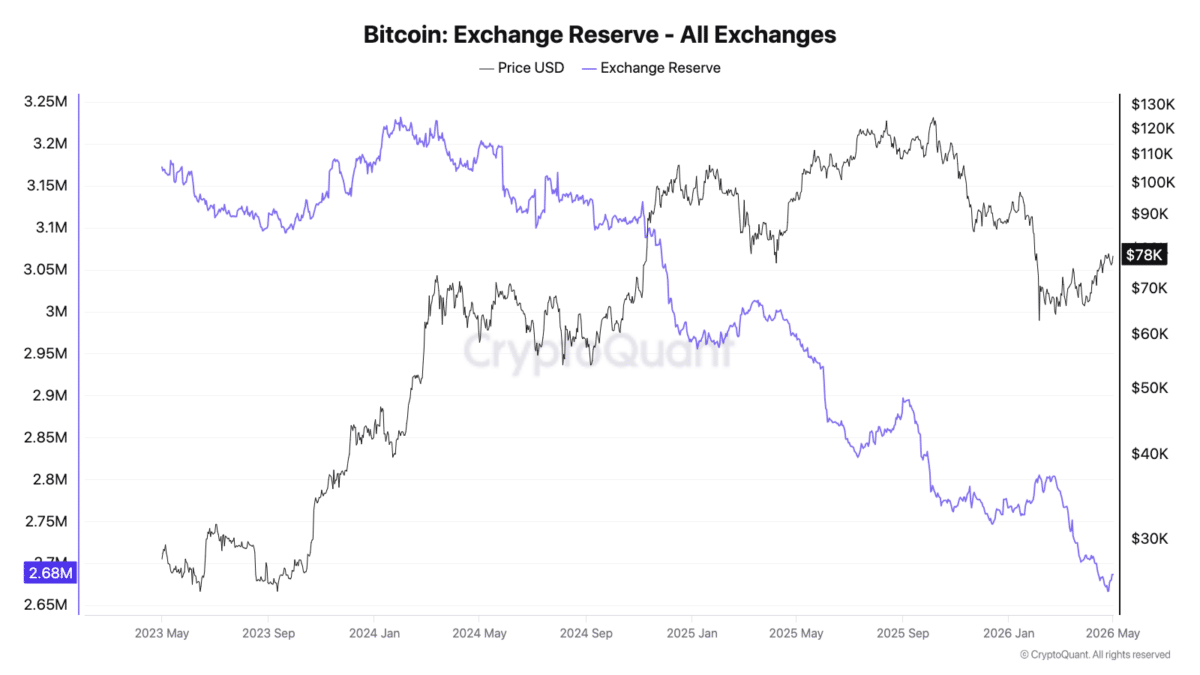
Bitcoin, on the other hand, increased its value beyond $100,000 before coming back down to $78,000. The increase in price did not affect the transfer of funds by the coin holders to their personal wallets. As of writing, according to CoinMarketCap data, Bitcoin was trading at $78,307.19, up 2.69% in the last 24 hours.
Corporate holdings reshape supply dynamics
Currently, public companies own around 1.17 million Bitcoin worth $89.69 billion, representing 5.56% of the total supply of Bitcoin. Nevertheless, Bitcoin ownership among companies is highly concentrated and not equally distributed across all companies.
Strategy portfolio is the leader, with a total of 818,334 BTC worth $62.77 billion. This figure is significantly higher than the sum of the nine next biggest companies’ portfolios. This fact shows that institutions’ investment in Bitcoin is highly concentrated in one company.
Large shareholders have more power to affect market sentiment and liquidity than small shareholders. In addition, the reserves of Bitcoin held on exchanges are steadily decreasing.
Together, these trends point to a tighter supply environment. Exchanges still handle most trading activity, but long-term holders keep pulling coins out of circulation. That balance continues to influence price moves and overall market stability.
Also Read: Prediction Markets Hit Record Highs in April 2026: Kalshi Takes the Lead