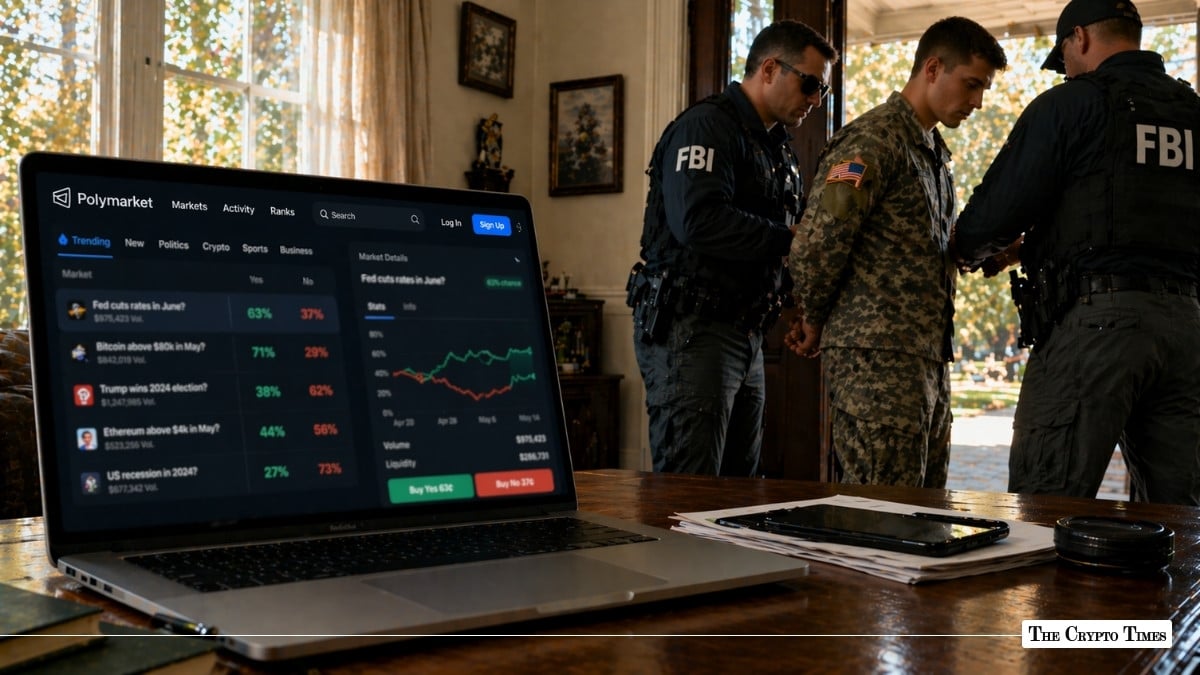
Federal authorities have charged an active-duty Army soldier for allegedly using classified military intelligence to profit from prediction markets, underscoring growing enforcement across digital asset platforms. The case also represents the first major criminal prosecution of insider trading on a decentralized platform.
According to the U.S. Department of Justice’s (DOJ) release, Gannon Ken Van Dyke allegedly used his role in “Operation Absolute Resolve”—a secret mission to apprehend former Venezuelan President Nicolás Maduro—to place strategic bets on Polymarket.
“Our men and women in uniform are trusted with classified information… and are prohibited from using this highly sensitive information for personal gain,” said Acting Attorney General Todd Blanche.
The Betting Streak
According to the indictment, between December 2025 and early January 2026, Van Dyke used his access to non-public, sensitive details about the operation to place 13 high-conviction bets.
Using a Polymarket account created in late December 2025, he wagered roughly $33,000, all predicting outcomes such as U.S. military involvement in Venezuela and Maduro’s removal from power by January 31, 2026.
After the operation succeeded in early January—when Maduro was apprehended in Caracas—several related contracts resolved in his favor, resulting in alleged profits of approximately $409,881.
In January, The Crypto Times had also reported that a Polymarket trader deposited $30,000 before Maduro’s capture and made $436,759 in less than 24 hours. This had already sparked insider trading concerns among community members at the time.
Attempts to Hide Profits and Identity
Investigators allege Van Dyke took steps to conceal his activity after unusual trading patterns drew attention. He reportedly moved most of his proceeds to a foreign cryptocurrency wallet before transferring funds into a brokerage account.
He also requested deletion of his Polymarket account and changed associated email credentials in an effort to obscure his identity.
Van Dyke has been charged with violations of the Commodity Exchange Act (three counts), wire fraud (carrying a maximum 20-year sentence), and unlawful monetary transactions.
A Wake-Up Call for Prediction Markets
The case marks a turning point for platforms like Polymarket. While often viewed as “decentralized” and outside the reach of traditional oversight, the DOJ and CFTC have made it clear that federal laws governing fraud and national security are platform-agnostic.
“Any clearance holders thinking of cashing in their knowledge for personal gain will be held accountable,” warned FBI Director Kash Patel.
This crackdown follows a busy week for digital asset regulators. Earlier this month, Kalshi suspended three congressional candidates for betting on their own elections, and the Office of Foreign Assets Control (OFAC) sanctioned a network of crypto scam operators linked to Cambodian Senator Kok An.
As prediction markets surge in popularity ahead of the 2026 midterms, the Van Dyke case serves as a stark warning: the blockchain provides a permanent ledger that federal investigators are increasingly adept at reading.
Also read: Sam Bankman-Fried Withdraws New Trial Motion, Questions Judge’s Fairness