
Bitcoin rallied to an 11-week high on Wednesday, briefly trading above $78,400, after US President Donald Trump confirmed an open-ended extension of the ceasefire with Iran, sparking a broad risk-on move across crypto and equities. BTC rose as much as 3.6% in early London hours, marking its highest level since February 3, before easing slightly to trade around $78,000. Ether moved in tandem, gaining as much as 3.8% on the day.
The rally extends a recovery that began earlier in the week when markets started pricing in a diplomatic off-ramp ahead of the ceasefire’s Wednesday expiry. The latest leg higher came after Trump’s Truth Social post late Tuesday, in which he said the US would hold off on planned military action at the request of Pakistani mediators, allowing Iran additional time to submit a unified proposal.
What Trump Actually Said
In his Truth Social post, Trump framed the extension as a response to political fragmentation within Iran, writing that Tehran’s government was “seriously fractured” and that Washington had been asked to pause its planned attack until Iranian leaders could produce a unified proposal. Crucially, he added that the US military would “continue the Blockade” and remain “ready and able,” signaling that pressure tactics would persist even during the extended truce.
The statement is a notable pivot from earlier in the week, when Trump had publicly indicated he did not want to extend the ceasefire and warned that “lots of bombs will start going off” if no agreement was reached. Al Jazeera reported that the extension is open-ended from the US side, with no fresh deadline specified.
In a Tuesday morning interview with CNBC, Trump had explicitly said, “We don’t have that much time,” and described Iran as “eager for bloodshed.” The reversal in tone within 24 hours—from rejection of an extension to an open-ended truce—underscores how rapidly policy signaling has been shifting during the five-week conflict and why crypto markets have been trading headline-to-headline rather than on fundamentals.
How Crypto Markets Reacted
Wednesday’s move continues a pattern that has defined Bitcoin’s price action through the five-week Iran conflict: sharp, headline-driven rotations between $70,000 and $78,000, tied almost entirely to the state of US-Iran diplomacy.
Earlier in April, the initial two-week ceasefire announcement on April 7 triggered a $657 million crypto liquidation cascade, and Bitcoin briefly hit $78,000 on April 17 when Iran reopened the Strait of Hormuz. That rally unwound within 48 hours after Iran closed the waterway again and walked away from a second round of talks in Islamabad, sending BTC back toward $74,000.
The current move also coincides with a separate catalyst on the institutional demand side. Strategy (formerly MicroStrategy) disclosed its largest Bitcoin purchase in 17 months, adding 34,164 BTC for approximately $2.54 billion. Spot Bitcoin ETFs also recorded roughly $996 million in net inflows last week, per SoSoValue data, suggesting institutional demand has held firm through the geopolitical volatility.
Oil markets reacted inversely. Brent crude, which had briefly topped $100 per barrel on Tuesday as ceasefire talks appeared to collapse, retreated to around $97.91, while WTI slipped 0.95% to $88.82. That softening in energy prices has historically been a tailwind for Bitcoin, as it eases inflation expectations and reopens the door to potential Fed rate cuts later in the year — a dynamic analysts have flagged as the key macro transmission channel between the Middle East conflict and crypto.
BTC Breaks Out of Six-Week Range
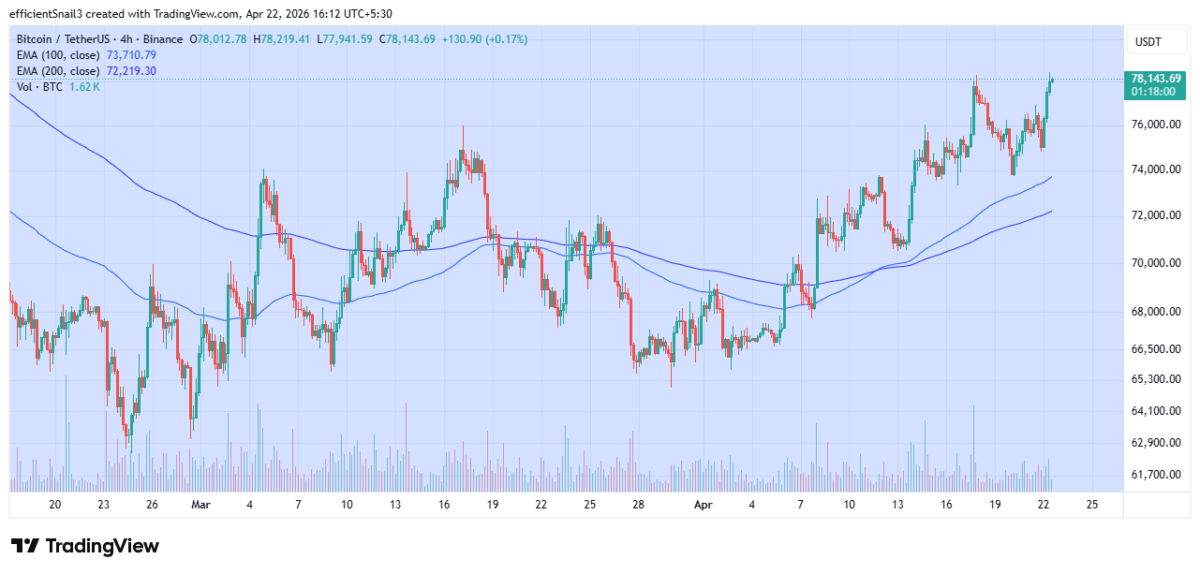
On the 4-hour chart, Bitcoin’s current move marks a clean technical breakout from the consolidation range that has contained price action since the initial ceasefire announcement on April 7.
The 100-EMA crossed above the 200-EMA earlier this month, forming a bullish golden cross on the 4-hour timeframe — a structure that typically confirms a shift from corrective to impulsive price action. The current breakout candle also came on elevated volume, adding conviction to the move.
That said, BTC is now entering a zone where prior sellers have stepped in aggressively. The $78,000–$78,400 region has been tested and rejected multiple times since February, and the market will need to see a daily close above $78,500 to confirm the breakout rather than fade back into the range.
Why the Rally Still Looks Fragile
Despite the bullish headline move, several signals suggest the rally remains fragile. First, Bitcoin perpetual futures funding rates have stayed negative for roughly 46 consecutive days—the longest such stretch since the FTX collapse in late 2022—indicating that leveraged traders remain structurally bearish even as spot buyers push prices higher. Historically, rallies built on spot demand rather than leveraged longs are more durable, but they can also unwind quickly if the underlying catalyst fades.
Second, Bitcoin has also continued to lag a broad global equity rally, with the MSCI ACWI posting an 11-day climb while Bitcoin rebuilds more slowly from sub-$74,000 levels—suggesting that crypto remains more sensitive to the geopolitical downside than upside.
Third, the ceasefire extension is not a peace deal. The US naval blockade remains in place, Iran has condemned it as “an act of war,” and the Strait of Hormuz saw only three commercial vessels transit in the 24 hours before Trump’s announcement. Any breakdown on these fronts — a flare-up in the Strait, a rejected Iranian proposal, or a resumption of military operations — could trigger the same kind of fast reversal seen after the April 11–12 Islamabad talks collapsed, when BTC dropped roughly 2% within hours of Vance’s press conference confirming no agreement.
Finally, mining pressure is weighing on the supply side. Record selling by public Bitcoin miners alongside a recent drop in mining difficulty suggests industry margins remain tight, which could limit how far prices can extend above the $76,000–$80,000 range without absorbing continued miner sales.