
On April 22, 2026, blockchain analytics firm Arkham Intelligence dropped fresh on-chain data showing that BlackRock, the world’s largest asset manager, has vacuumed up roughly $906 million worth of Bitcoin (BTC) over the past seven days through wallets tied to its flagship iShares Bitcoin Trust ETF (IBIT). That single week accounts for the lion’s share of the $996.4 million that flowed into U.S. spot Bitcoin ETFs as a whole, marking the strongest seven-day stretch since mid-January and putting a clean end to the brief distribution phase the market saw earlier this year.
Arkham’s on-chain feed tells the story clearly. Multiple inflows have hit IBIT-linked addresses in recent days, including a handful of 300 BTC transfers worth roughly $23 million apiece. The firm’s entity graph on Arkham shows a dense web of wallet clusters that captures just how large BlackRock’s crypto operation has quietly become.
How Much Bitcoin Does BlackRock Actually Hold?
The latest injection pushes IBIT’s holdings to somewhere between 802,523 BTC, valued at north of $62 billion at current prices roughly near $78,000. Some trackers have the figure sitting at 802,824 BTC on the dot, with the fund’s total market capitalization now above $159.2 billion when you factor in fund share structure. That places IBIT among the largest exchange-traded funds in the world across any asset class, not just crypto.
The holdings represent roughly 3.8% of Bitcoin’s total circulating supply. BlackRock’s broader crypto exposure sits around $69.5 billion all-in, including roughly 3.1 million ETH worth about $7.3 billion.
What makes this week’s buying particularly noteworthy is that it isn’t a one-off rebound trade. BlackRock already had a massive opportunistic accumulation wave in early January 2026; on-chain data shows it snapping up around 9,619 BTC worth $878 million in a single week to rebuild exposure after a brief Q4 2025 pullback.
Mid-April’s sustained flows make it clear this is a durable strategy, not a tactical reposition. Whoever is buying, and increasingly that’s pension funds, endowments, and retirement accounts routed through financial advisors, isn’t showing signs of slowing down.
The Arms Race With Strategy
The most interesting dynamic in this whole story isn’t BlackRock’s size. It’s who’s actually beating them right now.
For the first time since Q2 2024, BlackRock is no longer the single largest known public Bitcoin holder. On April 20, Bitcoin maximalist Michael Saylor-led Strategy announced its biggest weekly buy of 2026 so far: 34,164 BTC for roughly $2.54 billion. That pushed Strategy’s corporate treasury to 815,061 BTC, narrowly overtaking IBIT and briefly flipping the leaderboard.
The gap is razor-thin, somewhere between 9,000 and 12,000 coins depending on the exact daily snapshot. And the two acquisition models couldn’t be more different.
BlackRock’s buying is passive. Clients deposit capital into IBIT, and the fund’s mechanics trigger Bitcoin purchases on the back end. There’s no conviction play, no leverage, no dramatic Saylor-style posts on X. It’s traditional finance doing what traditional finance does, at an extraordinary scale.
Strategy, on the other hand, is pure financial engineering. Convertible debt, at-the-money equity issuance, and increasingly creative balance sheet structures have turned the firm into a leveraged Bitcoin proxy. When Saylor wants more BTC, he raises capital and buys more BTC. Simple, aggressive, and unapologetically directional.
Both strategies are working right now. But they represent two completely different bets on the same asset, and whichever one outperforms over the next cycle will say a lot about whether Bitcoin treats leverage as a friend or an enemy.
IBIT’s Explosive Growth, By the Numbers
IBIT launched in January 2024 right after the U.S. Securities and Exchange Commission (SEC) approved spot Bitcoin ETFs, and it’s been rewriting the ETF record books almost from day one. It crossed $10 billion in assets in just seven weeks and hit $80 billion in under a year. Cumulative net inflows into IBIT alone now top $64.9 billion, making it one of BlackRock’s top 10 holdings by assets under management (AUM), a remarkable feat for a fund that didn’t exist three years ago.
Recent daily flows show the momentum holding steady despite volatility in the underlying asset:
- April 17: +$284 million
- April 20: +$256 million
- April 21: +$39.3 million
Total spot Bitcoin ETF inflows across all U.S. issuers have now crossed $58 billion industry-wide, and IBIT is consistently eating the majority share. U.S. institutions are currently capturing roughly 96.4% of global crypto product inflows, which gives you a sense of just how dominant the American ETF rails have become.
The composition of those flows has also shifted in an important way. When the ETFs first launched in 2024, a huge chunk of the volume was just capital rotation (investors migrating from Grayscale’s higher-fee GBTC into cheaper products like IBIT and Fidelity’s FBTC). That’s no longer the case. Analysts watching daily tape now describe most of the IBIT inflows as genuine net-new demand hitting the market. Fresh money from outside the existing crypto holder base, directly absorbing Bitcoin’s fixed supply.
That distinction matters. Rotation doesn’t tighten supply. Net-new demand absolutely does.
Also Read: Bitcoin ETFs Records $125M in Outflows While BlackRock’s ETHB Outshines
What’s Actually Driving This
Despite the persistent geopolitical tension across the Middle East due to the ongoing U.S.-Iran conflict and a generally uneven macro backdrop through April, Bitcoin is holding firm in the $74,000 to $78,000 range. Three forces are doing most of the heavy lifting behind the bullish institutional tone.
- Regulatory clarity has finally arrived. A recent SEC notice reiterated that most cryptocurrencies, Bitcoin explicitly named among them, are not securities under U.S. law. That clears a regulatory runway institutional traders have been waiting on for nearly a decade.
- Long-term holders are standing still. On-chain metrics tell an unusual story. Bitcoin’s Exchange Inflow Coin Days Destroyed, a measure of how much “old” supply is moving to exchanges, has collapsed to levels not seen since 2017. Translation: the people who’ve held the longest are not selling. Combined with sustained ETF buying, that’s a textbook supply shock setup.
- Bitcoin is being repriced as a hedge, not a bet. Bitwise researchers have highlighted a genuine shift in institutional framing over the past few months. BTC is no longer being pitched to allocators as a speculative tech asset. It’s being pitched as a sovereign-grade treasury hedge against currency debasement, fiscal disorder, and geopolitical fragmentation. That reframing alone has opened the door to entirely new pools of capital.
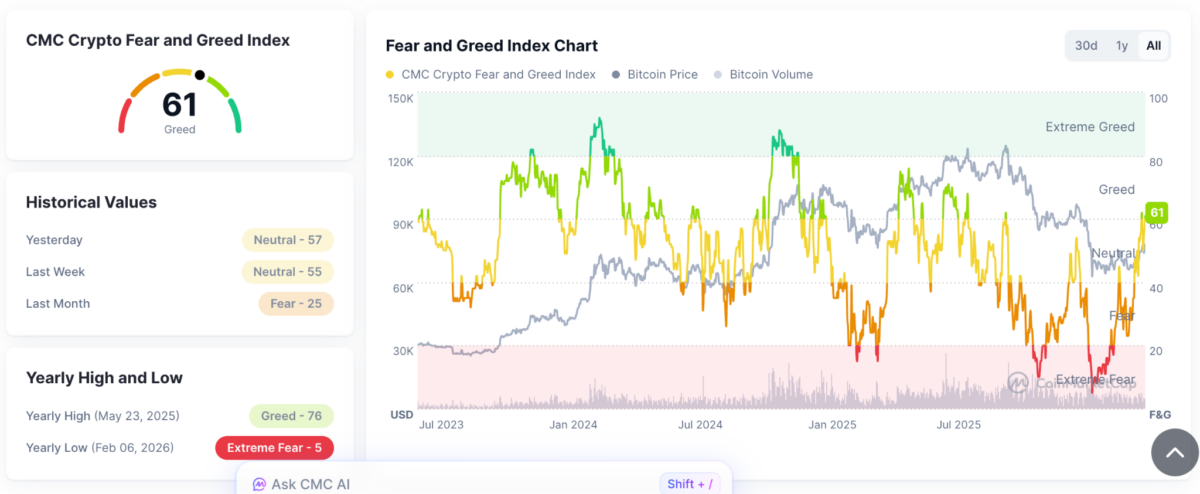
The Crypto Fear and Greed Index sits at around 61 as of late April, firmly in “Greed” territory. That’s not peak euphoria, but it’s a noticeable shift from the neutral-to-cautious readings that dominated Q1.
The Cost Basis Detail Worth Noticing
One underappreciated data point from Arkham’s report: the average cost basis for IBIT holders sits at roughly $87,000 per Bitcoin. With BTC currently trading below that level, it means a meaningful chunk of IBIT’s client base is actually sitting on unrealized paper losses, yet inflows keep pouring in.
That’s the kind of detail that tells you something real about conviction. Retail traders tend to dump positions underwater. Institutional ETF allocators, pension funds, and wealth managers running model portfolios don’t. The fact that inflows persist despite many investors being modestly offside suggests long-term conviction is winning out over short-term performance pain.
Arkham’s profit-and-loss tracking on BlackRock’s Bitcoin positions shows the same pattern at the aggregate level. Unrealized P&L peaked in late 2025, pulled back during the Q1 drawdown, and yet BlackRock kept accumulating rather than selling into weakness.
What’s Next
The next wave of institutional rails is already lining up behind IBIT. Morgan Stanley launched its own Bitcoin ETF (MSBT) earlier this month, and Goldman Sachs is reportedly preparing something similar for later in 2026. Every new TradFi issuer adds another distribution pipe, another layer of advisor coverage, and another pool of conservative capital that can now allocate to Bitcoin without touching an exchange directly.
BlackRock, though, remains the undisputed heavyweight of the TradFi crypto space. Analysts watching IBIT’s weekly flow patterns suggest that if the fund can sustain inflows above roughly $750 million per week, Bitcoin’s price floor tightens materially, and a push toward $100,000 before year-end starts looking more like a base case than a stretch target.
Larry Fink, once one of Wall Street’s more prominent crypto skeptics, has publicly shifted into something close to a full-throated Bitcoin advocate over the past two years. His firm’s transformation from cautious observer to the single largest on-ramp between traditional finance and crypto is arguably the defining institutional story of this cycle.
Whether BlackRock continues vacuuming Bitcoin through IBIT or Strategy keeps stacking directly onto its corporate balance sheet, the through-line is unmistakable. Bitcoin is evidently no longer being treated as an alternative asset by the largest players in global finance. It’s being treated as a core strategic position, with all the boring, steady, relentless accumulation that framing implies.
And in a market where supply is fixed, that kind of boring buying pressure tends to be exactly what matters.