Key Highlights
- The 365-day MVRV ratio has dropped to -41%, the lowest level since the November 2022 FTX collapse. Santiment data indicates widespread unrealized losses on the XRP Ledger, with many active wallets sitting deep in the red.
- XRP is trading near $1.31, down nearly 3% in the last 24 hours and far below its 2025 peak above $3.60. It continues testing critical support around $1.28 while major moving averages point lower.
- U.S. spot XRP ETFs hold $940.58 million in AUM with cumulative inflows of $1.21 billion since launch, yet daily flows flattened to $0 on April 6 and trading volume remained modest at $8.16 million.
XRP holders are nursing deep losses, with on-chain data revealing the cryptocurrency’s 365-day MVRV ratio has plunged to -41%. This marks the lowest average return for traders active on the XRP Ledger over the past year since the November 2022 FTX collapse.
Data from Santiment, an on-chain data and social metrics platform, shows that the majority of active wallets sit in the red, potentially creating a lower-risk environment for new or additional positions. The firm highlighted that similar extremes have historically preceded rebounds.
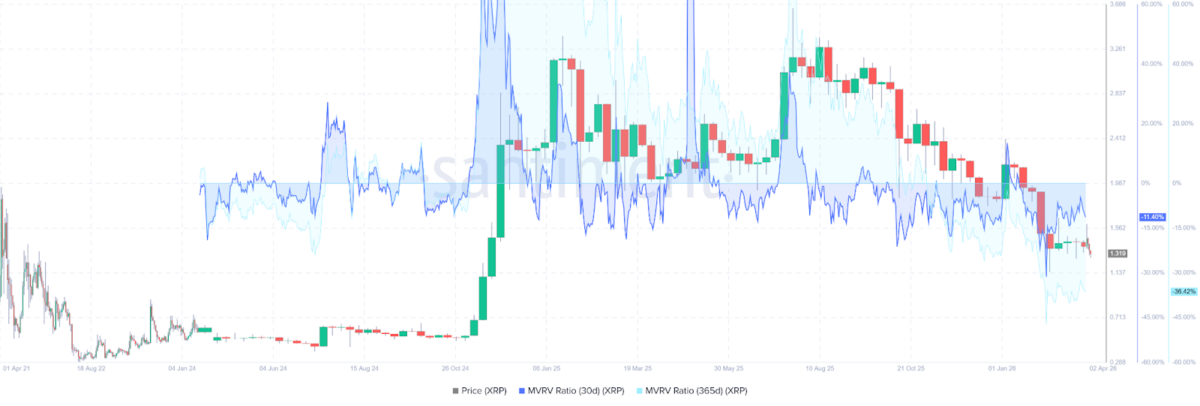
The Market Value to Realized Value (MVRV) metric compares current market price against the average price at which coins last moved on-chain. A sharply negative reading like this signals widespread unrealized losses among longer-term participants, painting a picture of capitulation in the market.
Back in late 2022, when XRP’s 365-day MVRV hit comparable lows amid the FTX fallout, the token climbed roughly 63% in the following 4.5 months. While past performance offers no guarantees, the parallel has some analysts eyeing the current setup as another “opportunity zone.”
XRP markets and its price trajectory
As of Tuesday, XRP traded near $1.32, down modestly in recent sessions and well off its 2025 highs above $3.60. The token has struggled in a broader risk-off environment, testing support levels around $1.28 while major moving averages point lower.

XRP futures and derivatives markets reflect ongoing caution amid the price decline. Its total open interest stands at $2.36 billion, while 24-hour futures volume reached $2.60 billion — significantly higher than spot volume of $437.61 million—as per Coinglass data.
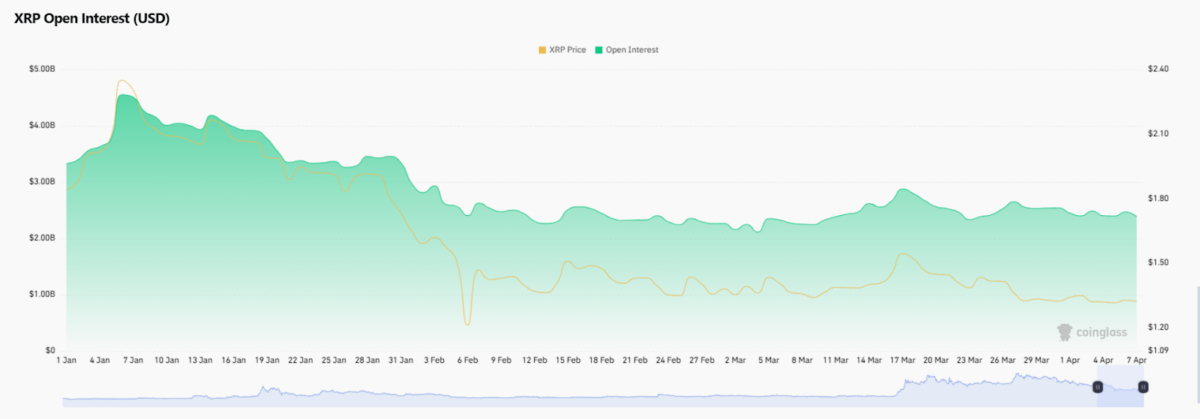
This suggests leveraged trading continues to dominate despite the downtrend. The overall long/short ratio sits near balanced at 49.1% long versus 50.9% short. However, major exchanges like Binance and OKX show a slight long bias among accounts.
Additionally, institutional interest in XRP through U.S. spot ETFs has slowed in recent sessions. As of April 6, 2026, total assets under management (AUM) across XRP ETFs reached $940.58 million, representing about 1.13% of XRP’s market capitalization—as per SoSoValue data.
Daily trading volume for the ETFs was $8.16 million on April 6. While early months saw strong institutional accumulation, the recent flattening of flows suggests caution among traditional investors amid broader market uncertainty and XRP’s corrective price action.
These ETF figures provide an important gauge of institutional conviction at a time when on-chain data shows retail and longer-term holders facing significant unrealized losses.
However, none of these metrics alone guarantee an immediate bounce. Some point to lingering macroeconomic headwinds and neutral-to-bearish derivatives positioning.
From an optimistic angle, this dip can be seen as the depth of holder pain as a classic contrarian signal—especially when combined with exhausted selling from those already underwater.
In its X post, Santiment advised monitoring both the 30-day and 365-day MVRV readings for XRP to gauge short- versus longer-term sentiment shifts. For now, the data underscores a market where fear has dominated, leaving many participants sidelined or locked in at higher entry points.
Whether this translates into fresh buying interest remains to be seen. Crypto markets have a habit of testing patience at precisely these junctures, but history suggests extreme negative MVRV zones have occasionally marked inflection points rather than continued freefalls.
Also read: Phantom Wallet Outage Sparks Token Loss Fears Among Users