Key Highlights
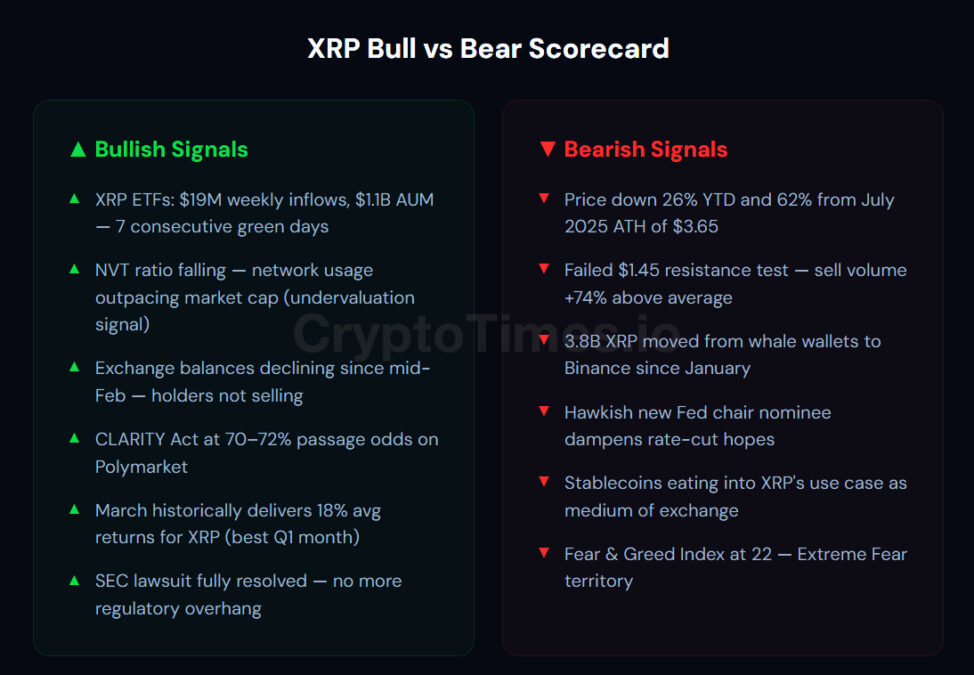
- XRP fell 3.3% to $1.41 after another failed attempt to break the $1.43–$1.45 resistance zone, with sell-off volume spiking 74% above average
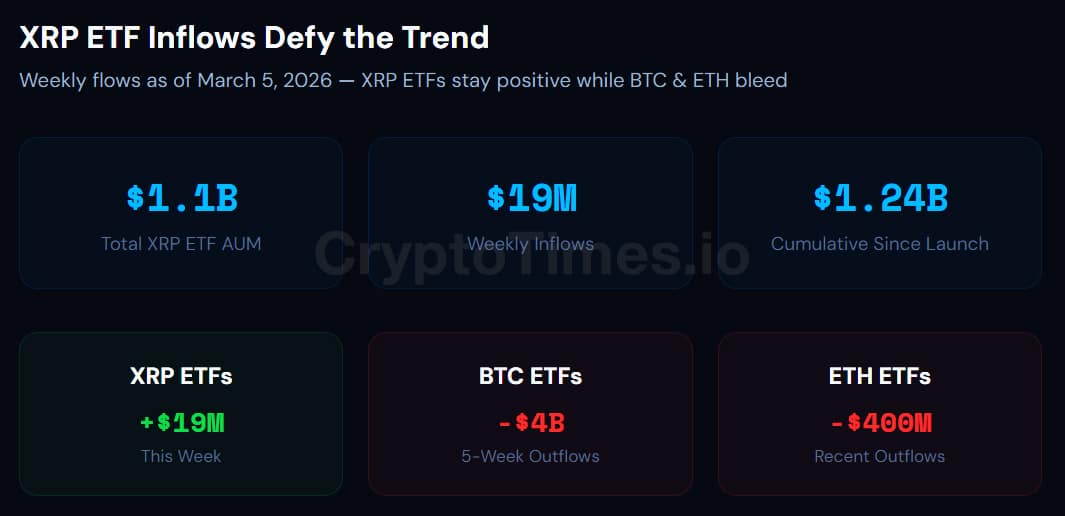
- XRP ETFs attracted nearly $19 million in weekly inflows, bringing total AUM close to $1.1 billion even as the price stayed flat
- The CLARITY Act, which could classify XRP as a digital commodity, now has 70–72% odds of passing in 2026 on Polymarket
XRP’s week told a tale of two forces pulling in opposite directions. Institutions keep buying. The price keeps stalling. And after seven days of push and pull, XRP sits almost exactly where it started — stuck around $1.41 with no clear breakout in sight.
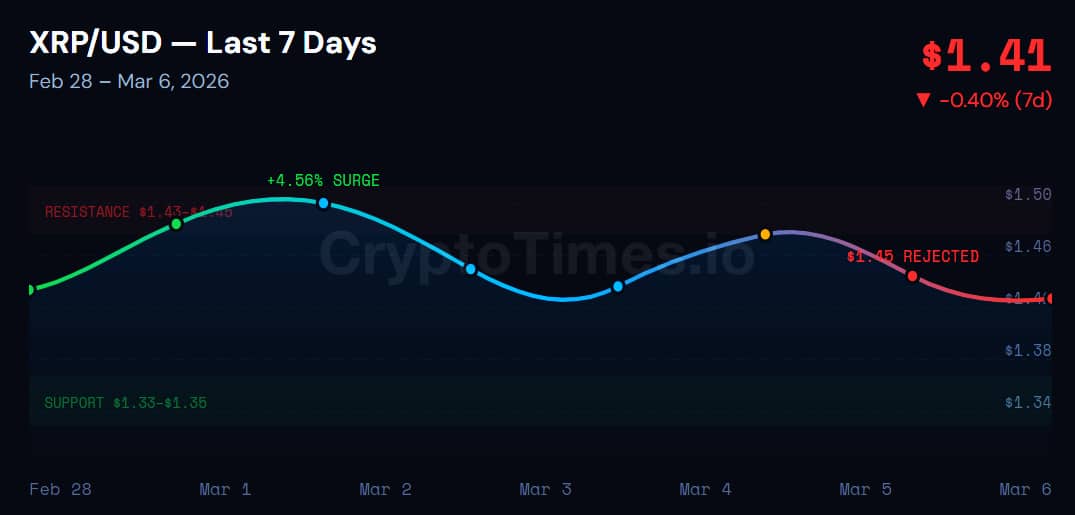
The token dropped 3.3% from $1.4588 to $1.4108 after repeatedly failing to hold above the $1.43–$1.45 resistance zone. A late-session break below $1.411 confirmed short-term downside momentum. For the week, XRP declined roughly 0.4%, underperforming the broader crypto market which gained 5.7%.
ETFs Keep Buying What the Market Keeps Selling
The disconnect between institutional interest and price action is becoming hard to ignore.
Over the past week, nearly $19 million flowed into XRP ETFs, bringing combined assets under management close to $1.1 billion. CoinShares data shows capital rotating toward selective altcoin products, with XRP funds maintaining positive year-to-date flows despite market volatility — a stark contrast to Bitcoin and Ethereum ETFs, which have been dealing with sustained outflows.
Bank of America also recently disclosed direct XRP exposure through an ETF, holding 13,000 shares worth approximately $224,640 — a small position but a significant signal from a major financial institution.
Yet none of this buying pressure has translated into price movement. Analysts suggest XRP’s inflows reflect relative strength compared to weakening demand for major-cap crypto ETFs, rather than strong bullish momentum — a developing institutional trend where capital rotates selectively into regulated altcoin products.
Geopolitics Gave a Brief Spark — Then Took It Away
Early in the week, XRP surged 4.56% in a single day as easing US-Iran tensions gave the market room to breathe. Reports of developments in the Middle East, including leadership changes in Iran, were interpreted by traders as reducing long-term war risk, which contributed to a brief market recovery.
But the optimism was short-lived. Broader headwinds including a hawkish new Fed chair nomination, precious metals outperforming crypto, and growing stablecoin adoption continue to drag down XRP alongside the wider market. XRP has now fallen 26% year to date and is down roughly 41% over the past 12 months.
The $1.27–$1.30 Floor: What’s Holding It Together
The $1.30 level has become XRP’s most tested support zone of 2026, with buyers stepping in repeatedly before it can break lower. The real structural defense sits just below.
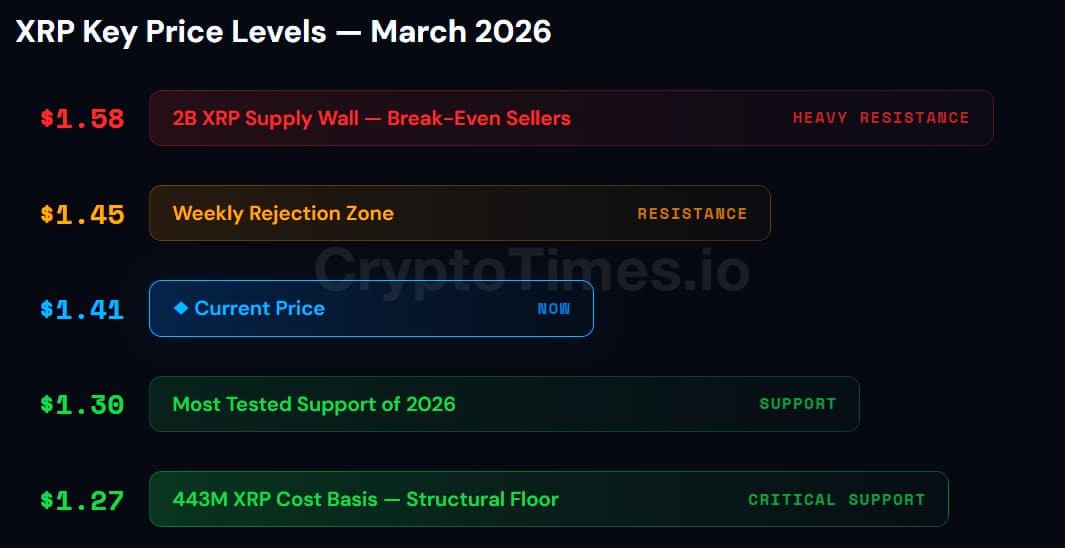
Cost basis data shows around 443 million XRP was accumulated near $1.27 — holders at that level aren’t looking to sell at a loss and tend to add positions when price dips toward their entry, creating consistent buying pressure.
On the flip side, a 2 billion supply wall sits at $1.58–$1.60, where holders are likely to sell to break even. This creates a well-defined range: strong defense below, heavy resistance above.
Analysts say $1.40 is now the pivotal level holding it could set up a move toward $1.45 and $1.55, while a breakdown opens the path to $1.33 and possibly $1.00.
On-Chain Data Shows Quiet Accumulation
Beneath the surface, the numbers tell a more interesting story.
XRP’s NVT ratio has fallen significantly, meaning transaction volume on the XRP Ledger is outpacing the token’s market valuation, a signal that suggests potential undervaluation. Exchange balances have also been declining since mid-February, with holders opting to keep coins off exchanges rather than positioning for immediate sale.
The NUPL indicator shows XRP remains in capitulation territory, a phase that historically lasts about one month before reversing the current stretch began at the start of February. Additionally, seasonality data shows March has delivered an average 18% return for XRP over the past 12 years, making it statistically the strongest month of Q1.
The CLARITY Act: The Catalyst Everyone Is Watching
The Digital Asset Market CLARITY Act passed the House with strong bipartisan support at 294 to 134, and if signed into law, would formally classify XRP as a digital commodity placing it on the same regulatory footing as Bitcoin and Ethereum.
Polymarket odds of the bill passing in 2026 have surged to around 70–72%, while Ripple CEO Brad Garlinghouse estimates an even higher probability of 80%. JPMorgan Chase has stated the CLARITY Act could unlock additional institutional capital for crypto, with analysts expecting clearer rules to boost adoption in the second half of 2026.
However, the bill stalled in the Senate over a stablecoin yield dispute, and with midterm elections approaching, the legislative window could close if the Senate doesn’t move fast enough.
Ecosystem Growth Continues Despite Price Stagnation
The XRPL ecosystem has deployed over $550 million since 2017 to support builders, and 2026 is introducing decentralized funding through DAOs, regional hubs, and venture-backed accelerator programs. Doppler Finance partnered with Hex Trust this week to expand institutional use of Wrapped XRP across multiple blockchains, and RippleX is introducing AI-powered security tools to strengthen the XRP Ledger’s defenses.
Growth in active wallets and broader liquidity improvements from late last year have carried over into Q1 2026, with RippleNet’s enterprise tools like escrow and payment channels providing real network utility.
What Comes Next: Consolidation or Breakout?
Current signals point to XRP consolidating in the $1.30–$2.00 range through mid-2026, with neither the bullish $5 catalysts firing nor the bearish $1 risks accelerating. A senior analyst at PrimeXBT has set a year-end price target of $3, representing over 100% upside — but cautioned this requires a clear catalyst like the CLARITY Act passing or a major bank settling payments through XRP.
The bottom line: XRP’s fundamentals and institutional backing have arguably never been stronger. But until the macro environment turns or a legislative breakthrough arrives, the price appears locked in a holding pattern.
Also Read: Bank of America Adds XRP Exposure With 13,000 Shares in ETF