
Key Highlights
- Bitcoin open interest has plunged from $47.58 billion in October 2025 to around $21 billion now, signaling widespread profit-taking and reduced leverage as traders exit amid uncertainty.
- Uncertainty over Federal Reserve rate-cut timing has driven flows into safe havens like Treasuries and gold, temporarily pressuring crypto without damaging core fundamentals.
- The ~46% drawdown from $126K ATH and $1.2T+ loss in total crypto market cap since mid-January looks like a classic post-rally reset so far, with long-term holders largely intact; potential rebound to $80K+ by mid-2026 hinges on clearer Fed signals and renewed liquidity.
The tragic drawdown in the crypto market has eventually echoed onto the popularity of Bitcoin as a store-of-value asset. Beside the declining BTC price, which is down nearly 46% from its all-time high, the traders’ interest in Bitcoin-related products have also shrunk to half from the peak.
Bitcoin had the highest market attention in October 2025, when it hit the new all-time high, but late profit-booking, geopolitical tensions, and uncertainty around U.S. macro updates pushed it dipping to multi-month lows.
Data from CryptoQuant shows that the current level of Open Interest (OI), the total amount of active futures or options contracts currently held by market participants, in Bitcoin sits near $21 billion. This amount topped to $47.58 in October 2025 and now it has dropped to pre-U.S.-election era of 2024 when traders started building their position.
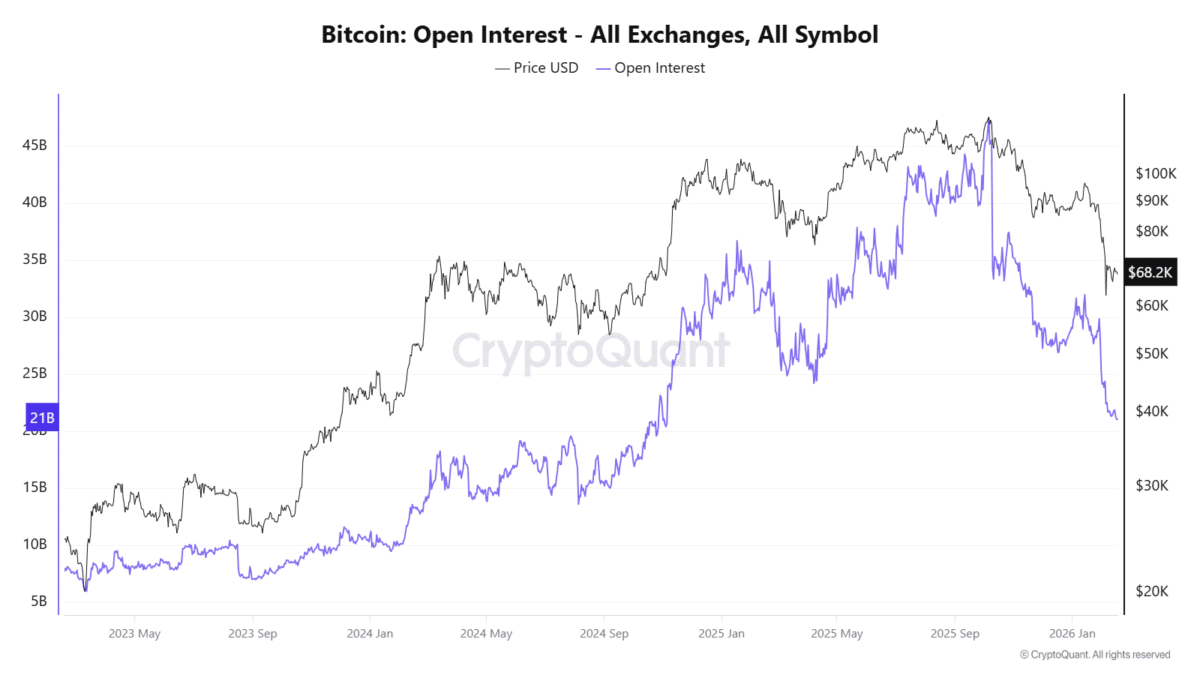
From this total, the largest crypto exchange Binance accounts for nearly $6.52 billion, representing 31% shares, while ByBit, which is the second largest, holds 17% with $3.61 in total open interest. It combines both the USD and USDT dominated futures and options markets.
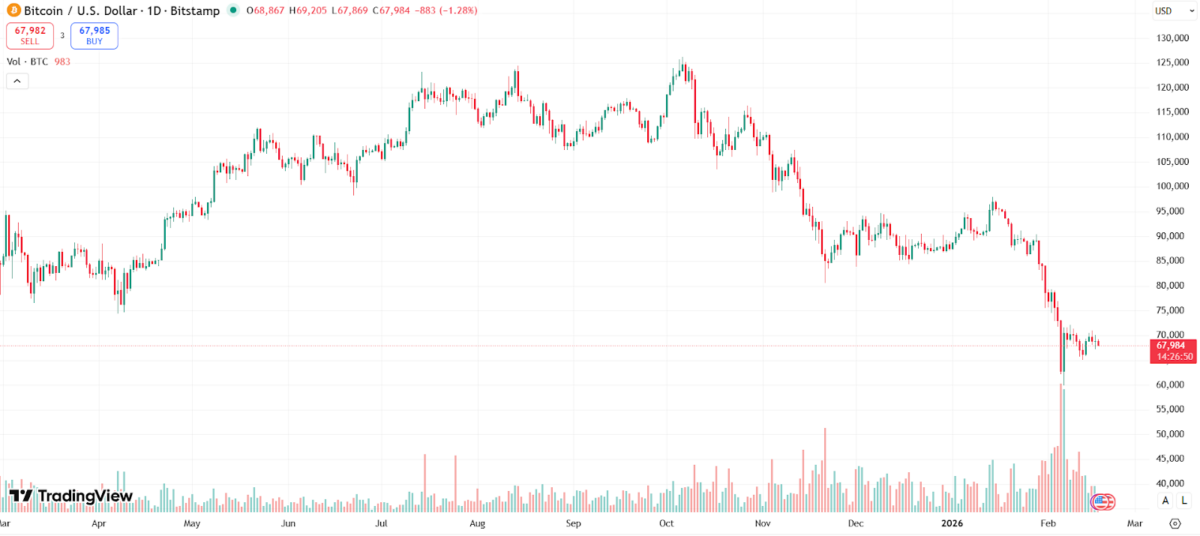
At the time of publishing, Bitcoin was trading at $68,000, down 28% in the past thirty days as per CoinMarketCap data. It has declined by 46% from the all-time high of $126,198—marked on October 7, 2025.
Market drawdown: Bear market or “small” correction?
The broader market drawdown has hit cryptocurrencies hard since mid-January, with Bitcoin briefly dipping below $60,000 on February 6, 2026. Although it has reclaimed slightly, the pullback tanked investor confidence, with the total crypto market cap losing over $1.2 trillion in 2026 so far.
Vikas Gupta, Country Manager-India, Bybit, notes that this drop coincides with short-term macro-economic factors and positioning reshuffle from market players. “It’s not a decline in the underlying fundamentals,” he said in an exclusive statement shared with The Crypto Times.
“Expectations of faster and deeper Federal Reserve rate cuts had supported risk assets, but growing uncertainty around the timing and scale of policy easing has tightened liquidity outlooks, prompting investors to rotate toward traditional safe-haven assets such as US Treasuries and gold,” Gupta said. “This shift has temporarily weighed on crypto prices without altering the long-term investment thesis.”
The Fed held interest rates steady at 3.5–3.75% into 2026 following stronger-than-expected jobs data and persistent inflation pressures above target. This decision reduced bets on aggressive easing this year and contributed to the broader rotation away from high-risk assets like crypto.
While some analysts warn of potential further downside toward $50,000 for Bitcoin if support levels break, others view this as an orderly reset rather than a structural collapse.
Traders’ exit after profit taking and market uncertainty
After Bitcoin’s explosive run to over $126,000 late last year, many players locked in gains during the early-year volatility. They soon started unloading positions as President Donald Trump’s winning-vibes cooled down and uncertainty built around Fed policy and broader risk appetite.
This wave of selling amplified the downturn. “Profit-taking by traders and institutions following the recent rally has also contributed to the correction. Bitcoin’s pullback has influenced broader market sentiment, leading to stronger declines across higher-risk altcoins,” Gupta further added.
The drawdown looks more like a classic post-rally reset than a full-blown bear market so far, with on-chain data showing long-term holders mostly holding firm despite some strain.
If macro conditions stabilize, involving clearer signals from the Fed on rate cuts later in the year and liquidity returns, this could set up for a rebound toward $80,000+ by mid-2026. For now, though, choppy trading and caution dominate as participants wait for the next catalyst.
Also read: Monero On-Chain Activity Remains Strong Despite Delistings