
Key Highlights
- India’s 1% TDS on crypto is pushing 85% of trading offshore, undermining domestic liquidity and innovation.
- Union Budget 2026 could decide whether India captures a $5 trillion Web3 economy or loses ground to foreign markets.
- Industry demands pragmatic reforms: lower TDS to 0.01%, rationalized capital gains tax, and a clear regulatory framework.
When the Union Budget for 2026–27 is presented in Parliament by Finance Minister Nirmala Sitharaman on February 1, 2026, it will arrive at a moment of quiet consequence for India’s digital economy.
Over the last decade, India has quietly built one of the world’s most advanced public digital backbones, from real-time payments and digital identity systems to large-scale financial inclusion infrastructure that reaches hundreds of millions of people.
In parallel, the country has also emerged as a major source of blockchain talent, fintech founders, and engineers working at the cutting edge of global crypto and Web3 development.
And yet, despite these structural advantages, India today finds itself drifting toward the margins of the global digital asset economy rather than shaping its direction.
This gap sits at the centre of the policy challenge now confronting the government. The question is no longer whether cryptocurrencies or blockchain-based systems belong in India’s financial future. Market behavior, international adoption, and domestic participation have already answered that.
What remains unresolved is how India chooses to engage with this reality—and on what terms. The real question is whether India intends to shape this sector strategically or allow it to grow beyond its regulatory and economic influence.
The answer will not be found in speeches or policy intent notes. It will be embedded in the fine print of taxation, compliance architecture, and regulatory signalling contained in the Union Budget 2026.
In the Union Budget 2025, the government chose to maintain the existing crypto tax framework, offering no relief to the industry. The 30% tax on virtual digital asset gains and the 1% TDS on transactions were retained without any changes, despite repeated appeals from exchanges and industry stakeholders.
The budget made no specific mention of crypto or Web3, signalling that the government preferred to continue with a cautious, tax-first approach rather than introduce regulatory clarity or reforms.
What parliament data shows about crypto tax in India
In a written reply tabled in the Lok Sabha in December 2025, the government laid out, for the first time in detail, how crypto taxation is actually playing out on the ground. The response showed that while tax collections from crypto transactions have gone up over the last three years, the system itself is far from settled.
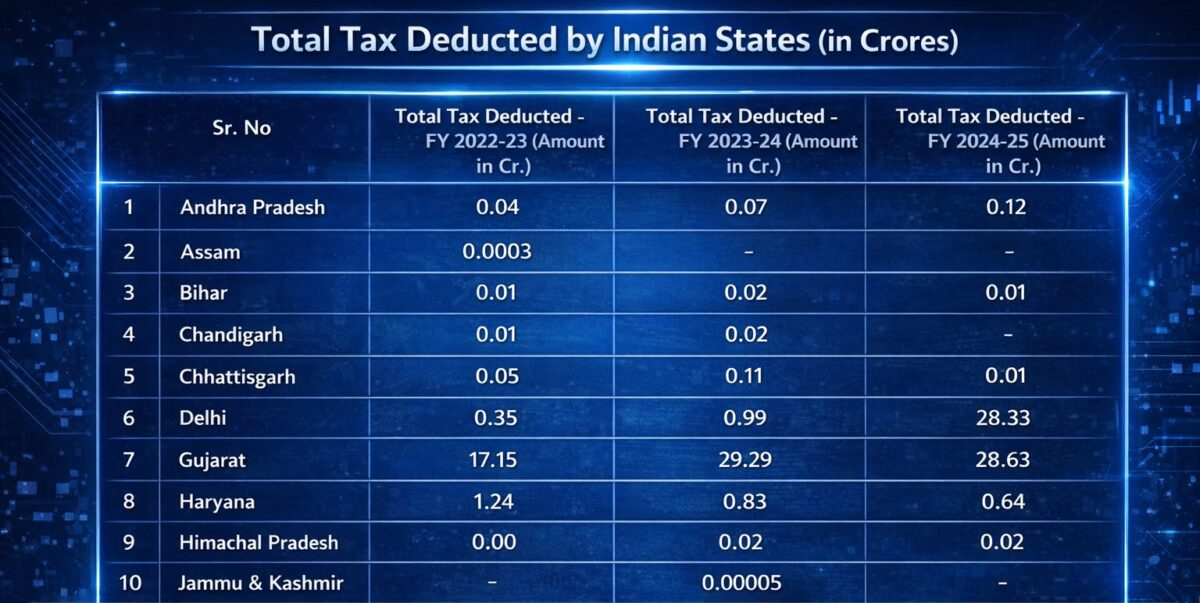
The Finance Ministry admitted that enforcement action had to be taken against several exchanges for non-compliance.
In its own words, “survey actions under Section 133A of the Income Tax Act were carried out against three crypto exchanges and non-compliance of TDS provisions under Section 194S to the tune of ₹39.8 crore and undisclosed income of ₹125.79 crore were detected.” The reply also revealed that further investigations led to the discovery of undisclosed income amounting to ₹888.82 crore linked to virtual digital asset transactions.
What stands out even more is what the government has not done. In the same reply, the Finance Ministry clearly stated that no study has been carried out to examine how other countries tax or regulate crypto.
“No studies for implementation of taxation models as seen in other countries, such as Thailand and Indonesia, for cryptocurrency have been undertaken,” the government said. This effectively confirms that India’s approach so far has been driven almost entirely by tax enforcement, not by policy design.
The contradiction is hard to miss. On one hand, authorities are collecting hundreds of crores in taxes and carrying out surveys and searches. On the other hand, there is still no formal framework that defines how crypto should operate in India, how exchanges should be regulated, or how the sector fits into the broader financial system.
Even during India’s G20 presidency, no concrete global framework on crypto regulation emerged. As things stand, India is taxing crypto aggressively, but without clearly deciding what role the asset class is meant to play in the country’s economy.
The illusion of success in the tax numbers
At first glance, the government appears to have succeeded in bringing crypto activity into the tax net. Official data shows that tax deducted at source on virtual digital asset transactions rose to approximately ₹511.83 crore ($55.8 million) in Financial Year (FY) 2024–25, up from ₹362.7 crore ($39.5 million) the previous year and more than double the ₹221.27 crore ($24.1 million) collected in FY 2022–23.

These figures are frequently cited as proof that the crypto tax framework is working. But this conclusion does not survive closer scrutiny.
Tax Deducted at Source (TDS) data captures only transactions conducted on Indian exchanges that comply with domestic reporting norms. It does not reflect the much larger volume of trading undertaken by Indian users on offshore platforms, nor does it capture activity routed through decentralized exchanges, peer-to-peer networks, or overseas entities that fall outside Indian jurisdiction.
Industry estimates derived from blockchain analytics, exchange order flow, and cross-border settlement data indicate that Indian residents traded between ₹4.8 lakh crore ($52.37 billion) and ₹5.2 lakh crore ($56.7 billion) worth of digital assets on offshore platforms in FY 2024–25 alone. In other words, for every rupee collected in TDS, nearly ₹100 worth of trading activity occurred outside the Indian tax net.
Once this context is applied, the apparent success of the current regime begins to look less like regulatory effectiveness and more like statistical distortion. The tax system is capturing a shrinking slice of a much larger market that has quietly moved beyond its reach.
Background of the crypto tax framework
India introduced crypto taxation in the Union Budget 2022. The Finance Act that year brought virtual digital assets under the Income Tax Act, imposing a 30% tax on gains and a 1% TDS on every transaction.
The idea behind the TDS was to track transactions in a market that was largely unregulated at the time. It was not meant to be a revenue source. It was not designed as a revenue-raising measure.
The measure was positioned as a tracking mechanism rather than a fiscal one. No changes have been made to this structure since its introduction, and no separate regulatory framework has been notified alongside it.
How a compliance tool became a market distorter
The central flaw in India’s crypto taxation regime lies not in its intent, but in its structure.
Unlike the capital gains tax, which applies only to profits, the 1% TDS on virtual digital assets is levied on the gross value of every transaction. In traditional financial markets, the very idea of such a setup would be unheard of.
In markets where liquidity and turnover are the main drivers, margins are slim, and capital efficiency is of the utmost importance.
Typically, professional traders use margins that range between 0.1% and 0.3% per trade.
Market makers, who facilitate liquidity and help stabilize prices, operate on even tighter spreads. A flat 1% deduction on every transaction renders these activities mathematically unviable.
The arithmetic is unforgiving. After 10 trades, 10% of deployed capital is lost to tax regardless of profitability. No market participant can sustain operations under such conditions.
The impact was immediate and predictable. Liquidity providers exited Indian exchanges. Bid–ask spreads widened sharply. Trading volumes collapsed. Retail participants faced poorer execution and higher costs. Exchanges saw revenues shrink, leading to layoffs, closures, and consolidation.
What emerged was not a regulated ecosystem, but a hollowed-out one.
The tax structure that made participation unviable
The impact of the 1% TDS cannot be understood without looking at the second pillar of India’s crypto tax framework: the 30% tax on gains under Section 115BBH.
This provision applies a flat tax rate on all profits from virtual digital assets, with no allowance for loss set-off, no carry-forward of losses, and no deduction for trading costs. In effect, crypto is treated differently from every other financial asset class in the country.
In equity markets, losses can be adjusted against gains. In commodities and derivatives, trading expenses are deductible. In crypto, none of this applies.
The practical consequence is visible at the transaction level.
Why the math simply does not work for traders
To understand why India’s crypto tax regime has driven activity offshore, it helps to look at a simple, real-world example.
Consider a retail trader who deploys ₹10 lakh in crypto over the course of a year.
When this trader first deposits funds into a crypto exchange and executes a buy order, 1% TDS is deducted immediately. That means ₹10,000 is taken at the time of purchase itself, even before any profit is made.
If the trader later sells the asset and withdraws the funds, another 1% TDS is deducted at exit. That is another ₹10,000 gone.
Now, assume the trader redeploys the same capital again during the year, which is common in active markets. The moment the funds are deposited again and trades are executed, another 1% TDS applies. And when the trader exits for the second time, yet another 1% is deducted.
In practical terms, a trader who deposits and withdraws capital twice in a year ends up paying close to 4% of total capital purely in TDS, regardless of whether any profit was made.
This deduction happens on turnover, not on income.
It is important to underline what this means. The tax is applied even if the trader makes a loss. It is applied even if the trade breaks even. And it is applied before profitability is calculated.
On top of this, any profit that does remain is taxed separately at 30% under Section 115BBH, with no allowance for loss set-off, no carry forward of losses, and no deduction for transaction costs or fees.
So in effect, a crypto trader in India faces:
- 1% TDS when buying (18% GST on exchange fees)
- 1% TDS when selling (18% GST on exchange fees)
- Repetition of this cycle with every redeployment of capital
- 30% tax on net profits
- On top of this, the government also charges 4% as a health and education cess
- No ability to offset losses
- No recognition of trading expenses
This structure means that even a modest trading strategy becomes unviable. A trader making 2–3% annual returns can end up paying more in tax than the profit actually earned.
How does this compare with stock market taxation
This is where the contrast with India’s equity markets becomes stark.
In stock trading:
- There is no TDS on buying or selling shares
- Securities Transaction Tax (STT) is extremely small and applies only once per trade
- Capital gains are taxed only on profit, not on turnover
- Losses can be set off against gains
- Losses can be carried forward for up to eight years
- Business expenses can be deducted for active traders
For example, an equity trader who trades ₹10 lakh multiple times in a year does not lose capital simply for participating in the market. Tax liability arises only when profits are realized.
In crypto, however, the tax is imposed at every step of activity, regardless of outcome.
This is why the crypto market reacts so differently to taxation than equity markets. Crypto trading depends heavily on liquidity, volume, and capital efficiency. A structure that taxes capital movement itself destroys these fundamentals.
The result is predictable. Serious traders move offshore. Liquidity migrates. Market making disappears. And the remaining activity becomes shallow, expensive, and inefficient.
This is not a question of avoiding tax. It is a question of whether a market can function at all under a structure where capital is taxed repeatedly before profits even exist.
Adding to the regulatory burden, the government has now made crypto tax reporting mandatory from 2026, requiring all traders to disclose their crypto holdings and transactions to the tax authorities. This measure reinforces the existing TDS and flat tax structure, making compliance even more complex for active traders.
That is the core flaw in India’s current crypto tax design and the reason why trading volumes have shifted abroad despite rising TDS collections.
This is why volumes did not decline gradually. They collapsed.
Comparison of Crypto vs Stock Market Taxation in India (₹10 Lakh Example)
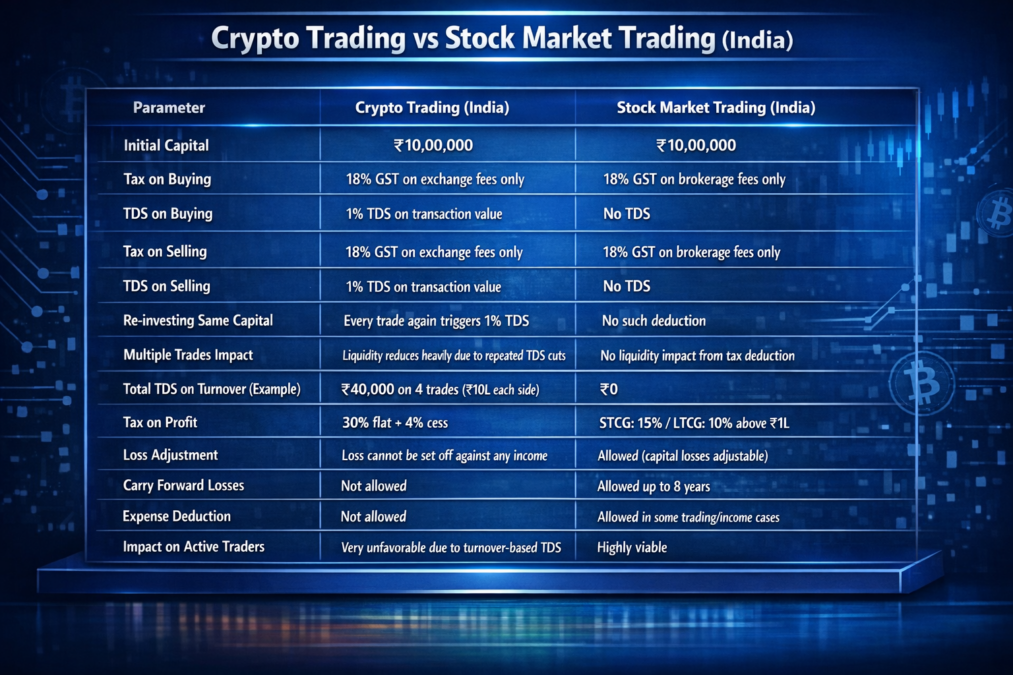
Between FY 2022–23 and FY 2023–24, trading activity on Indian exchanges fell by more than 70%, even as global crypto volumes remained stable. The issue was not demand. It was costly.
Crypto became the only asset class in India where capital was taxed on entry, exit, and profit, without recognition of risk or loss. Once this structure took hold, the outcome was inevitable.
The quiet migration offshore
By late 2023, the consequences of this structure had become visible. Trading volumes on Indian exchanges had declined by more than 70% from their peak. Several platforms shut down entirely, while others pivoted to non-crypto businesses.
At the same time, Indian activity on offshore exchanges surged. Dubai, Singapore, Seychelles, and similar crypto-friendly jurisdictions turned out to be the hotspots of choice for Indian traders. Stablecoins replaced the fiat rails. Peer-to-peer markets boomed.
VPN usage increased after the ban of some foreign platforms, showing that users bypassed restrictions to continue trading. This migration was not limited to retail traders.
Founders, developers, market makers, and proprietary trading desks began relocating operations abroad. Intellectual property was registered outside India. Treasury functions moved offshore. Venture capital followed.
What occurred was not capital flight in the traditional sense, but something more subtle and potentially more damaging: the gradual export of an entire financial ecosystem.
The numbers behind the shift
When viewed alongside actual trading activity, the scale of this displacement becomes clear.
| Metric | FY 2022-23 | FY 2023-24 | FY 2024-25 |
|---|---|---|---|
| TDS collected in India | ₹221.27 crore (≈ $26.7M) | ₹362.7 crore (≈ $43.7M) | ₹511.83 crore (≈ $61.7M) |
| Estimated offshore trading by Indians | ₹3.2–3.6 lakh crore (≈ $38.6–43.4B) | ₹4.1–4.5 lakh crore (≈ $49.4–54.2B) | ₹4.8–5.2 lakh crore (≈ $57.8–62.7B) |
| Share of trading outside India | ~65% | ~78% | >85% |
| Effective tax capture | <1% | <1% | ~0.5% |
The data reveal a stark reality: as enforcement increased, compliance did not rise proportionally. Instead, the activity migrated. The tax base narrowed even as headline collections rose.
This is the classic signature of a policy that suppresses participation rather than regulating it.
Consolidation at the exchange level
FY 2024–25 crypto data shows concentration at a few exchanges. CoinDCX paid ₹259.58 crore ($28.3 million) in TDS. Total TDS collected was ₹511.83 crore ($55.8 million). More than 50% came from CoinDCX.
Also Read: CoinDCX CEO bats for 0.01% Crypto Tax in India ahead of budget
Smaller exchanges struggled with TDS compliance. Some shut down. Some reduced operations. Liquidity moved to larger exchanges. 1% TDS made market making difficult. Section 133A surveys found ₹39.8 crore ($4.38 million) unpaid TDS and ₹125.79 crore ($13.72 million) undisclosed income at the exchange level. Other investigations found ₹888.82 crore in undisclosed income from Virtual Digital Assets (VDAs). Most trading now happens at a few large platforms.
A growing gap between potential and reality
The timing of the Union Budget 2026 matters because the economic opportunity is no longer speculative.
Estimates suggest that embracing virtual digital assets and the broader Web3 ecosystem could add $1.1 trillion to India’s GDP by 2032. Large-scale cloud and digital adoption, including blockchain, could contribute $380 billion to GDP by 2026 and create 14 million jobs.
Yet, the divergence between India’s potential and its current trajectory is illustrated by the staggering volume of trade that has exited the domestic jurisdiction. Indian nationals traded nearly ₹5 lakh crore on offshore platforms in a single year.
If this volume had been executed on compliant domestic exchanges, the 1% TDS, or even a rationalized 0.01% TDS, would have yielded significant revenue. More importantly, trading fees would have generated Goods and Services Tax for the state. Instead, this value was captured by foreign entities such as Binance, Bybit, and KuCoin, contributing nothing to the Indian exchequer.
The shadow multiplier of Web3
The ₹5 trillion figure cited in industry discourse refers not just to lost trading volumes but to the broader multiplier effect of the Web3 economy. By pushing trading offshore, India disincentivizes the establishment of domestic liquidity providers, market makers, and custodians.
These are high-tech businesses that pay corporate tax and employ skilled engineers. Startups require liquid token markets to monetize their products. Suppressed domestic markets force them to incorporate in Dubai or Singapore to access capital and liquidity. India possesses 11% of the global Web3 talent pool, yet without a domestic market, this talent largely works for foreign protocols.
Indian engineers build the product, but the intellectual property and economic value accrual occur elsewhere. The current tax regime acts as a primary incentive for offshore migration, effectively subsidizing foreign exchanges at the cost of domestic industry health. The Make in India initiative is undermined in the digital sector by a tax policy that makes trade in India mathematically unviable.
How India’s approach differs from global practice
Globally, the trajectory has been markedly different.
The United States has gone down the path of regulatory clarity through legislation and agency guidance, culminating in the GENIUS Act, which brings stablecoins into the regular banking system.
Europe’s Markets in Crypto Assets (MiCA) regulation is a single licensing regime for 27 countries. Singapore and Dubai have set up clear and predictable rules, thus fostering institutional involvement.
India, by contrast, has relied primarily on taxation as a regulatory substitute.
This approach has produced a paradox. While the country possesses one of the largest crypto user bases and developer communities in the world, it remains largely absent from the institutional layer of the global digital asset economy. Major funds, custodians, and infrastructure providers operate elsewhere.
Markets can adapt to high taxes. What they cannot adapt to is uncertainty.
Global regulatory benchmarks
While India debated TDS rates, the United States and the European Union moved decisively to integrate digital assets into formal financial systems. The GENIUS Act in the United States integrates stablecoins with insured banks.
Dollarization risk is a major concern for the Reserve Bank of India (RBI) and remittance flows. Europe’s MiCA regulation creates a single licensing framework for 27 countries, allowing passporting for CASPs and institutional inflows.
Dubai VARA and Singapore MAS have established clear rules, attracting Indian founders and capital. India’s focus on taxation rather than regulation has produced a paradox.
While the country possesses one of the largest crypto user bases and developer communities, it remains absent from the institutional layer of the global digital asset economy. Major funds, custodians, and infrastructure providers operate elsewhere.
What global data shows
A recent PricewaterhouseCoopers (PwC) report, a firm that provides audit, tax, and advisory services across 151 countries, on global crypto regulation shows how far other markets have already moved ahead. The report says more than 560 million people worldwide now hold digital assets, and most large economies no longer treat crypto as an experimental sector.
According to PwC, countries in Europe, the US, and parts of Asia have already put full regulatory systems in place for crypto exchanges, custodians, and stablecoin issuers. This includes licensing for exchanges, mandatory audits, capital requirements, and compliance standards that mirror those followed by banks.
The report also points out that enforcement has replaced uncertainty. Regulators are no longer debating whether crypto should exist. They are monitoring transactions, tracking risks, and supervising platforms through formal frameworks.
PwC notes that jurisdictions offering clear rules and predictable taxation are seeing higher institutional participation and business activity. In contrast, countries relying mainly on restrictive taxes or unclear policies are seeing trading volumes and startups shift abroad.
The report adds that stablecoins and tokenised assets are now a key focus area globally, with several countries integrating them into their financial systems under regulated structures.
What the PwC report says about India
India does not have a full crypto rulebook yet. PwC says over 52 countries already have clear regulations for crypto. These rules include licensing, audits, and compliance requirements. India is not among them.
Despite this, India has a very large crypto market. Around 90 million Indians hold or have used crypto. Adoption is high, but there are no clear rules for exchanges or businesses.
So far, India has focused on taxation. There is a 30% tax on crypto income and a 1% TDS on transactions. This helps the government track activity, but it does not make things clear for companies or users. There is no licensing system, no set capital requirements, and no standard compliance process.
In other countries, exchanges follow strict rules. They have audits, customer protection, and reporting requirements. India has some checks, but mostly through tax tracking. There is no dedicated regulatory structure.
Because of this, bigger exchanges can survive because they can pay for compliance. Smaller exchanges struggle, and some have shut down or reduced activity. Some trading has moved abroad because of uncertainty about the rules.
India has scale and a lot of users, but no clear framework to support them. Without proper rules, the market is unstable. If things do not change, India could fall behind countries that have set up clear crypto regulations.
The policy dilemma for the Union Budget 2026
The Finance Ministry faces a choice. Retaining a 1% TDS may secure ₹500–600 crore ($55 – $65 million) for the Consolidated Fund, but it risks losing India’s seat in the future digital economy. Industry bodies advocate for a reduced TDS of 0.01%, allowing liquidity providers to return and offshore volume to be repatriated.
Regulatory clarity and incentives to build domestic infrastructure are critical if India is to capture the $5 trillion opportunity and protect its talent and intellectual property. Strategic action now could turn policy inertia into an economic engine, creating jobs, tax revenue, and global leadership.
Industry voices on Budget 2026 and crypto
As Union Budget 2026 approaches, leaders in India’s crypto industry are watching closely. They say the current tax framework, introduced in 2022, has shaped trading behavior and pushed activity offshore.
Many highlight that regulatory clarity and predictable rules will be key to bringing domestic activity back. India already has a large base of crypto users and Web3 talent. But high taxes and unclear rules are limiting domestic participation.
The India crypto story is no longer hypothetical. Nearly 100 million Indians hold digital assets and the broader global base is over 560 million. We are past early adoption and are in the real participatory growth stage. For 2026, FIU-IND’s updated AML and CFT expectations push the sector toward bank-grade KYC, monitoring, and traceability. In the Budget, the most practical unlock would be predictability. This includes a clear rulebook for VDA intermediaries and reviewing frictions like the 1% TDS that hurts liquidity and onshore participation.
Vikram Subburaj, Co-Founder and CEO of Giottus Technologies
“India can be an innovation hub if compliant players get clarity on licensing, custody, and taxation. There should also be regulatory sandboxes for Web3 rails at UPI scale and a dedicated crypto regulatory body for single-window clearance and customer protection.”
As we approach Budget 2026, the virtual digital asset sector is looking for measured relief, especially since it has been four years since the current taxation framework was introduced. The decisions taken now can accelerate innovation and help India emerge as a global Web3 and VDA leader.
Sumit Gupta, Co-Founder & CEO of CoinDCX
“Pragmatic reforms that bring users back to compliant platforms while strengthening compliance are key. Reducing TDS from 1% to 0.01% would retain monitoring while removing the primary incentive for offshore migration. Aligning the 30% capital gains tax with income tax slabs, allowing loss offsetting and standard business deductions for Web3 ventures, would create a stable and transparent ecosystem for responsible innovation.
I do not expect anything to change immediately in this Budget regarding the 1% TDS or the 30% tax. These do not solve government concerns. Over time, more clarity is expected on regulatory rules. Recent FIU updates focus on the formalization of infrastructure and tracking for crypto players. There is also chatter about dedicated bodies responsible for crypto, including stablecoin monitoring by the RBI. Gradually, we expect more formalization and clarity for crypto payments in India.
Edul Patel, Co-Founder & CEO of Mudrex & Saber
2026 is likely to be a selective market rather than broadly bullish. Short-term rebounds may appear due to liquidity shifts, positioning resets, or technical factors, not underlying fundamentals. Macro developments, like US inflation and Fed policy, will influence market direction. Investors should focus on risk management, diversification, controlled exposure, and technical signals. The market will reward informed and disciplined participation rather than speculation.
Vikas Gupta, Country Manager – India of Bybit,
India’s VDA ecosystem is at a pivotal stage, with growing adoption across the country. However, the current tax framework presents challenges for retail participants by taxing transactions without recognizing losses, creating friction rather than fairness. A reduction in TDS on VDA transactions from 1% to 0.01% could improve liquidity, ease compliance, and enhance transparency while preserving transaction traceability. Raising the TDS threshold to ₹5 lakh would help protect small investors from disproportionate impact.
Ashish Singhal, Co-Founder of CoinSwitch
Introduced in 2022 as a stand-in for regulation at that time, VDA taxation has since been complemented by strong oversight from FIU-IND and improved compliance. This Budget presents a great opportunity to revisit the framework in a manner beneficial to both investors and the government. We remain hopeful that the government will recognize this gap and consider reviewing the current framework soon.
Budget 2026 is coming… but will it save future of Indian crypto?
Budhil Vyas, Data scientist and crypto educator behind the Crypto Talks YouTube channel
Every crypto user are asking for just 3 things:
First — Clear rules. No confusion. No grey area.
Second — Lower taxes & remove 1% TDS with Fix % of tax.
Third — Fair system. Let traders set off losses.
Right now, high tax is pushing money offshore and people are leaving india just because of non supportive system… and killing volume in India.
If the government listens, India can become a global crypto hub, If not… users will keep moving out & we will regret later!!
With the Union Budget 2026, there is an opportunity to rationalize India’s digital asset framework through targeted, pragmatic refinements. The current 1% TDS and 30% flat tax, without loss set-off provisions, have constrained liquidity and pushed activity offshore. Reducing TDS to a workable range, allowing loss set-off within VDAs, and clarifying cost basis treatment, including transaction costs, would help keep activity onshore while maintaining compliance.
Aishwary Gupta, Payment Head of Polygon
A pragmatic starting point would be to set clear rules for rupee-linked digital instruments, whether that means tokenized bank deposits issued under existing banking oversight or a regulated stablecoin model with strict requirements around reserves, disclosures, audits, redemption rights, and licensed issuers. Countries across the Middle East, Singapore, and Japan are moving decisively on this front. India’s young, tech-savvy population and strong fintech ecosystem make it naturally positioned to lead, provided the right tax and policy signals are in place.
Together, these perspectives show that the industry is not looking for exemptions. They are asking for “predictable rules, rational taxation, and a clear regulatory framework.” This can support domestic liquidity, innovation, and compliance.
What the industry is actually asking for
Contrary to popular perception, the industry is not seeking exemptions or special treatment. Its demands are narrow and pragmatic.
A reduction of TDS to around 0.01%, sufficient to maintain transaction traceability without destroying liquidity.
Rationalization of capital gains taxation, including loss set-offs.
Clear legal classification of digital assets and custody norms.
Regulatory certainty that allows long-term planning and institutional participation.
These measures would not weaken oversight. They would strengthen it by bringing activity back within the formal economy.
A decision that will shape the next decade
The debate around crypto in India is often framed as ideological. In reality, it is economic.
It is about whether India wants to shape the next generation of financial infrastructure or merely observe it from the sidelines. Whether it wishes to build platforms or consume them. Whether it wants to capture value or export it.
Budget 2026 will not announce this choice explicitly. But it will encode it — quietly, precisely, and decisively — in tax rates, definitions, and compliance rules.
And those choices will determine whether India emerges as a serious participant in the global digital economy or watches its most promising frontier mature elsewhere.