Key Highlights
- The Co-Founder of Binance says he’s talking with a dozen governments about tokenizing national assets to unlock value and build future financial markets.
- Crypto payments could grow as new systems let users swipe cards while crypto settles quietly in the background, CZ says.
- He believes crypto will become the payment layer for AI, with blockchain acting as the natural system for intelligent agents.
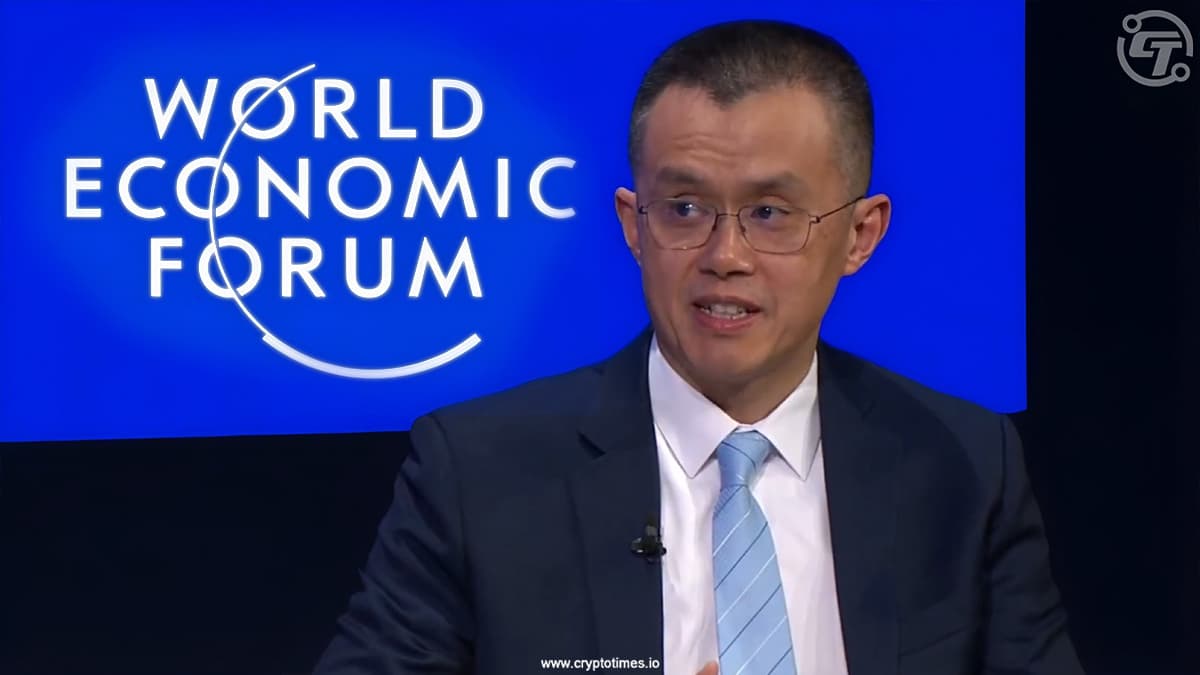
Changpeng Zhao, the Co-Founder of Binance and widely known as CZ, revealed at the World Economic Forum in Davos that he is actively talking with around a dozen governments about tokenizing some of their national assets.
He explained that tokenization, creating digital representations of real-world assets, could allow governments to realize financial gains upfront and use the proceeds to develop financial markets and industries.
According to CZ, in crypto, only exchanges and stablecoins are truly proven industries so far. Zhao says 2026 will be the year when sovereign nations begin realizing financial gains upfront by placing real estate, commodities, and national infrastructure on-chain.
In his view, tokenization could turn national assets into liquid, digital tools for the future economy.
Payments and AI
Zhao also addressed crypto’s role beyond trading. He said crypto payments have yet to see widespread consumer adoption, but that infrastructure is now emerging that could change that.
In these systems, users swipe a card, crypto is settled in the background, and merchants receive fiat currency. This, he predicts, could significantly expand crypto payments in the coming years.
“So now when we have those bridges, I think payments is going to become pretty big,” he said.
The third area he highlighted was AI, which he believes could become one of the biggest drivers of crypto in the future.
Zhao said crypto is likely to become the main payment layer for intelligent agents, arguing that blockchain is a more natural interface for automated systems than traditional banking tools. “When AI goes big, they’ll do payments in crypto — whether it’s buying tickets or paying for restaurants,” he said.
Fewer bank visits, not fewer banks
At Davos, Zhao also shared his view on how traditional banking could change in the coming decade.
He suggested that over the next decade, people may visit physical banks less often as crypto, blockchain, and electronic know-your-customer (KYC) systems make financial services more accessible.
“Over time, people will have less need to visit physical banks,” he said, noting that cryptocurrencies, blockchain, and electronic KYC systems are accelerating the shift. He recalled how ING pioneered online banking 25 years ago, showing how technology can gradually transform long-standing financial systems.
CZ said physical banks will likely shrink significantly over the next 10 years, but stressed they will not disappear. “They serve many important purposes,” he said. “But the space is being redefined.”
Binance stress-tested during market turmoil
Addressing the ongoing debate about the safety of digital assets versus traditional banking, CZ pulled no punches. He recalled Binance’s ability to process $7 billion in withdrawals in 24 hours during the 2022 and 2023 market panics.
In December 2022, after the collapse of FTX, Binance processed around $7 billion in withdrawals in a single day and about $14 billion over one week, without disruption.
He cited a similar situation in December 2023, after turbulence linked to Luna USD and RTX, and before the Silicon Valley Bank collapse. Binance again saw $7 billion withdrawn in one day, with hundreds of millions more in the surrounding days, while operations remained stable.
“I don’t know of any bank that can handle that,” CZ said. He explained that these events highlight the design differences between crypto platforms and traditional banks.
Taken together, CZ’s comments point to a future where governments tokenize assets, payments quietly run on crypto rails, AI uses blockchain as its financial layer, and traditional banking continues to evolve. While risks remain, he believes the financial system is clearly entering a new digital phase.
Also Read: Ripple’s Stablecoin Is Now Live on Binance for Trading