
Key Highlights
- A single wallet earned over $128,000 betting on Israel attacking Iran by late January.
- Odds jumped as copy traders piled in before the position was fully exited.
- The episode has revived insider-trading concerns around prediction markets.
A trader has once again drawn attention on Polymarket after profiting from bets tied to a potential Israeli military strike on Iran, just months after making similar gains during last year’s conflict.
The user, Rundeep, built a large position in early January, rode a sharp move in market odds, and exited within 24 hours. The trade has left observers debating whether the gains reflected sharp speculation or privileged information.
A familiar wallet, a familiar trade
On January 6, the wallet began accumulating shares in the market “Israel attacks Iran by January 31, 2026,” where prices hovered near 21 cents. As other traders followed the move, the “Yes” odds climbed above 30 cents, pushing total market volume toward $2 million.
By January 7, the trader had closed the entire position, reportedly after changing the account name and withdrawing funds. On-chain data shows the in-and-out trade cleared over $128,000, a move that looked less like a geopolitical thesis and more like a clean volatility snipe.
Insider whispers resurface on X
The activity quickly spread to X, where users flagged similarities to a wallet that profited during the June 2025 Israel–Iran conflict.
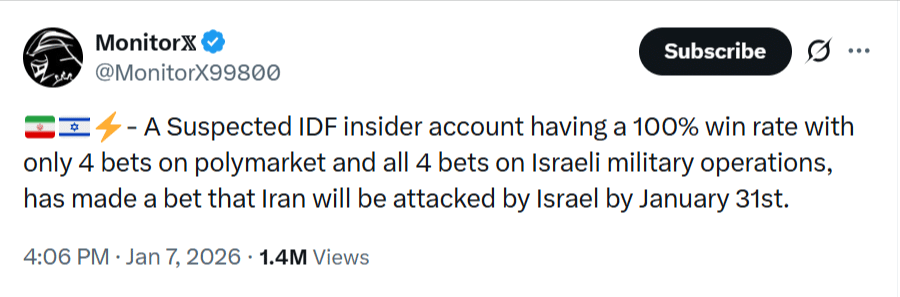
Accounts like PredictFolio and MonitorX suggested the wallet might belong to an Israeli military insider, citing a tiny sample of eerily precise bets tied only to Israeli operations.
These claims remain unproven, but they have reignited debate around whether prediction markets can be exploited by traders with access to non-public geopolitical information.
Echoes of past controversies
The episode recalls this week’s case in which a Polymarket trader turned $30,000 into more than $400,000 by betting on the capture of Venezuelan President Nicolás Maduro shortly before it was announced publicly. That incident sparked calls in Washington for limits on who can bet on sensitive political and military events.
While prediction markets are legal, critics argue that the line between forecasting and insider trading becomes dangerously thin when real-world operations are involved.
Tighter rules, same questions
The timing also coincides with Polymarket’s recent rollout of taker fees on ultra-short crypto markets, aimed at curbing high-frequency bots and improving liquidity. These measures, however, do little to address concerns around informational asymmetry in geopolitical betting.
For now, the Israel–Iran trade underscores a recurring tension: prediction markets reward accuracy, but when accuracy appears too precise, they invite scrutiny.
Also read: Polymarket Launches Housing Markets Powered by Parcl