Key Highlights
- Ethereum acts as the final judge for high-value transactions, while faster “Layer 2” networks handle daily speed.
- Unlike banks (SWIFT) that take days, Ethereum moves money and finalizes the deal simultaneously.
- Over $115 billion in staked ETH protects the network, making it virtually impossible to attack.
- Ethereum focuses on security (Layer 1) and lets specialized layers (Layer 2) handle the heavy lifting.
When you send an email, a WhatsApp message, or a photo, it arrives instantly. The internet, as we know it today, is a master at moving information. But if you try to send money to a friend in another country on a Friday afternoon, they might not receive it until Tuesday. Why is it that we can stream 4K video from the other side of the planet in milliseconds, but moving value takes days? The answer lies in the internet’s history.
The early internet was built to share data, not to transfer value. It lacked a native “ledger” or record-keeping system to track who owns what. As a result, when we moved banking online, we simply built a digital skin over an old, pre-internet system of paper trails and bank vaults.
While Satoshi Nakamoto introduced Bitcoin as the first breakthrough to this landscape—acting as “digital gold”—it lacked major features to make transferring “values” functionable. This is where Ethereum came in, an updated version of blockchain technology where smart contracts were introduced.
Fast forward today, Ethereum is no longer just a slow computer for running quirky apps; it is becoming the Internet’s Settlement Layer. Think of it as a global, digital Supreme Court: a bedrock of truth that ensures transactions are final, irreversible, and secure, allowing faster, cheaper systems to build on top of it.
What is the Settlement Layer?
In the context of blockchain, the Settlement Layer is the foundational blockchain (Layer 1) that guarantees the security, finality, and dispute resolution for the entire ecosystem.
Think of the settlement layer as the “bedrock” of the digital economy. It is not designed to be the fastest or cheapest place to trade; it is designed to be the most secure. It serves three specific functions:
- Finality: It locks transactions in place so they can never be reversed.
- Dispute Resolution: It acts as an arbiter for faster, cheaper networks (Layer 2s) built on top of it. If a Layer 2 network tries to cheat, the Settlement Layer catches the fraud and enforces the correct result.
- Liquidity Anchor: It holds the master ledger of assets (like Ethereum (ETH) and stablecoins) that are used across the ecosystem.
While other networks focus on speed (execution), the settlement layer focuses on being an incorruptible source of truth.
What is settlement in crypto?
Settlement in crypto refers to the moment a transaction becomes irreversible and ownership is officially transferred on the blockchain.
In traditional finance, “payment” and “settlement” are different steps. When you swipe a credit card, you pay instantly, but the bank doesn’t actually settle the funds for days (T+2). This delay creates risk.
In crypto, settlement is atomic, meaning the instruction to pay and the movement of funds happen simultaneously.
- Traditional Settlement: Promises are made now; money moves days later.
- Crypto Settlement: The transaction is final once the block is confirmed on the settlement layer (usually within 12-15 minutes on Ethereum).
Once a transaction is “settled” on Ethereum, it is carved into digital stone. It cannot be undone, censored, or reversed by a bank manager or a government official.
The problem with the old way: Messaging vs. Money
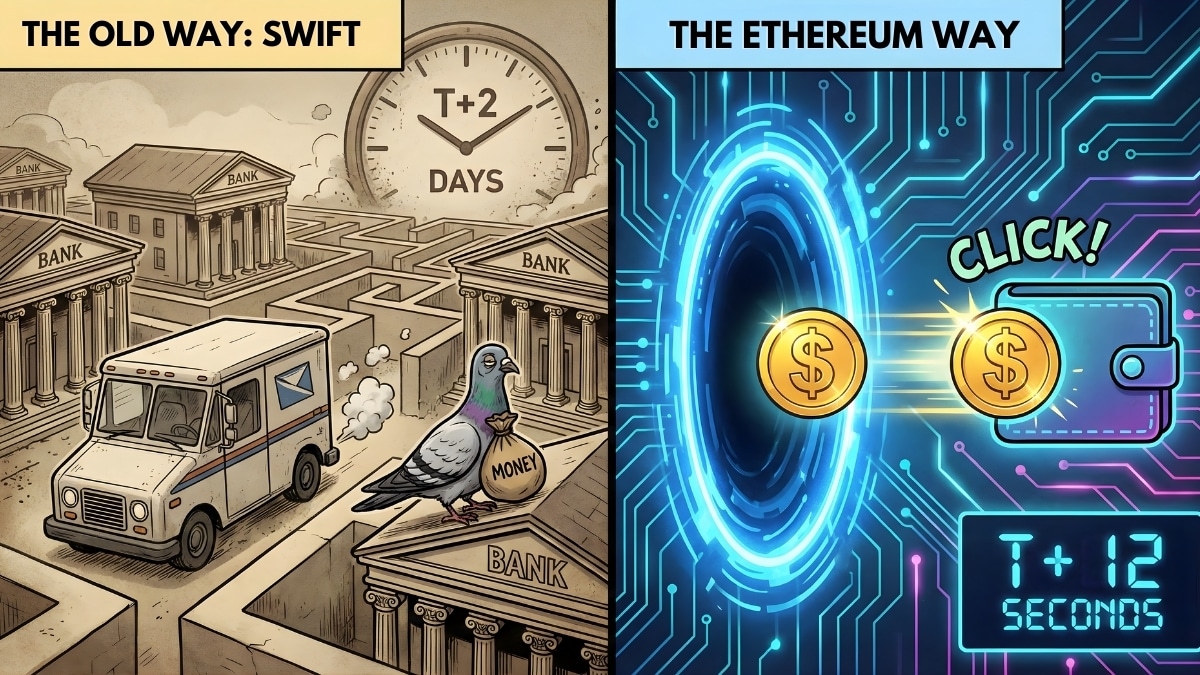
The current banking system (TradFi) uses a network called SWIFT. Many people think SWIFT moves money, but it doesn’t. It is actually a messaging system.
When Bank A wants to send money to Bank B, it sends a SWIFT message saying, “Please debit this account and credit that one.” The actual money moves later, often through a chain of intermediary banks. This separation of “the message” and “the money” creates massive headaches:
- Delay: It takes days (T+2) to settle trades.
- Risk: If a bank goes bankrupt after the message is sent but before the money settles, the money is lost (counterparty risk).
- Cost: Every middleman takes a fee.
Ethereum, on the other hand, operates on the Atomic Settlement model. The instruction to move money is the movement of money. They happen simultaneously in the same block. There is no T+2. There is only the time it takes for the block to be finalized (about 12–15 minutes). This removes the risk of someone promising to pay and then failing to deliver.
The $105 billion security shield
Why do people trust Ethereum to settle trillions of dollars? Because of its Proof-of-Stake (PoS) consensus.
Think of PoS as a security deposit system. To be a “validator” (someone who helps run the network), you must lock up (stake) 32 ETH. If you try to cheat the system or process a fake transaction, the network automatically destroys (slashes) your money.

The cost of corruption
As of late 2025, there is over 35 million ETH staked on the network. At current prices (nearly $3,000 per ETH), this represents a “shield” of over $105 billion.
To attack Ethereum—i.e. to rewrite the ledger and steal money—you would need to buy and control a majority of this staked ETH. This would cost tens of billions of dollars. And even if you succeeded, the community would simply fork the network and delete your stake. This concept is called Economic Finality: the guarantee that reversing a transaction is so expensive that no rational actor would ever attempt it.
This is why Ethereum is called “Trustware.” It automates trust using money, not laws.
L2 ecosystem: The high-speed execution engines
While network congestion and foundation makes Ethereum slow, the emergence of Layer 2 (L2) rollups are the skyscrapers built on top of it. This is where you, the user, will actually live.
Rollups are separate blockchains that bundle thousands of transactions together into a single “batch.” They then send a tiny summary of that batch down to Ethereum (Layer 1) to be settled.
There are two main types of L2s:
- Optimistic Rollups (e.g., Arbitrum, Optimism): These rollups assume all transactions are valid. They operate on a “innocent until proven guilty” model. There is a 7-day “challenge window” where anyone can prove a transaction was fraud. If no one complains, the batch settles on Ethereum.
- ZK Rollups (e.g., zkSync, Starknet): These use complex math (Zero-Knowledge proofs) to prove the transactions are valid before sending them to Ethereum. They are “guilty until proven innocent” but offer instant security without the 7-day wait.
The result? Users get transactions that cost pennies and happen in seconds on L2, while inheriting the multi-billion dollar security of Ethereum L1.



RWAs: Where the Wall Street moved in
The strongest proof that Ethereum is becoming the Internet’s Settlement Layer is that traditional finance (TradFi) is starting to use it. This trend is called Real-World Assets (RWAs).
Giants like BlackRock and Franklin Templeton are now issuing “tokenized” treasury bills on Ethereum. instead of waiting days for a bond trade to settle, they can trade these tokens 24/7 with instant finality.
Why Ethereum?
- Liquidity: It has the most “stablecoins” (digital dollars like USDC), acting as the oil for the financial engine.
- Reliability: Unlike some high-speed chains that crash occasionally, Ethereum has run uninterrupted for years. For a bank moving billions, reliability is worth more than speed.
The roadmap: The future is “Blobs” and “Statelessness”
The development on Ethereum isn’t finished. Its developers are continuously working on upgrades to make the chain even better performative and dig its roots deeper as a settlement layer.
The “Blob” upgrade (Proto-Danksharding)
In 2024, Ethereum introduced “Blobs.” Before this, Layer 2s had to pay expensive rent to store data on Ethereum permanently. Blobs created a new lane for data that expires after about 18 days. It’s like Snapchat for transaction data: “Here is the proof, check it now, because it will delete itself later.” This reduced fees on Layer 2 networks by 10x to 100x.
The Verge: Verifying on a smartwatch
The ultimate goal, according to Ethereum Co-Founder Vitalik Buterin, is Statelessness. Currently, running an Ethereum node (a computer that verifies the network) requires storing huge amounts of data. The “Verge” upgrade will allow devices as small as a smartwatch to verify the network using mathematical proofs, without storing the whole history. This ensures that no matter how big the financial system gets, regular people can still check the books.
The digital jurisdiction
Ethereum has successfully transitioned from a “World Computer” to the “Internet’s Settlement Layer.” It has accepted that it doesn’t need to be the fastest or the cheapest place to trade a meme coin. Instead, it aims to be the most secure place to finalize the trade.
It is building a digital jurisdiction—a global court system that is open to everyone but controlled by no one. Whether it’s a gamer buying a sword, a refugee carrying their savings in a digital wallet, or a central bank settling a bond trade, they all need a layer of the internet that deals in absolute truth. That is the role Ethereum is built to fill.
Disclaimer:
Some elements of this content may have been enhanced with the help of our artificial intelligence (AI) assistants for purposes such as basic refinement, review, image generation, and translation to deliver high-quality news in a shorter time frame. However, all AI-assisted content is reviewed and approved by our team to ensure accuracy, fairness, and editorial integrity.