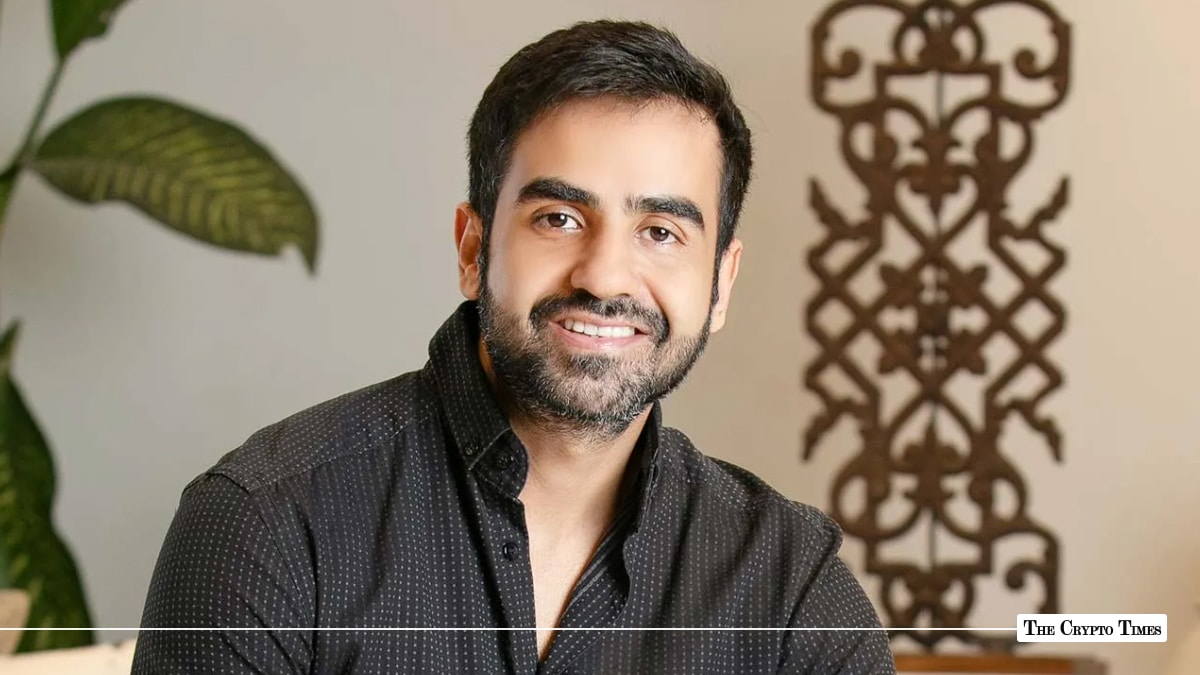
Nikhil Kamath, co-founder of India’s largest brokerage Zerodha and a prominent voice in India’s investing ecosystem, has publicly pushed back against the growing call for India to adopt dollar-backed stablecoins, and in the same breath floated an alternative that cuts closer to home: a gold-linked digital token built on the vast, largely dormant gold reserves sitting in Indian households.
In a post on X on May 11, 2026, Kamath said: “The world still runs on the dollar. But countries are quietly hedging out: buying gold, trading in non-USD pairs, building payment rails outside SWIFT. UPI has been incredible for India to say the least.”
He then turned his attention directly toward dollar-pegged stablecoin advocates. “To friends championing dollar-backed stablecoins, specifically dollar-backed, this seems like a bad idea long-term for India. Credit where due, to Modi govt and regulators, you got this one right in the face of a lot of pressure.”
His post, which had amassed over 63,000 views within hours of publication, landed in the middle of an active and unresolved debate over India’s digital currency future.
What Kamath is actually saying
The argument Kamath is making is not that stablecoins are inherently bad — it is that dollar-backed stablecoins are specifically misaligned with India’s long-term monetary interests.
The concern is not unfamiliar among economists who study emerging market economies. When a country’s citizens and businesses routinely transact in dollar-denominated digital instruments, it effectively deepens that country’s dependence on the U.S. financial system, even if no physical dollar ever changes hands.
For a country that has spent decades building payment infrastructure to reduce that dependency — most visibly through Unified Payments Interface (UPI), the widespread adoption of USDT or USDC equivalents would represent a step in the opposite direction.
Kamath’s praise of UPI is pointed. India’s Unified Payments Interface now processes billions of transactions monthly, operates 24 hours a day across the year, and handles everything from street vendor payments to major commercial settlements. It is the kind of domestic payment infrastructure that most countries do not have, and it is precisely the infrastructure gap that made dollar-backed stablecoins attractive to markets across Southeast Asia, Latin America, and Africa in the first place.
The implicit argument: India does not need what dollar stablecoins offer, because it already built a better version of it, domestically, under sovereign control.
The Gold stablecoin proposition
Kamath went a step further and posed a question that has already generated considerable discussion in financial and crypto circles.
“On the other hand, if there were a gold-based stablecoin, and one could monetise the unutilised gold sitting in Indian households to return a yield — don’t know enough to talk about this, but thoughts?”
The question is more substantive than its casual framing suggests.
Indian households hold an estimated 25,000 tonnes of gold, according to a 2025 HSBC Global study — a figure that surpasses the combined gold reserves of the world’s top ten central banks.
A separate Morgan Stanley note from June 2025 put India’s cumulative household gold holdings at 34,600 tonnes, valued at approximately $3.785 trillion, or nearly 89% of India’s GDP at that time.
The vast majority of this gold sits idle in homes, lockers, and temples, generating no financial return for its holders.
The concept Kamath is gesturing at — a blockchain-based token backed by physical gold that allows holders to earn a yield on otherwise dormant holdings, would effectively be a tokenised version of a gold monetisation scheme, but with the liquidity, programmability, and accessibility that blockchain infrastructure enables.
It is not an entirely new idea in global markets. Tokenised gold products such as Tether Gold (XAUT) and PAX Gold (PAXG) already exist internationally, though they are primarily designed as investment instruments rather than yield-generating ones linked to domestic household holdings.
What Kamath is proposing, even if tentatively, is something more specific to India’s situation: a mechanism that converts the country’s enormous private gold reserve into productive financial capital without surrendering it to foreign currency infrastructure.
The regulatory context: A house divided
Kamath’s remarks arrive at a moment when India’s own institutions are not aligned on the stablecoin question.
The Reserve Bank of India has been unambiguous. In its December 2025 Financial Stability Report, the RBI urged countries worldwide to prioritise Central Bank Digital Currencies over privately issued stablecoins, arguing that only CBDCs can preserve what the bank calls the “singleness of money.”
RBI Governor Sanjay Malhotra, speaking at the Delhi School of Economics in late 2025, was explicit in his dismissal of pressure to follow the United States on stablecoins, pointing to UPI, NEFT, and RTGS as evidence that India’s domestic payment infrastructure already delivers what dollar stablecoins claim to offer abroad.
The Finance Ministry, however, has moved in a different direction. India’s Economic Survey 2025–2026 hinted at a regulatory framework for stablecoins, signalling that some part of the government is at least open to exploring the space.
The result, as The Crypto Times reported in April 2026, is that India’s crypto policy discussion paper has been shelved again — a reflection of the ongoing standoff between the RBI’s firm opposition and the Finance Ministry’s more open posture.
Against that backdrop, Kamath’s remarks are not simply a personal opinion. They land as a contribution to a live policy debate, from a founder with significant credibility in both investing and fintech circles.
Not his first time on this track
This is not the first time Kamath has engaged publicly with the question of gold-backed alternatives to fiat-pegged tokens.
In January 2023, he took note when reports emerged that Iran and Russia were exploring a jointly issued gold-backed stablecoin for use in bilateral trade settlement — a token that came to be known as the “token of the Persian Gulf region.”
Kamath called it a potential “day 1, event 1 of establishing a new economic order everywhere” and expressed surprise at how little coverage the development was receiving from global media.
That earlier comment was more observational than prescriptive. His May 2026 post is different in that it is actively directed at India’s own policy environment, addressing regulators and stablecoin advocates within the country rather than commenting on geopolitical dynamics elsewhere.
The broader picture: Stablecoins at $320 billion and rising
The timing of Kamath’s comments also matters in the context of global stablecoin growth. The overall stablecoin market has expanded significantly in recent months, with total supply rising to approximately $320 billion as of April 2026, a growth of roughly 56% since the start of 2025, according to DeFi analytics platform DeFiLlama. USDT alone reached a record $189.6 billion in April.
The growth is being driven not just by retail speculation but by institutional adoption. Major financial infrastructure providers — from Interactive Brokers enabling stablecoin account funding in January 2026, to Mastercard expanding stablecoin payment rails in partnership with Africa-focused firm Yellow Card last week — are increasingly treating dollar-backed tokens as a serious payment layer.
That mainstream institutional momentum is precisely what makes Kamath’s warning more pointed, not less. The more deeply dollar stablecoins embed themselves in global payment infrastructure, the harder it becomes for any country to resist their gravitational pull — especially when its own citizens are moving money through those rails regardless of official policy.
India already recorded over $10 billion in stablecoin inflows in the first half of 2025 alone, according to available market data, the overwhelming majority of which was dollar-denominated.
What happens next
Kamath has not proposed a concrete product or policy. He has posed a question and offered a direction — and explicitly acknowledged he does not have enough expertise to sketch a full answer.
The practical questions around a gold-backed stablecoin tied to household holdings are significant. How would physical gold held in private homes be verified, vaulted, or custodied at scale? What regulatory body would oversee issuance? How would yields be generated and distributed? Would the RBI’s hostility toward privately issued stablecoins extend to a gold-linked token, or would its domestic asset base make it more palatable to the central bank?
None of those questions has an answer yet. But the conversation has started — and it has started at a level of visibility that is difficult to ignore.
For a country sitting on what may be the world’s largest private gold reserve, the idea of converting that dormant wealth into a yield-generating digital asset, without surrendering monetary sovereignty to the dollar, is one that was probably going to surface eventually. Kamath has put it on the table.
Also Read: The Hidden War: How India’s RBI Plans to Use Transparency to Tame Crypto