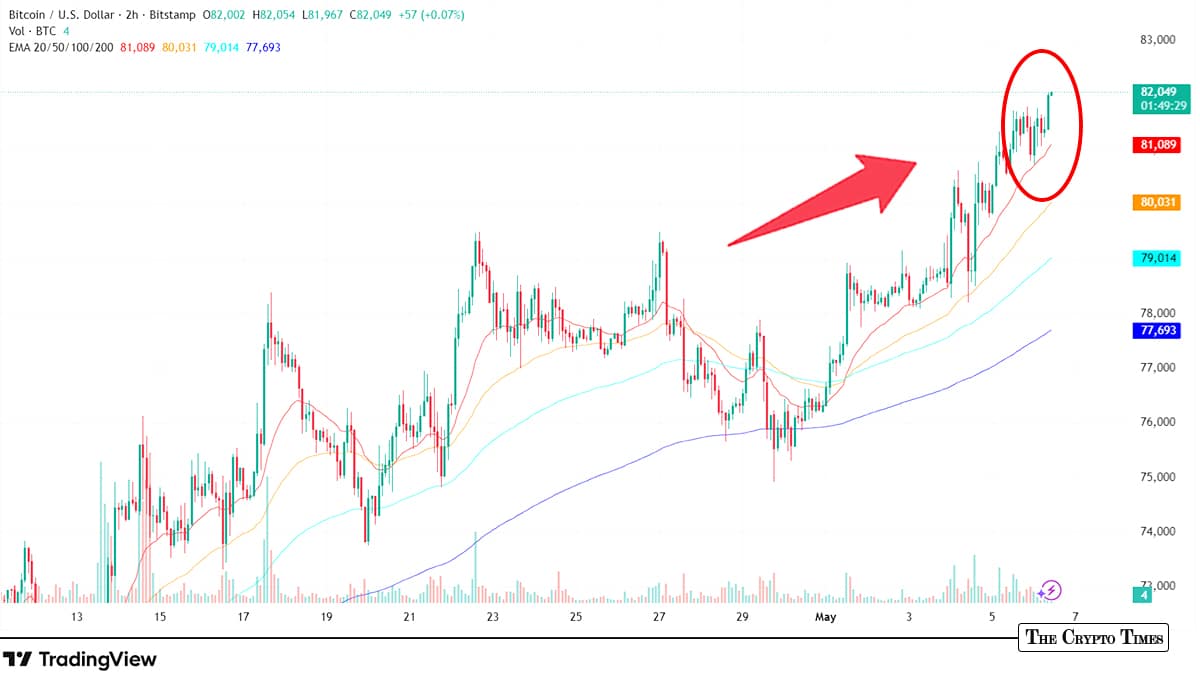
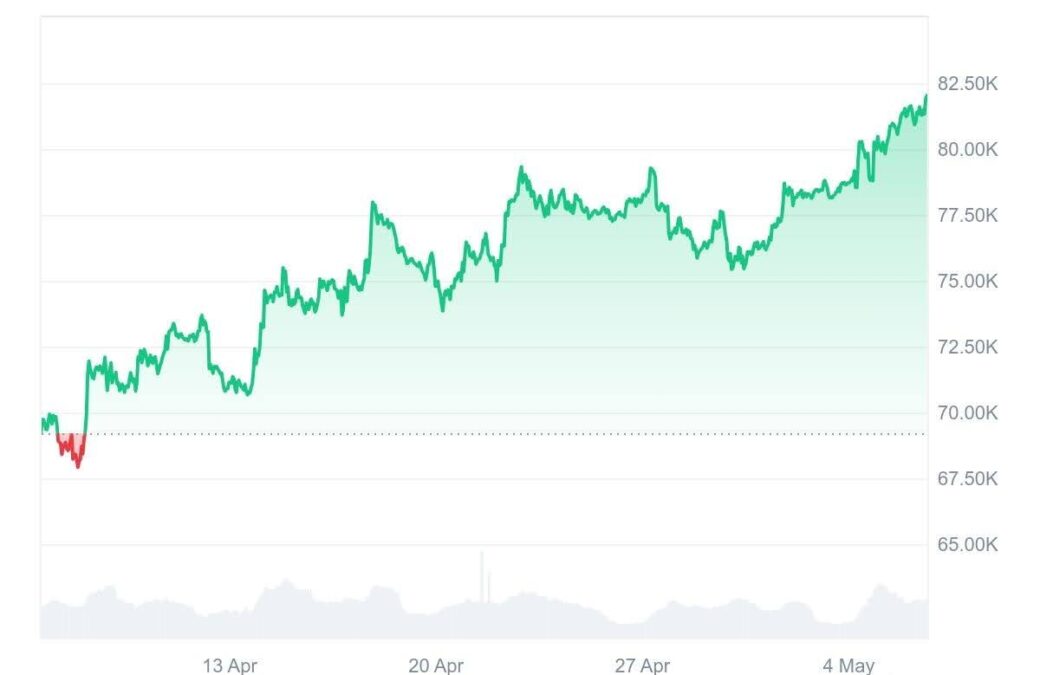
Bitcoin is trading near $81,500 Wednesday morning, having decisively cleared the $80,000 psychological ceiling that had capped its price action for months. The cryptocurrency is up more than 20% from its April lows near $66,000 and has now reclaimed that key level as support for the first time since late January.
Market participants are calling it a legitimate breakout rather than another head-fake—and much of the conviction stems from something subtler than raw buying pressure: the sudden disappearance of the so-called “tail-risk premium.”
At the time of publishing, BTC was trading near $82,125—up roughly 1.76% in the past 24 hours. The largest crypto asset has surged by 5.63% in seven days while more than 17% in the past month—as per CoinMarketCap data.
The vanishing Tail-Risk premium
For weeks, the threat of a wider conflict in the Middle East had kept a lid on risk assets. Oil prices had spiked toward $130 a barrel on fears that Iranian forces might choke the Strait of Hormuz. That geopolitical overhang forced investors to price in worst-case scenarios—higher inflation, tighter monetary policy, and a potential flight from anything remotely speculative.
Bitcoin, still viewed by many institutions as a high-beta play on global risk appetite, bore the brunt of that caution.
Then came the shift as U.S. President Donald Trump announced “Project Freedom”—a U.S.-led escort operation for commercial shipping through the strait—prompted an immediate de-escalation. This led to oil futures dropping roughly 5% in a single session.
The tail-risk premium that had been baked into asset prices simply evaporated. With one major uncertainty off the table, capital that had been sitting on the sidelines or parked in safe havens began rotating back into Bitcoin and equities.
The move was swift: Bitcoin staged its breakout on May 4, triggered in part by a wave of short covering that liquidated more than $150 million in futures positions across the crypto complex.
Institutional fuel meets technical validation
But geopolitics alone doesn’t explain the staying power. The rally has been underpinned by something more structural: relentless institutional demand. U.S. spot Bitcoin ETFs recorded nearly $2.44 billion in net inflows during April—almost double the previous month—and the trend has carried into May.
BlackRock’s iShares Bitcoin Trust (IBIT) continues to dominate the flow charts, absorbing coins faster than miners can produce them. Meanwhile, Strategy (the company formerly known as MicroStrategy) has kept its aggressive accumulation pace, now sitting on more than 818,000 BTC.
These are not retail-driven pumps; they are large, real-money bids that tighten supply even as headline prices climb.
Technically, the chart is starting to cooperate in ways it hasn’t since the October 2025 all-time high above $126,198. Bitcoin has formed higher lows since the $60,000–$66,000 zone and is now testing the underside of its 200-day moving averages.
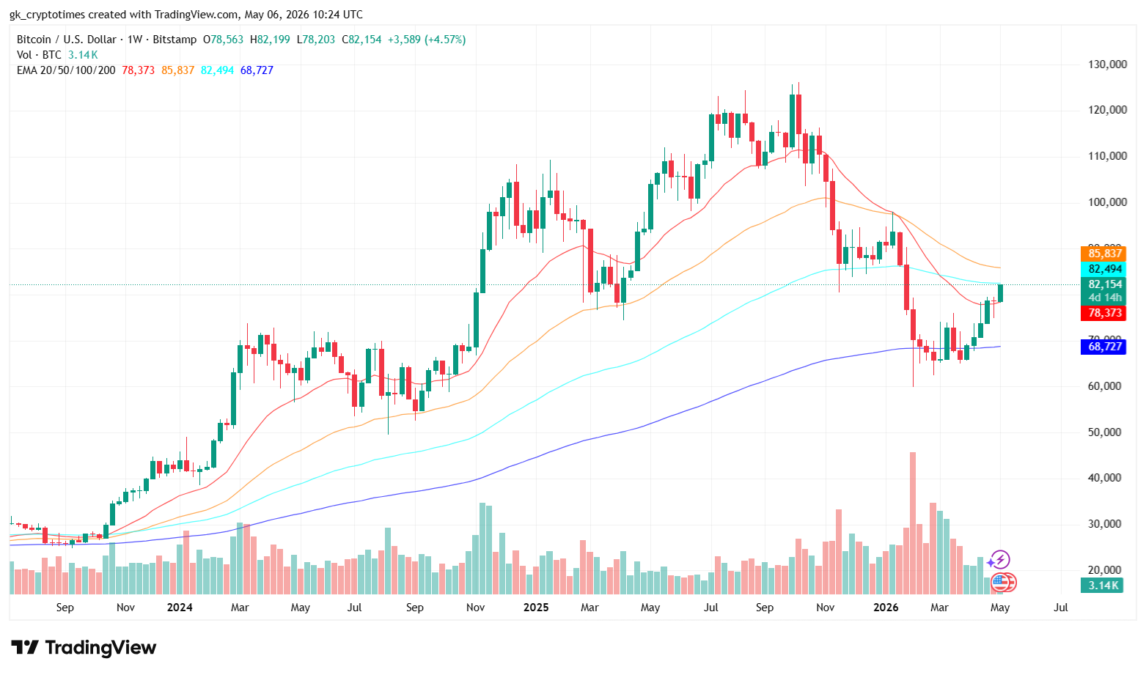
Analysts watching the daily chart note an emerging bull-market support band and positive momentum signals, including MACD crossovers that many describe as the cleanest in months. The $80,000 level, once stiff resistance, is now being defended on dips—a classic sign that market structure has flipped.
Still, the question hanging over the tape is whether this is the start of the next major leg higher or merely a relief rally in a larger bear market.
On-chain metrics show mixed retail participation, and some large holders remain wary after the 50% drawdown from last year’s peak. The next resistance cluster sits between $82,000 and $83,000, with analysts eyeing $85,000–$86,000 as a realistic near-term target if volume sustains. A failure to hold $78,000–$79,000 on any pullback would quickly revive bearish arguments.
What makes this breakout feel different from the multiple failed attempts earlier in 2026 is the combination of factors: a genuine removal of macro tail risk, confirmed institutional absorption, and a cleaner technical setup.
The tail-risk premium that had kept Bitcoin range-bound for so long has been replaced by something closer to cautious optimism.
Whether that optimism hardens into a full-blown bull resumption remains to be seen. For now, though, the $81,000 handle is no longer a ceiling—it’s a floor. And in a market still 35 percent below its all-time high, that distinction matters.
Also read: CME Group to Launch First-Ever Bitcoin Volatility Futures on June 1