U.S. spot Bitcoin ETFs recorded $1.9 billion in net inflows for April 2026, marking the category’s most robust monthly performance this year and the largest since October 2025.
The figure, while slightly below some mid-to-late April peaks that approached $2.4 billion before final adjustments, underscores a clear turnaround. After heavy outflows in late 2025 and early 2026 tied to Bitcoin’s retreat from its all-time high near $126,198, March’s $1.32 billion rebound set the stage.
April nearly doubled that pace, flipping year-to-date flows positive and pushing cumulative inflows since the ETFs’ 2024 launch to roughly $58 billion. Total assets under management hovered near $100.53 billion by month-end, which once topped to $152 billion in July 2025—as of latest SoSoValue data.

Performance breakdown and key metrics
April’s inflows reflect sustained institutional interest amid a recovering Bitcoin market. The month saw consistent daily positive flows, including multi-day streaks that extended up to nine consecutive sessions mid-month.
ETF purchases absorbed significantly more Bitcoin than daily mining output—roughly 450-600 BTC per day on average—tightening spot supply and supporting price recovery.
This performance builds on the broader maturation of the Bitcoin ETF market. Since their debut in early 2024, these products have transformed crypto investing by offering regulated, accessible exposure through traditional brokerage accounts.
Cumulative flows nearing $58 billion highlight their role as a major on-ramp for traditional capital, even as the sector navigated volatility from macroeconomic shifts and geopolitical events.
Dominance of major players
BlackRock’s iShares Bitcoin Trust (IBIT) once again led the pack, often accounting for 75% of daily flows and driving much of the month’s momentum. The fund’s low fees, strong brand, and seamless integration into investor portfolios have made it the go-to choice, frequently capturing the lion’s share of new capital.
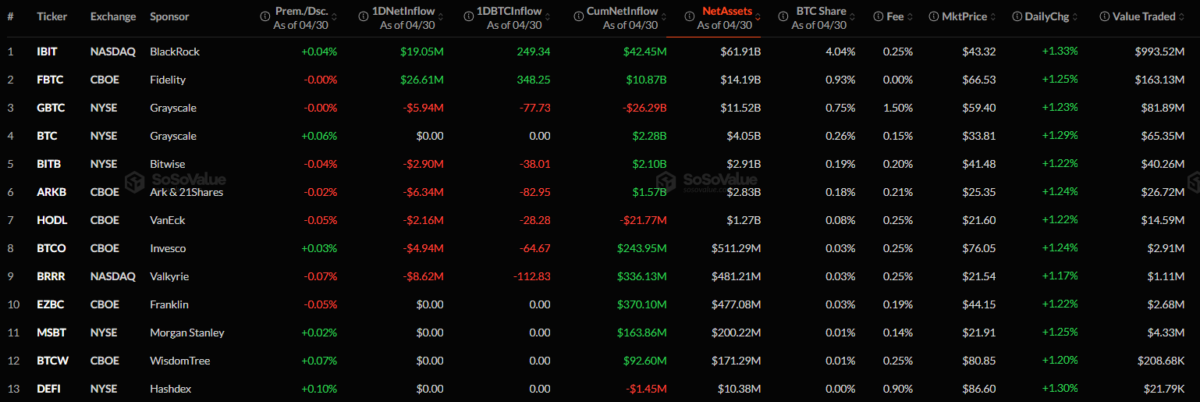
Fidelity’s FBTC contributed steadily with consistent inflows, appealing to investors seeking diversified options. In contrast, Grayscale’s GBTC continued to experience net redemptions, a trend persisting since its conversion due to higher fees compared to newer competitors. This rotation from legacy products to lower-cost alternatives underscores investor sophistication and fee sensitivity in the maturing ETF landscape.
Other participants, including Bitwise, ARK 21Shares, and Invesco Galaxy, added incremental flows, rounding out a broad-based recovery across the sector.
Bitcoin price action and market correlation
The inflows moved in clear lockstep with Bitcoin’s price performance. The cryptocurrency climbed roughly 12% during April, rising from around $68,000 early in the month to peaks near $80,000 before settling in the $76,000–77,000 range.
At the time of publishing, BTC was trading near $77,150—up 2% in the past 24 hours.
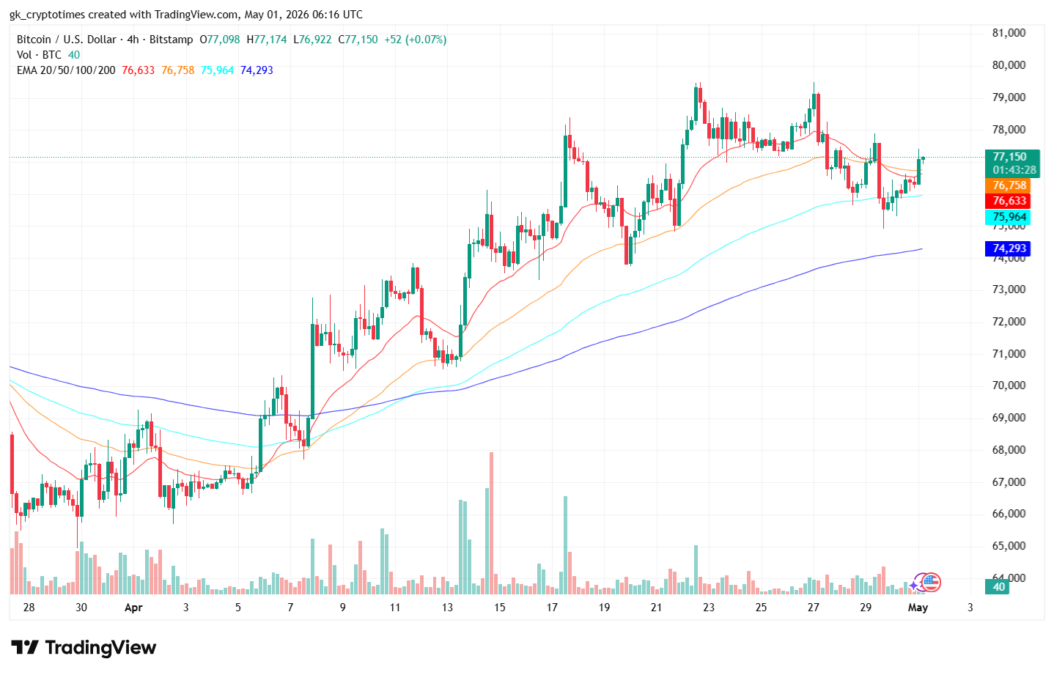
This rebound helped stabilize the market after earlier volatility, with institutional demand providing a reliable bid.
Bitcoin’s supply dynamics further amplified the effect. ETF accumulation reduced available liquid supply on exchanges, which has hovered at multi-year lows. This scarcity, combined with steady buying pressure, reinforced Bitcoin’s narrative as a maturing asset class capable of weathering cycles.
Sustained ETF inflows absorbed selling pressure from profit-taking and market corrections while signaling broader confidence. Analysts widely regard this accumulation as evidence of renewed institutional conviction.
Macro factors, including Federal Reserve policy expectations and signs of geopolitical easing, played supporting roles, but the core driver remained direct exposure to Bitcoin via regulated vehicles.
The performance also lifted sentiment across the broader crypto market, with altcoins and related assets benefiting from the positive spillover. Total Bitcoin held by U.S. spot ETFs now exceeds 1.3 million BTC, representing a meaningful portion of the circulating supply and embedding ETFs deeply into the ecosystem.
Read: Why Are ETF Inflows Not Trustworthy? Inside Outs of the TradeFi’s Crypto Capital
Outlook for May and beyond
With Bitcoin holding above key technical levels and ETFs demonstrating resilience through late-month volatility, the stage is set for potential continuation into May—if momentum holds. Market watchers will monitor Federal Reserve decisions, U.S. regulatory developments, and global risk appetite closely.
April’s standout results serve as a strong indicator of the sector’s resilience. As Bitcoin ETFs continue to attract traditional finance capital, they solidify their position as a cornerstone of institutional crypto allocation strategies.
This month’s data not only reflects improved market conditions but also underscores the growing mainstream acceptance of Bitcoin as a strategic asset.
Also read: Senate Closes the Door on Prediction Market Participation for Lawmakers