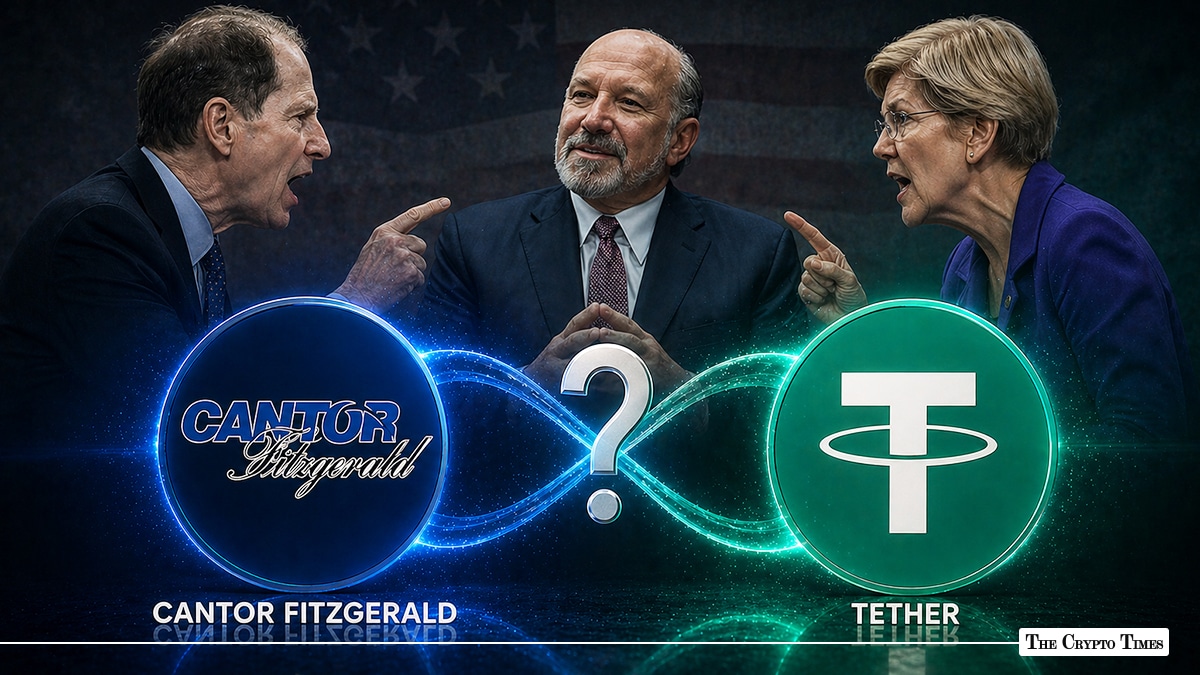
Two Democratic senators have opened the latest in a sustained series of conflict-of-interest inquiries into Commerce Secretary Howard Lutnick, demanding loan documents that would clarify the financial relationship between Tether and a trust benefiting Lutnick’s four adult children — a relationship first surfaced by Bloomberg in March that, ethics experts argue, may undermine the very purpose of the federal divestiture rules Lutnick used to clear his confirmation.
According to a Bloomberg report, in letters sent Wednesday, Senators Elizabeth Warren (D-Mass.) and Ron Wyden (D-Ore.) wrote that the loan raises “serious questions about your relationship with Tether and the company’s influence on your policy decisions,” adding bluntly: “We want to ensure that Tether has not sought to bribe or otherwise exert control or influence over you.”
The senators, who lack the majority needed to compel disclosure, are seeking the underlying credit document describing the size and terms of the transaction. They also asked both Lutnick and Tether whether they had discussed the loan or any other matters since Lutnick was nominated to the Cabinet in February 2025.
What the Loan Actually Is
The transaction sequence is unusual. In October 2025, Lutnick — formerly the long-time CEO of Cantor Fitzgerald — sold his multi-billion-dollar stake in the financial services firm to trusts benefiting his four adult children, satisfying the federal ethics rules that allow presidential appointees to shed potential conflicts of interest by divesting.
The day after the sale, a credit filing was registered in New York state showing that one of those trusts — “Dynasty Trust A,” which benefits all four of Lutnick’s children — had borrowed an undisclosed sum from Tether. The loan is secured by “all assets” held by the trust, including any acquired in the future.
A Cantor Fitzgerald executive familiar with the deal said the loan was specifically backed by a convertible bond entitling Cantor to a 5% stake in Tether. Cantor paid $600 million for that bond in April 2024. Since then, the valuation of Cantor’s Tether stake has ballooned by billions of dollars on paper, making it the most valuable single position the trust holds.
Cantor and Tether did not disclose the loan amount, the terms, or whether the funds were used by the trusts to buy out Lutnick’s stake. Cantor spokesperson Stan Neve previously told Bloomberg that the acquisition “was funded through multiple sources, multiple companies and multiple trusts at market rates and market prices.”
The Ethics Question
A Commerce Department spokesperson said Lutnick “has fully complied with the terms of his ethics agreement, including all divestiture and recusal requirements, and will continue to do so.”
The substantive concern—voiced by ethics experts including Kathleen Clark, a law professor at Washington University in St. Louis—is whether the loan, in effect, allowed Tether to finance the very transaction designed to eliminate Lutnick’s conflict of interest with the company.
If Tether’s loan helped Lutnick’s children buy out his Cantor stake, ethics experts argue, the divestiture restored the appearance of compliance while leaving the underlying financial entanglement intact — and arguably deepened it, by adding a creditor relationship to the existing custody and equity ties.
“This transaction, which theoretically should have eliminated conflicts of interest, actually created new ones,” Clark told Bloomberg in March. The Cantor executive familiar with the deal disputed this characterisation, arguing the loan does not alter the “already robust economic and strategic alliance” between Tether and the company.
A Pattern of Inquiry
Wednesday’s letter is not a one-off. It is the fourth distinct Warren-led congressional inquiry into Lutnick-Cantor-Tether financial entanglements in the past 14 months:
January 2025
Warren wrote to Lutnick ahead of his confirmation hearing, citing his “deep involvement with and support for Tether, a known facilitator of criminal activity that has been described as ‘outlaws’ favorite cryptocurrency,'” and requesting information about his personal stake, conversations with Trump administration officials about Tether, and whether Cantor had performed Know Your Customer due diligence.
August 2025
Warren and Wyden wrote to Brandon Lutnick, the secretary’s son and Cantor Fitzgerald’s current chairman/CEO, about possible conflicts of interest stemming from Cantor’s creation of “Tariff Refund Agreements” — financial products allowing clients to bet on the legal outcome of Trump’s tariff policy. The senators noted that Cantor was effectively running a market on the actions of a federal department headed by the senior Lutnick, raising insider-trading concerns.
February 2026
Warren, Wyden, and Sen. Chris Van Hollen pressed Lutnick on the $1.6 billion USA Rare Earth deal, in which the Commerce Department announced direct funding and loans to a critical minerals company on the same day Cantor was named “lead placement agent” for USA Rare Earth’s $1.5 billion private fundraising round. Trump megadonors Steve Schwarzman, Ken Griffin, and Steven A. Cohen reportedly received access to shares.
April 2026
The current letter on the Tether loan to Dynasty Trust A.
The pattern matters because it situates the loan inquiry within an established narrative arc. Each successive letter has raised the specificity of the financial question, and each has pointed to the same structural concern: that Cantor Fitzgerald, now run by Lutnick’s two adult sons (Brandon as chairman/CEO, Kyle as executive vice chairman), continues to do business directly adjacent to — and in some cases, downstream of — Commerce Department decisions and investments.
The Cantor-Tether Relationship in Full
The April 2026 loan inquiry sits within a Cantor-Tether relationship that has deepened materially since Lutnick took office:
- Custody: Cantor Fitzgerald custodies a substantial portion of Tether’s $192 billion in reserves — which back the USDT stablecoin — and earns “tens of millions of dollars a year” in fees from the arrangement. Reports from late 2025 indicate Cantor now custodies approximately 99% of Tether’s Treasury holdings, up from roughly 80% in 2024.
- Equity: Cantor’s $600 million convertible bond purchase in April 2024, which Lutnick personally negotiated, gives the firm a 5% Tether stake. Tether reported $10 billion in profit last year on a 99% margin — making the stake’s paper appreciation arguably the most consequential single investment of Cantor’s recent history.
- Bitcoin lending: Cantor launched a multi-billion-dollar Bitcoin-backed lending programme in late 2024 with Tether’s support, starting at $2 billion in initial funding and designed to scale into the tens of billions.
- Bitcoin treasury vehicle: In April 2025, Cantor backed the launch of Twenty One Capital (planning to list on Nasdaq under ticker “XXI”), a Bitcoin treasury company seeded with approximately $1.5 billion in Bitcoin from Tether and other backers. Tether is a major shareholder; Lutnick’s son Brandon is the chairman.
- Personal/family loan: The Dynasty Trust A loan now under congressional scrutiny.
When Warren’s January 2025 confirmation letter said Lutnick was “deeply involved” with Tether, that was descriptive. By April 2026, the involvement has accumulated layers — custody fees, equity appreciation, lending programme partnership, treasury vehicle co-founding, and now a family trust credit relationship — that critics argue make divestiture functionally impossible regardless of paper compliance.
The Policy Stakes
The loan inquiry lands as the GENIUS Act — the federal stablecoin framework — moves through implementation and Treasury rulemaking. Tether’s USDT, while not currently issued under U.S. supervision, has spent the past year preparing for U.S. market re-entry through a separately structured product (USAT) and has explicitly courted regulatory accommodation that would benefit a foreign issuer of its size and profile.
Critics of the Lutnick arrangement — including ethics experts, the senators, and a growing list of Republican lawmakers concerned about the Fellowship PAC’s $1.75 million donation to Texas AG Ken Paxton funded with Cantor-linked capital — argue that Lutnick’s web of Tether relationships creates an ongoing influence vector regardless of formal divestiture status. Tether benefits when U.S. crypto policy is permissive; Lutnick’s family trusts hold positions whose value scales with that benefit.
Tether itself remains controversial. The company and related entities were fined $60 million by U.S. regulators in 2021 over allegations they had made misleading statements about losses and reserves; they did not admit wrongdoing. USDT is banned from sale in New York. A 2024 UN report described the token as the “preferred choice” of organised crime in Southeast Asia. A federal probe into possible sanctions and AML violations was reported by the Wall Street Journal in October 2024.
Tether has consistently said it cooperates with global law enforcement and provides “unparalleled monitoring” of token movements.
What’s Next
Warren and Wyden cannot force compliance with their request — Democrats lack majority status in either chamber — but the letter produces three downstream effects:
- The public record: Each letter adds documentation to what has become the most thoroughly chronicled Cabinet-level conflict-of-interest case in the Trump administration’s second term, building material that future investigations or legal proceedings could draw upon.
- Industry signal: Lutnick’s continued centrality in crypto policy — combined with the depth of his family’s Tether financial relationship — has become a flashpoint within the industry itself. Some Republican lawmakers have publicly urged Lutnick to halt the Fellowship PAC donation, arguing the optics damage both the industry and the party.
- The midterm calculation: Democrats are framing the Lutnick-Cantor-Tether ties as part of a broader narrative of Trump-administration corruption, with the rare earth deal, the tariff-trading product, and now the Tether loan forming a thematic argument they intend to carry into 2026 campaign messaging.
For now, what’s clear is that the answer Warren and Wyden are looking for — the actual size and terms of the loan, and whether it funded the buyout — remains undisclosed. And until it is, the inquiry will continue.
Also Read: Tether Confirms 140K Bitcoin Holdings, Plans Merger with Twenty One Capital