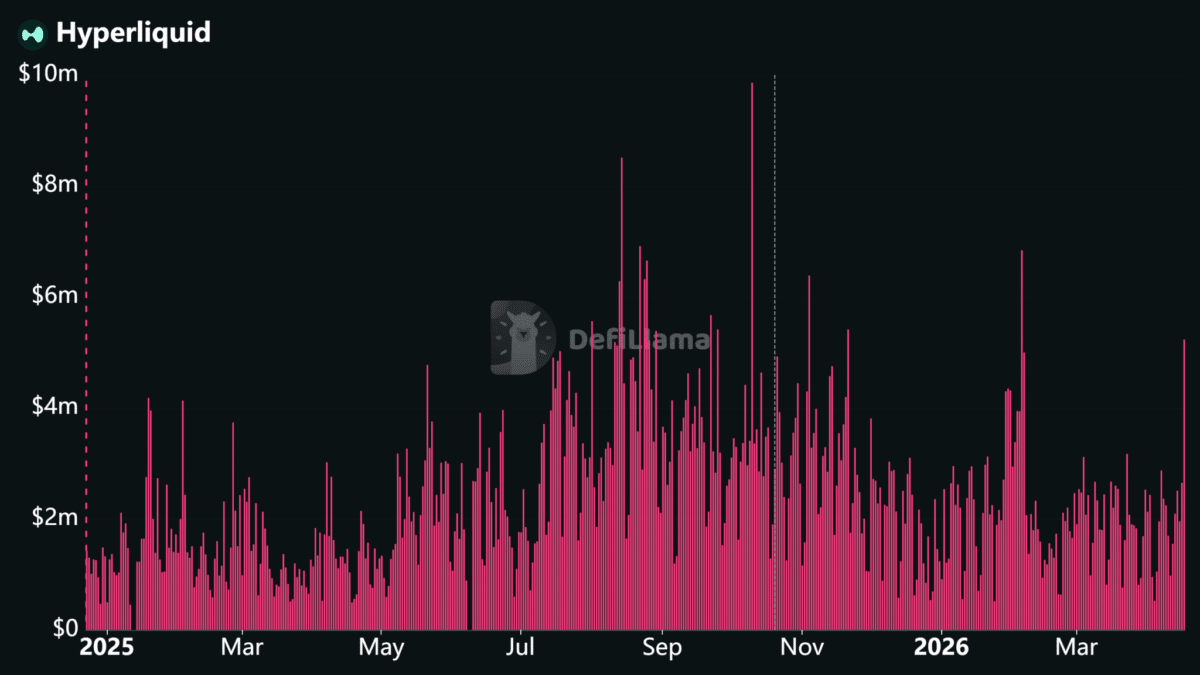
Hyperliquid, the self-funded decentralized perpetual futures exchange running on its own Layer 1 blockchain, posted $5.23 million in daily protocol revenue on April 17, 2026.
Data from DefiLlama confirms this is the platform’s strongest revenue day since early February, when it briefly peaked at $6.84 million during a sharp volatility event driven by geopolitical tensions around the Strait of Hormuz.
The $5 million daily mark had not been touched since then, with the platform’s daily revenue averaging in the $1.5 million to $3.5 million range through most of March and early April as the broader crypto market went through an extended correction.
The return above $5 million is not just symbolic. It coincides with a sharp recovery in market sentiment. Bitcoin has reclaimed $77,000, the CMC Crypto Fear and Greed Index has jumped to 61, entering the “Greed” zone for the first time since October 2025, and the global crypto market cap has climbed to $2.61 trillion on the back of easing geopolitical fears and rising spot Bitcoin ETF inflows, which have already crossed $1.6 billion in April alone.
That renewed risk appetite appears to be channeling directly into Hyperliquid’s perpetual contract markets, where the bulk of its fee income is generated.
The $5 million threshold also matters structurally for the HYPE token. Approximately 97% of all trading fees flow into the Assistance Fund, which automatically purchases HYPE from the open market, with $5.23 million in daily revenue, which translates to roughly $5.07 million in direct buy pressure on the token in a single day.
The last time this level was hit, on February 5, the fund bought back 160,750 HYPE in 24 hours, the highest single-day buyback of 2026. Since the program began in late 2024, over 40.5 million HYPE have been accumulated.
According to DWF Ventures, at a sustained $5 million daily revenue and a token price range of $35 to $55, the entire HYPE circulating supply could theoretically be repurchased in approximately 1.5 to 3.4 years.
How Hyperliquid makes its money
The protocol’s revenue model is built almost entirely on trading fees from perpetual futures, spot trading, and HLP vault transactions. In Q1 2026, Hyperliquid processed $619.46 billion in perpetual trading volume, leading every other decentralized perpetual exchange by a significant margin.
On an annualized basis, the platform is generating roughly $685 million in revenue as of April, with 30-day revenue at approximately $52.7 million across around 1.89 million users.
Dominant market position keeps growing
Hyperliquid now commands a 44% share of the decentralized perpetual futures market, with open interest at $5.15 billion, far ahead of rival Aster’s $899 million. Its share of global perpetual contract trading volume rose to nearly 6% in March, up from 3.5% a year ago.
That growth has persisted even as overall exchange volumes declined since August 2025, a clear sign that Hyperliquid is pulling real share from centralized exchanges rather than simply riding a rising tide.
The expansion into real-world asset trading through HIP-3 has been a major catalyst. TradFi assets now account for over 30% of the platform’s overall trading volumes. The S&P 500 perpetual market on Hyperliquid crossed $100 million in volume within its first day in March after S&P Dow Jones Indices licensed its flagship index to Hyperliquid-based Trade.xyz.
The third-party ecosystem has also matured rapidly, with Q1 2026 third-party revenue reaching an annualized run-rate of $104 million, representing 16.2% of total platform revenue.
HYPE token and institutional momentum
HYPE is trading around $44 at press time, with a market cap exceeding $10.6 billion. The token has gained over 14% in the past week, outperforming the broader market’s 2.5% rise. It has delivered over 480% returns since its November 2024 launch at $7.56, though it remains about 25% below its all-time high of $59.37.
Institutional momentum around HYPE is building fast. Grayscale filed an S-1 with the SEC on March 20 for a spot HYPE ETF (ticker: GHYP) on Nasdaq. Bitwise and 21Shares have also filed for their own spot products. Separately, Bitwise launched a Hyperliquid Staking ETP on Deutsche Börse Xetra on April 9.
BitMEX co-founder Arthur Hayes has projected a $150 price target for HYPE by August, tying his thesis to HIP-4, the upcoming upgrade that introduces binary options and prediction markets in Q2 2026.
The $5.23 million revenue day on April 17 raises the key question: was this a one-day spike fueled by the broader market bounce, or the start of a sustained return above the $5 million daily mark? If the current sentiment recovery holds and HIP-4 delivers on its promise to expand trading volumes further, Hyperliquid could be setting a new revenue baseline rather than revisiting a temporary peak.
Also Read: Miner Bitcoin Inflows to Binance Drop Sharply as Market Stabilizes