Key Highlights
- Short-term holders (holding <155 days) control 5.7 million Bitcoin (BTC), with ~92% underwater. Their realized price sits above current spot prices ($71,000), creating significant selling pressure and a potential “wall” that could cap any rally.
- Long-term holders (holding >155 days) dominate with 14-15 million BTC and a much lower realized price ($43,000–$44,000). Their stable conviction and tendency to buy dips near or below the overall realized price (~$54,000) could act as a strong on-chain floor if prices pull back further.
- Strategy’s high entry point, holding 762,099 BTC at an average cost of ~$75,694, has repeatedly acted as overhead resistance, with recent rallies stalling near it. Their ongoing accumulation adds to concentrated supply but also highlights fragility around current levels.
Bitcoin is hovering near $71,000 and showing resilience, but on-chain metrics are flashing warning signs that the rally could stall—or worse.
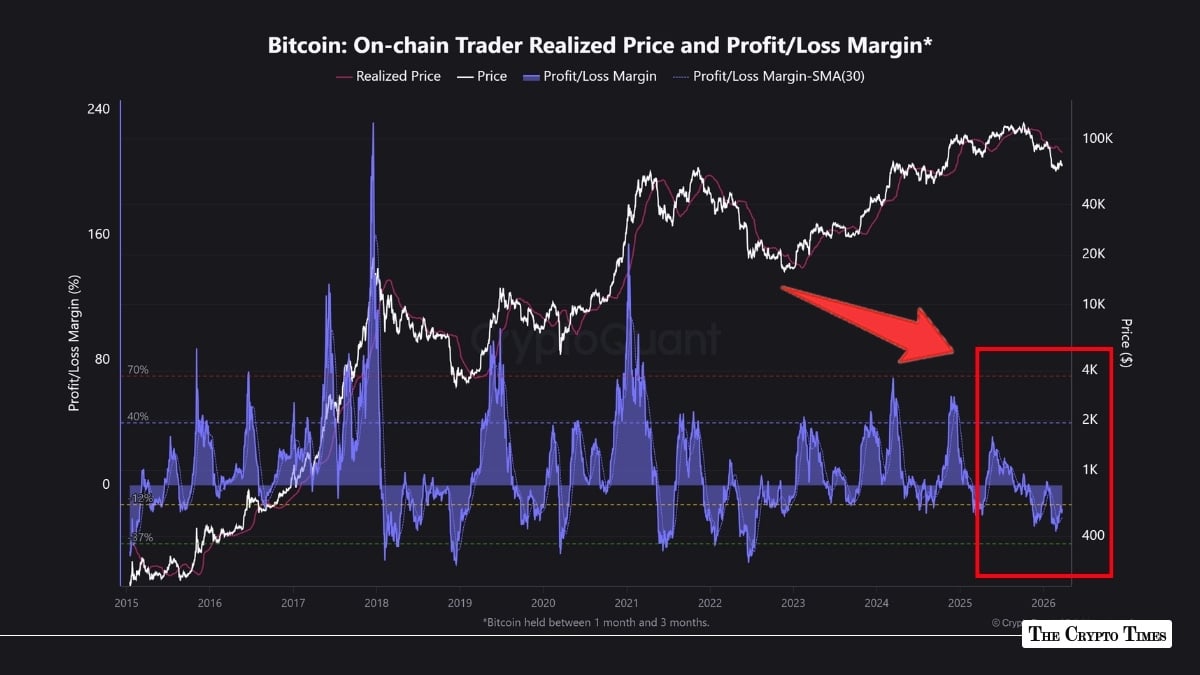
According to fresh data shared by analytics firm CryptoQuant, the cryptocurrency is bumping up against the realized price of short-term holders, a level currently sitting above spot prices.
These investors, who typically hold for less than 155 days, are carrying heavy bags: roughly 5.7 million BTC, with about 92% of that supply underwater. Only 8% are in profit. That creates a wall of potential selling pressure every time the price tries to push higher.
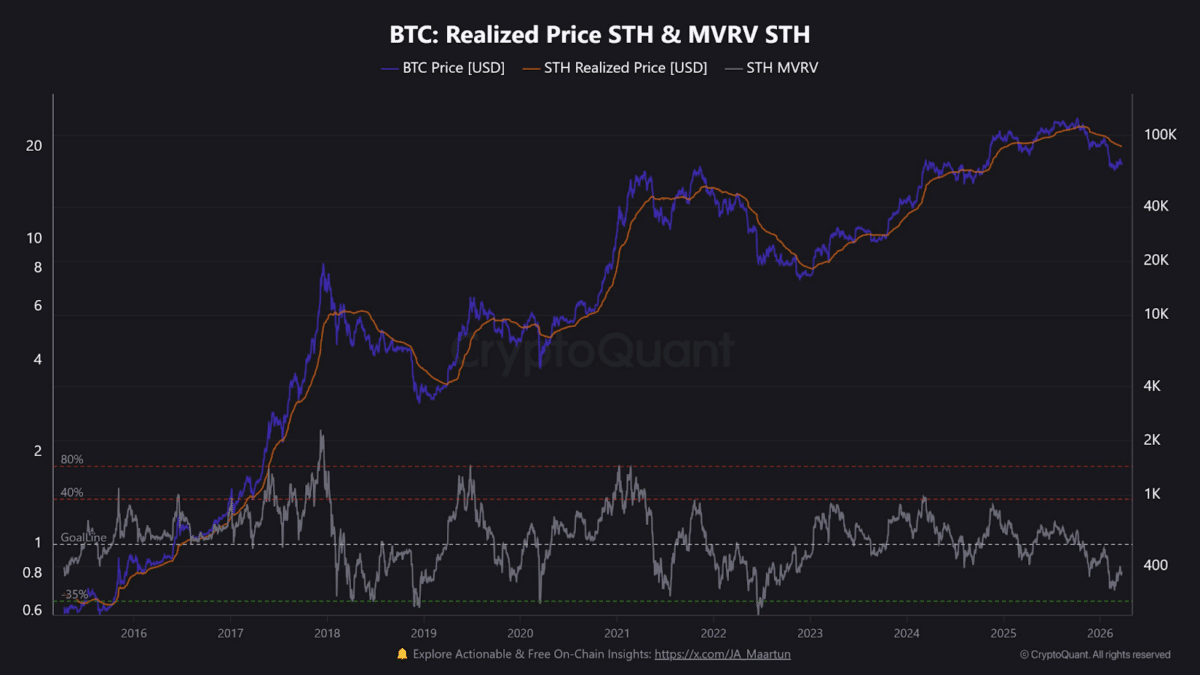
The pain is visible in the short-term holder MVRV ratio, which remains below 1, signaling widespread unrealized losses. Historically, when this cohort is deep in the red, it often leads to capitulation—forced selling that can accelerate downturns.
Bitcoin short-term vs. long-term supply dynamics
Charts show that short-term holders (STH) currently control a significant but volatile slice of Bitcoin’s supply—around 5.7 million BTC. Their realized price hovers well above spot levels (near $84,000 in recent readings), reflecting purchases made during the later stages of the 2025 rally.
With most of this group still underwater, any attempt to break higher faces immediate sell pressure as these “weak hands” look to exit at breakeven. The STH MVRV staying below 1 highlights acute stress in this cohort, a pattern that has preceded sharper corrections in past cycles.
In contrast, long-term holders (LTH)—those holding for 155 days or more—dominate the rest of the supply, with roughly 14-15 million BTC in their wallets at present. Their realized price sits much lower, around $43,000-$44,000, providing a deep psychological and on-chain support zone.
LTH supply tends to be far more stable; these investors have historically shown strong conviction, rarely selling even during drawdowns. When prices dip toward or below the overall realized price of ~$54,000, long-term buyers often step in, absorbing supply and helping form market floors.
For now, the structure looks shaky. Short-term holders desperate to break even could keep capping upside, while any deeper pullback risks testing lower realized levels where longer-term buyers might step in. The tug-of-war between these two cohorts will likely decide whether Bitcoin consolidates or faces a more meaningful correction.
Strategy’s growing Bitcoin pile adds another layer of resistance
Adding to the overhead resistance is Strategy (formerly MicroStrategy), the corporate Bitcoin heavyweight. The firm now holds 762,099 BTC, acquired at an average cost of roughly $75,694 per coin.
Recent rallies have repeatedly slammed into that level before reversing, turning Strategy’s cost basis into a de facto ceiling for now. The company continues its aggressive buying streak, adding another 1,031 BTC last week alone, but its paper losses underscore the fragility.
With a total investment exceeding $57 billion, Strategy’s holdings represent one of the largest concentrated corporate positions in the asset. Its continued accumulation—often funded through equity and debt offerings—has turned the company into a de facto Bitcoin proxy for many investors. Yet the high average entry point means any prolonged weakness around current levels risks amplifying market jitters.
Also read: Bhutan Shifts 519 BTC to New Wallets Amid Ongoing Sell Strategy