Key Highlights
- CoinGecko said PancakeSwap, Uniswap, and Hyperliquid ranked among the top 10 crypto exchanges by trading volume over the past six months.
- Binance remained the largest venue for both spot and perpetuals trading, with $3.54 trillion in spot volume and $13.61 trillion in perps volume from August 2025 to January 2026.
- DEX share of spot trading volume doubled to 13.6% in January 2026, while DEX share in perpetuals expanded fivefold to 10.2%.
According to CoinGecko’s CEX & DEX Trading Activity Report 2026, three decentralized platforms, Hyperliquid, PancakeSwap, and Uniswap, now rank among the top 10 crypto exchanges by trading volume. This marks one of the clearest signs yet that on-chain trading infrastructure is becoming a serious competitor to traditional centralized venues.
Centralized exchanges still control the bulk of crypto trading, but decentralized rivals are no longer operating at the margins. A recent report found that over the six-month period from August 2025 to January 2026, PancakeSwap and Uniswap entered the top 10 spot exchanges by cumulative volume, while Hyperliquid became the first perpetuals-focused DEX to make the top 10 in derivatives trading.
Binance still led the market by a wide margin. CoinGecko said Binance posted $3.54 trillion in cumulative spot volume and $13.61 trillion in perpetuals volume during the period, far ahead of second-place competitors in both categories.
In spot markets, the top 10 list remained largely dominated by centralized platforms such as MEXC, Bybit, Gate, HTX, Toobit, Crypto.com, and KuCoin. However, PancakeSwap and Uniswap each captured about 6.1% market share over the six-month window, with cumulative spot volume of $0.55 trillion and $0.54 trillion respectively, enough to place them alongside major centralized rivals.
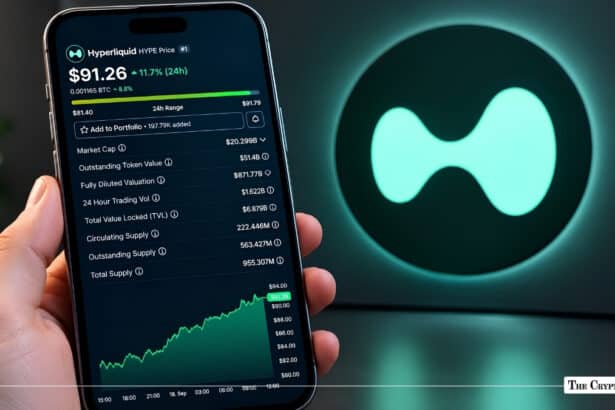
On the perpetuals side, Hyperliquid ranked 10th with $1.59 trillion in cumulative volume and a 3.3% market share, trailing centralized exchanges including OKX, MEXC, Bybit, Bitmart, Gate, Bitget, Toobit, and BingX. Even so, its inclusion is notable because it is the first perp DEX to break into that league.
DEX share keeps rising
CoinGecko’s broader data suggests this is not a one-off ranking shift but part of a longer structural trend. The DEX share of global spot trading volume rose from 6.9% in January 2024 to 13.6% in January 2026, while absolute DEX spot volume climbed from $95.86 billion to $231.29 billion. At its June 2025 peak, DEXs accounted for 24.5% of spot volume, helped by Binance Alpha 2.0 routing trades through PancakeSwap.

The derivatives market is showing a similar pattern. Total crypto perpetuals trading volume grew 75% from $4.14 trillion in January 2024 to $7.24 trillion in January 2026, while perp DEX volume jumped from $81.74 billion to $739.48 billion. That pushed DEX market share in perpetuals from 2.0% to 10.2% over the same period. CoinGecko linked that surge in part to Hyperliquid’s November 2024 airdrop and the emergence of rival platforms such as Lighter and Aster.
Hyperliquid’s RWA push is accelerating
The rise of Hyperliquid in derivatives trading is also being driven by growing activity in tokenized real-world assets (RWAs). Recent data shows the platform processing over $1.4 billion in RWA trading volume, as traders increasingly use the protocol to gain exposure to commodities and other traditional financial markets on-chain.
This trend has sparked discussion around whether the HYPE token could evolve into a proxy for broader financial market activity, similar to how stock indices track traditional markets. Hyperliquid’s derivatives infrastructure allows traders to speculate on assets beyond crypto while remaining entirely on-chain, blurring the lines between decentralized finance and traditional financial markets.
PancakeSwap pushes into AI-driven DeFi
PancakeSwap’s growing presence among the top exchanges also comes as the protocol expands beyond traditional trading features. The decentralized exchange recently introduced AI-powered “Skills” designed for autonomous DeFi agents, allowing software agents to analyze swaps, liquidity pools, and yield farming strategies before executing transactions.
The tools include modules such as Swap Planner, Liquidity Planner, and Farming Planner, enabling agents powered by large language models to scan markets, simulate strategies, and generate ready-to-execute trading routes across multiple chains.
Uniswap strengthens wallet-level liquidity access
Uniswap’s ranking in the top exchanges also reflects its role as one of the largest liquidity sources in DeFi. Recently, the popular self-custody wallet MetaMask integrated the Uniswap API directly into its swap infrastructure, allowing users to route trades straight to Uniswap pools without leaving the wallet interface.
The integration connects MetaMask to liquidity across Uniswap v2, v3, v4, and UniswapX, potentially improving pricing and execution for token swaps across more than a dozen supported networks.
CEXs still dominate, but the gap is narrowing
Despite the momentum, CoinGecko said CEXs remain the main liquidity hubs, with monthly spot trading volume still staying above $1 trillion during the period studied. The report’s conclusion is less about DEXs overtaking centralized exchanges today and more about how quickly the gap between off-chain and on-chain trading infrastructure is closing.
That shift suggests DEX growth is moving beyond meme-coin speculation and into core market structure. If decentralized exchanges can keep improving execution, liquidity depth, and user experience, their share of both spot and derivatives activity could continue rising from here.
Also Read: Hyperliquid Plans Upgrade to Boost Leverage for Experienced Traders