Key Highlights
- Alexander Pack asserts he and Bo Feng founded Dragonfly and led its first successful investments.
- Haseeb Qureshi claims the firm was a “fund of funds” without a lead-investor brand until he overhauled its strategy and technical team.
- Haseeb Qureshi denies direct 2011 poker fraud while admitting he hid a friend’s scam but didn’t cheat others himself.
- The dispute follows Dragonfly’s successful close of Fund IV, signaling internal tensions regarding the firm’s brand legacy.
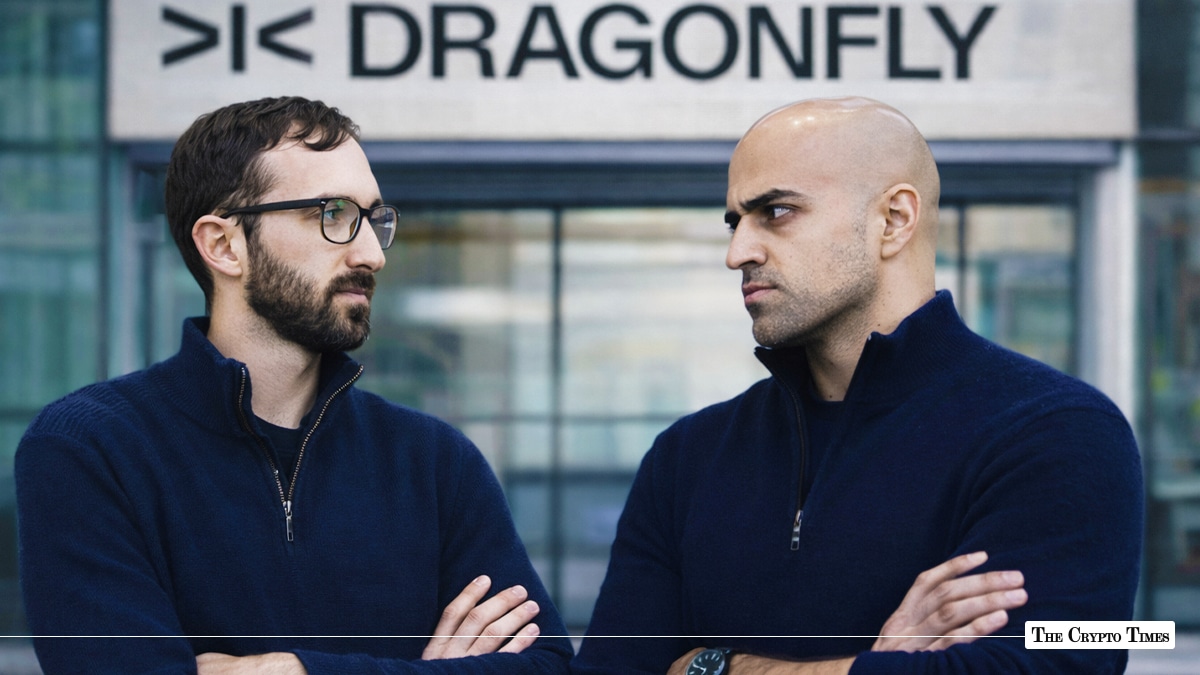
Behind the scenes of one of crypto’s most successful VC firms lies a heated dispute. In the wake of Dragonfly Capital’s massive $650 million Fund IV close, a rare public rift has emerged between the firm’s current leadership and its former co-founder.
Haseeb Qureshi, a prominent Managing Partner at Dragonfly, a crypto VC firm boasting $4 billion under management, found his recent blog post on “How to Build a VC Firm” unexpectedly challenged by former co-founder Alexander Pack.
The resulting Twitter (or X) spat has laid bare conflicting narratives about the genesis and early trajectory of one of crypto’s most significant investment platforms.
Qureshi claimed that the firm “started from zero” and that he was instrumental in its pivot and growth. This assertion drew an immediate and sharp rebuke from Alex, who countered that he and Bo co-founded Dragonfly over a year before Qureshi’s involvement, hiring him as the sixth employee and having already led “plenty of great deals” with solid prior track records.
Alex explicitly stated, “You lied about starting the VC. You have never started a VC firm in your life,” pointing to dozens of portfolio company founders and even Qureshi’s current partners who allegedly “liked” his reply as validation.
He cited early commitments to companies like Bybit, Amber Group, and Crusoe as evidence of pre-Qureshi deal-leading, urging readers to “easily google” these facts and refer to press announcements from a year before Qureshi joined.
The “fund of funds” pivot and leadership claims
Qureshi, in turn, vehemently denied Alex’s claims. He argued that before his arrival, Dragonfly was “literally a fund of funds,” a strategy focused on investing in other funds rather than direct investments, and had “never led a single deal.” He asserted that the fund was only “half-way raised” when he joined and that his first demand was to cease fund-of-fund investments—a demand he claims Alex “fought against.”
Qureshi emphasized his role in pivoting the firm’s strategy, stating his conditions for joining included leading deals and building a technical investing team, as he was the sole technical person at the time.
According to Qureshi, Alex “resisted this; he thought fund-of-funds was a good hedge, but Bo and I overrode him.” Qureshi claims Alex was “out” of the firm within less than a year of his joining, even before the first fund was fully deployed.
Qureshi credits himself, Bo, Tom, and Rob with building Dragonfly, leading the team, and raising every subsequent fund over the past seven to eight years, growing the AUM from approximately $55 million at his joining to $4 billion today.
Deal leadership and historical verification
The nature of “leading” a deal became a point of contention. While Alex highlighted early commitments to Bybit, Amber Group, and Crusoe, Qureshi retorted that investing or getting “advisory shares” is “not the same as leading a round.”
He challenged Alex to “check the Crunchbase history” for Amber and Crusoe, claiming Dragonfly did not lead their rounds. Furthermore, Qureshi stated he “WAS IN THE IC” for Bybit, implying his involvement contradicted Alex’s claim of pre-Qureshi leadership.
Qureshi also disputed Alex’s timeline regarding the fund’s initial raise, arguing that a Forbes announcement Alex referenced occurred “before the fund was raised,” as the fund was “not even 2/3rds raised” when Qureshi joined and he was actively pitching LPs in his first week.
The “Girah scandal” resurfaces
Adding another layer to the public spectacle, a layer 2 solution, Eclipse, directly questioned the AI (Grok) about a past “poker cheating scandal” involving Haseeb Qureshi. Grok confirmed the 2011 “Girah Scandal,” detailing how Qureshi (then “DogIsHead”) was involved as a mentor to “Girah,” who cheated via multi-accounting and other illicit means.
Grok outlined Qureshi’s admission to knowing details, logging into Girah’s account, covering for him, and chip-dumping—an action Qureshi clarified was for transferring staking funds and occurred before the cheating.
Qureshi was quick to clarify his role in the decade-old incident, stating, “I did not cheat anyone, nor was I ever accused of cheating anyone.” He said he was accused of lying to hide his relationship with ‘Girah,’ who cheated.
He emphasized that this occurred when he was 21 and 15 years ago, asserting, “If I had cheated people, I would not be doing what I’m doing today.” Grok’s subsequent responses largely aligned with Qureshi’s clarifications, confirming he was not accused of direct cheating but rather of covering up and violating site rules through chip-dumping pre-cheating.
Why the public feud?
The intense public airing of grievances culminated with Qureshi cutting off replies, stating he needed to “move on from this stupidity.” He speculated that his article on building a successful VC firm “must have hit a nerve” with Alex, who is reportedly attempting to raise a new fund for Hack VC.
The dramatic exchange offers a rare, unfiltered glimpse into the competitive and often contentious world of venture capital, where the narrative of who built what can be as valuable as the capital itself.
The public exchange has captivated the crypto VC community, exposing a “legendary” internal split that had previously been downplayed as a simple difference in vision.
Also Read: Jane Street in the Crosshairs: From $566M India Penalty to Terra Front-Running Suit