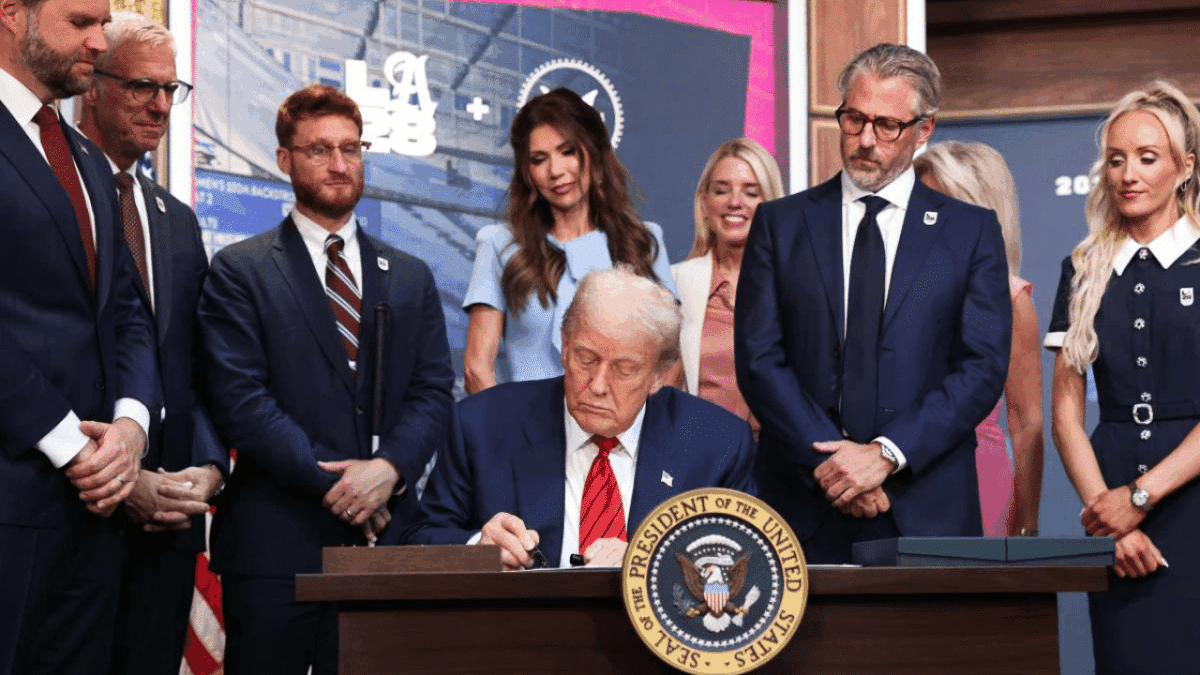
In a move that marks a significant shift in federal banking oversight, the U.S. President Donald Trump on Thursday signed an executive order aimed at preventing financial institutions from denying services to individuals or companies based on political, regulatory, or reputational beliefs, a practice widely referred to as “debanking.”
The order comes amid rising tensions between the crypto industry and federal regulators over alleged discriminatory banking practices.
The executive order directly addresses what the White House described as a pattern of unfair treatment toward the digital assets industry. “The digital assets industry has also been the target of unfair debanking initiatives,” a fact sheet from the White House stated. “These practices erode public trust in banking institutions and regulators, harm livelihoods, freeze payrolls, and impose significant financial burdens on law-abiding Americans.”
Central to the new order is the removal of “reputational risk” as a legitimate reason for enhanced regulatory scrutiny. The Federal Reserve has previously defined reputational risk as the “potential that negative publicity regarding an institution’s business practices, whether true or not, will cause a decline in the customer base, costly litigation, or revenue reductions.” While not specific to crypto, critics argue the term has been selectively used to justify restrictions on the sector.
The order directs federal regulators, including the Federal Reserve, Office of the Comptroller of the Currency (OCC), and Federal Deposit Insurance Corporation (FDIC), to stop using reputational risk as a component of supervision within 180 days.
It also requires them to review banks under their purview for past or present discriminatory practices and refer relevant cases to the Justice Department for possible civil action.
“Most banks already have policies and procedures governing when they’ll decline to open an account or close accounts for existing customers, typically emphasizing things like money-laundering risk or solvency concerns. Today’s order puts increased pressure on those policies,” said David Sewell, a partner at law firm Freshfields.
The executive order is seen as a response to complaints from crypto firms and conservative groups who claim their accounts were unfairly shut down. Trump had previously promised to end what’s been dubbed “Operation Choke Point 2.0” — a term popularized by Castle Island Ventures co-founder Nic Carter in 2023, drawing parallels to a 2013 Department of Justice initiative that targeted high-risk industries such as payday lending and firearms sales.
Republican lawmakers welcomed the executive order, with House Financial Services Committee Chair French Hill stating that targeting individuals based on their political beliefs undermines the foundational freedoms of the United States and has no place in the financial system. He praised President Trump for taking decisive action to protect Americans from politically motivated financial discrimination.
Sen. Cynthia Lummis, R-Wyo., also praised the move. “Thanks to @POTUS’s leadership, now millions of Americans can secure their financial futures by including digital assets in their 401(k)s,” she said on X.
Banks, for their part, argue they don’t reject customers based on beliefs, but that inconsistent and subjective regulatory guidance has led to confusion. “It’s in banks’ best interest to take deposits, lend to and support as many customers as possible. Unfortunately, regulatory overreach, supervisory discretion and a maze of obscure rules have stood in the way,” said a joint statement from the Bank Policy Institute, American Bankers Association, Consumer Bankers Association, and Financial Services Forum.
The executive order is part of a broader push by conservatives to rein in federal regulators, especially after Trump claimed in a CNBC interview that JPMorgan Chase and Bank of America refused to take his deposits following his first term, a claim not substantiated with evidence. JPMorgan said it does not close accounts for political reasons, while Bank of America declined to comment on specific clients.
With Thursday’s action, federal agencies are now under a six-month deadline to re-evaluate policies, a move that could reshape banking access for the crypto sector and beyond.
Also Read: Trump’s WLFI Launches USD1 Points Program for Stablecoin Users