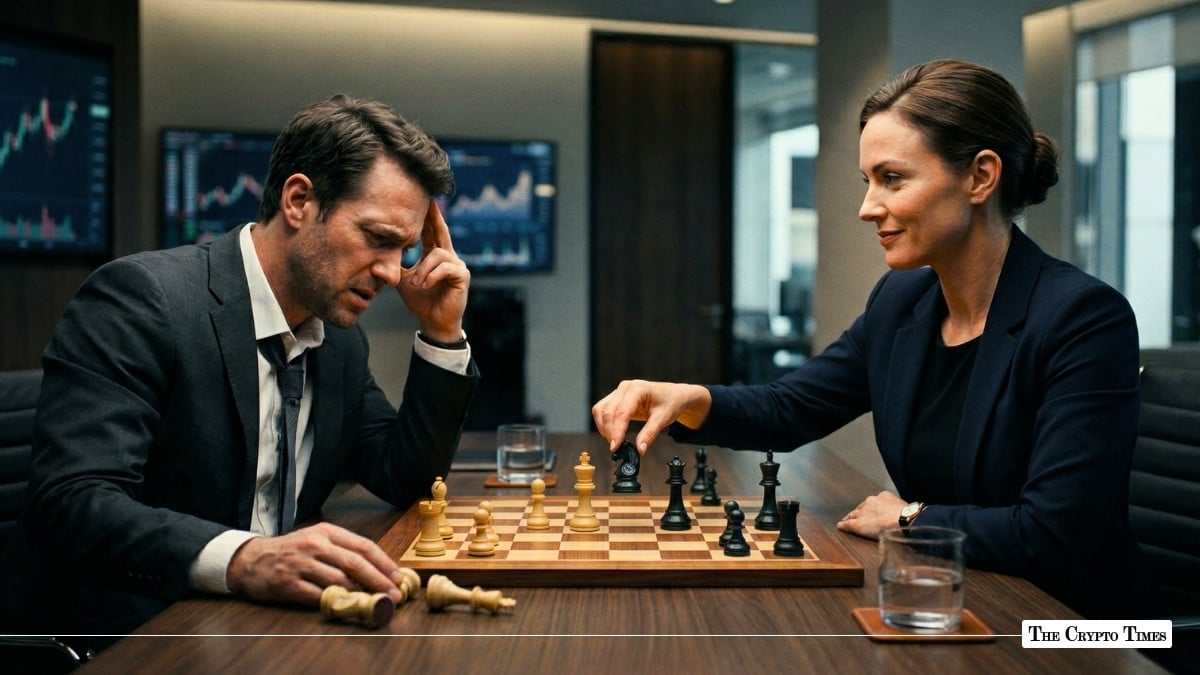
Walk into any crypto conference, scroll through X for five minutes, or join a Discord alpha group, and you will see it: the “Crypto Bro.” He is defined by high-frequency trading, laser-eye profile pictures, and a vocabulary consisting almost entirely of “To the moon,” “LFG,” and “NGMI.” A conviction, shouted at high volume, that the next 10x is one leveraged long away.
But while the “bros” are busy dominating the conversation, the data suggests they are losing the actual war.
There is a quiet, statistically documented counter-narrative emerging from the noise: women are consistently outperforming men in the market. This isn’t a matter of “wokeness” or gender politics; it is a matter of cold, hard ROI. From the traditional halls of Fidelity to the volatile exchanges of the crypto world, the numbers tell a story that the “alpha” crowd isn’t ready to hear. Success in crypto isn’t about technical wizardry, “gut feelings,” or having the loudest voice in the Telegram group. It is about the absence of ego.
The thesis is simple: Men treat trading like a competitive sport; women treat it like a disciplined business. In a market as unforgiving as Bitcoin, the “Ego Tax” is the most expensive fee you will ever pay.
Old Lessons for New Assets
To understand why women are winning in the 2020s, we have to look back at the 1990s. Long before Satoshi Nakamoto penned the Bitcoin whitepaper, the futures and options pits of Chicago—the CME and the CBOT—were the ultimate testing grounds for human psychology.
Veteran floor traders from that era often share a specific “insider secret.” In those pits, which were 99% male and violently aggressive, the few women who survived didn’t just endure—they thrived. Why? Because the loudest, most aggressive men in the pit were almost always the first to go bust. They were the ones who would “fight” the tape, doubling down on a losing position because their ego wouldn’t allow them to admit the market was right and they were wrong. The pit veterans knew that the market doesn’t reward conviction, charisma, or volume. It rewards risk management. Boring, unsexy, repetitive risk management.
Vikram Rangala, the Executive Director of ZebPay, who worked in Chicago as a market analyst in Futures and Options, recently shared with The Crypto Times, “A secret that many know but don’t talk about: women are better traders. They consistently outperform men.” This isn’t a new revelation; it’s a fundamental truth of market mechanics that has moved from grain futures to digital gold.
The asset class has changed. Bitcoin wasn’t on anyone’s radar when grain futures were king. But human psychology—the biology of fear, greed, and the dopamine hit of a winning trade—hasn’t changed at all. The market still rewards whoever can manage their own nervous system better than the person on the other side of the trade.
This is the open secret among seasoned pros: women often possess a kind of natural hedge against the most common trading mistakes. Not because of anything essential about being a woman, but because the cultural pressures that push men toward performative risk-taking simply don’t apply to them in the same way. They’re not trading to impress anyone. They’re trading to make money. It turns out those are two very different things.
Also Read: Crypto Fear & Greed Index: How it works and is used in Crypto Trading?
Calculating the “Ego Tax”
In trading, every mistake has a price tag. The most famous academic work on this subject isn’t from a crypto think tank—it’s a UC Berkeley paper called “Boys Will Be Boys,” published by Brad Barber and Terrance Odean. The findings have been replicated so many times that the core conclusion is basically settled science.
1. The Over-Trading Trap
The study found that men trade roughly 45% more frequently than women. In the crypto world, where 24/7 markets make it incredibly easy to “click the button,” this gap likely widens. Every one of those extra clicks is a fee, a spread, a tax event, and—most importantly—an opportunity to be wrong. By trading 45% more, men aren’t increasing their chances of winning; they are increasing their “noise” exposure. The result? Men’s net annual returns are reduced by 2.65 percentage points per year, compared to 1.72 percentage points for women. Same market, same opportunities, different outcomes.
Drill deeper and it gets starker. Single men traded 67% more than single women—presumably because there’s no partner in the room quietly asking what exactly the plan is—and that hyperactivity cost them an extra 2.3 percentage points in annual returns versus their female counterparts. No spouse. No brake. No returns.
Behavioral economists have a clean name for what’s driving this: overconfidence bias. It’s the well-documented tendency to believe you have more control over outcomes than you actually do—a cognitive trap that leads directly to ignoring stop-losses, piling on leverage, and treating every dip as a personal affront that must be answered with a bigger position. Crypto didn’t invent this bias. It just built the perfect casino for it.
2. The “Revenge Trade”
The “Ego Tax” is highest when a trader is losing. When a man hits a stop-loss, his biological impulse is often “revenge.” He feels a psychological need to “beat” the market, to prove he is smarter than the algorithm that just took his money. This leads to compounding errors—taking higher leverage on the next trade to “get back to even.”
It’s a trait that shows up vastly more often in male traders, and it’s one of the fastest ways to turn a small mistake into a portfolio-ending one. The setup doesn’t care about your feelings. The chart doesn’t know you’re angry. But the person clicking buy after a stop-out does, and they pay for it.
3. Risk-Intelligent vs. Risk-Averse
The flip side is the “risk-averse” stereotype, which deserves to be retired. Critics often label women as “risk-averse,” implying they make more money simply because they take fewer chances. Women aren’t risk-averse. They’re risk-intelligent. They wait for high-conviction setups instead of chasing every green candle, and they use protective tools consistently.
According to a report from Reuters, 43% of women consistently set stop-loss orders, compared to just 35% of men — a roughly ten-point gap in the single most basic act of capital preservation available to any trader.
Using a stop-loss isn’t an act of fear; it is an act of professional survival. It is the realization that protecting your capital is more important than “being right.” Women treat their portfolio like a fortress to be guarded, while men often treat it like a pile of chips at a casino.
The meme-stock era gave us an even cleaner data point. Industry reporting suggested that during the 2021 GameStop and AMC frenzy—the defining “FOMO trade” of the retail era—86% of the orders came from men. Women simply didn’t chase the hype in anything like the same numbers. Call it caution or call it professionalism; either way, the people who skipped the top of that particular wave generally kept their capital intact.
Data from Nationwide shows that during major market volatility, only 8% of women liquidated their portfolios, compared to 15% of men. While the “bros” were panic-selling at the bottom, women were holding. Their “HODL” conviction tends to be stronger because it is tied to long-term life goals—buying a home, funding an education, or achieving retirement—rather than short-term social status or the dopamine hit of a “winning trade.”
Resilience During Black Swans
The real separation happens when the market stops being orderly.
In the 2008 financial crisis and again in the 2020 COVID crash, studies from Nationwide found that men were nearly twice as likely to sell at the bottom. That’s the single most expensive mistake a long-term investor can make — converting a paper loss into a permanent one, right before the recovery. The “alpha male” strategy, so confident in a bull market, tended to crumble into pure emotional decision-making the moment the charts went red.
Women, across the same events, were more likely to stay the course, stick to a diversified plan, and let time do the work. That’s the mechanical reason annual returns consistently edge out by 0.4% to 1.8% in favor of women. And in a compounding game, a gap that small over twenty years turns into a genuinely different retirement.
The market doesn’t know your gender. The market is a pure meritocracy; it only reacts to orders. Discipline, patience, and emotional regulation are universal human skills, but the data suggest that women are currently better at implementing them.
The Counter-Argument
Someone will object that this is cherry-picking, that trading isn’t about gender, that the whole framing is unfair. Fair enough, and there’s a real counter-argument worth stating plainly.
- On overconfidence: The bias isn’t exclusive to men. Any trader, of any gender, who masters their ego will likely perform about as well as any other. The gap in the data isn’t about chromosomes; it’s about how cultural pressure interacts with a specific set of cognitive traps. An exceptional male trader who keeps his overconfidence in check will do roughly as well as an exceptional female trader with the same discipline. The gap is a behavioral average, not a ceiling.
- On survival bias: It’s also worth noting that trading has been male-dominated for decades, which means the women who entered, persisted, and stayed in the field are a pre-filtered group—often possessing elite levels of discipline and resilience. That selection effect probably flatters the female average somewhat, compared to the much broader and more varied pool of male participants. It doesn’t erase the gap. It just explains part of it.
The Numbers Don’t Lie
With those caveats on the table, the underlying evidence is still remarkably consistent:
- Fidelity Investments (2021): A 10-year analysis of 5.2 million customer accounts from 2011 to 2020 found women outperformed men by 40 basis points, or 0.4%, annually. The reasons cited: women trade less, ride out market lows, avoid extra fees, and invest more consistently rather than trying to time the market
- Warwick Business School: A study of 2,800 investors found women outperformed the FTSE 100 by 1.94%, while men outperformed it by just 0.14% — a gap of roughly 1.8 percentage points, compounded over three years.
- Hargreaves Lansdown: An analysis of the brokerage’s own client base showed women’s investments returned 0.81% more than men’s over a three-year window. The same analysis found women traded shares 49% less frequently than men.
Three studies. Three methodologies. Three different datasets. One direction.
The “bros” might not like the reality that their aggressive, high-frequency, “alpha” strategy is actually a performance-killer. But the market is the ultimate truth-teller. It doesn’t care about your “laser eyes” or your aggressive tweets. It only cares about who has the most capital left at the end of the year.
Statistical Cheat Sheet
| Metric | Women | Men | Source |
|---|---|---|---|
| Annual outperformance | +0.4% | Baseline | Fidelity Investments |
| Outperformance vs. FTSE 100 | +1.94% | +0.14% | Warwick Business School |
| Trading frequency | Baseline | +45% | UC Berkeley (Barber & Odean) |
| Single-person trading frequency | Baseline | +67% | Barber & Odean |
| Stop-loss usage | 43% | 35% | Capital.com |
| Panic selling in volatility | 8% | 15% | Nationwide |
| Meme-stock orders (2021 GME/AMC) | 14% | 86% | Industry data |
| Return reduction from over-trading | 1.72% | 2.65% | Barber & Odean |
| Selling at the bottom (2008, 2020) | Baseline | ~2x more likely | Nationwide |
The Future is Disciplined
None of this is a victory lap, and it’s not an argument that men are bad traders. It’s an argument that the traditional masculine way of trading—the high-frequency, high-conviction, high-volume, high-ego approach that crypto culture has aggressively marketed for the better part of a decade—is mathematically inefficient. It was inefficient in equities. It was inefficient in Futures. And it’s inefficient in Bitcoin.
The crypto industry has a choice. It can keep selling the dream of the degen alpha chad, or it can grow up and start rewarding what actually works: patience, stop-losses, long time horizons, and the emotional intelligence to not fire off a revenge trade at 2 a.m.
In a market as volatile as Bitcoin, the ultimate flex isn’t a flashy trade, a 100x leverage position, or a “to the moon” prediction. The ultimate flex is a superior ROI. And right now, whether the “bros” like it or not, that ROI has a female face. The truth is the truth: the best way to trade like a pro is to start trading like a woman.
The question is, are the men in the room disciplined enough to listen?
Also Read: Bitcoin Tops Choice as 62% of Indian Women Eye Crypto Investments: CoinSwitch