Hear that sound? It’s not Bitcoin smashing another all-time high—it’s the cracking of the old financial system’s spine. Why?
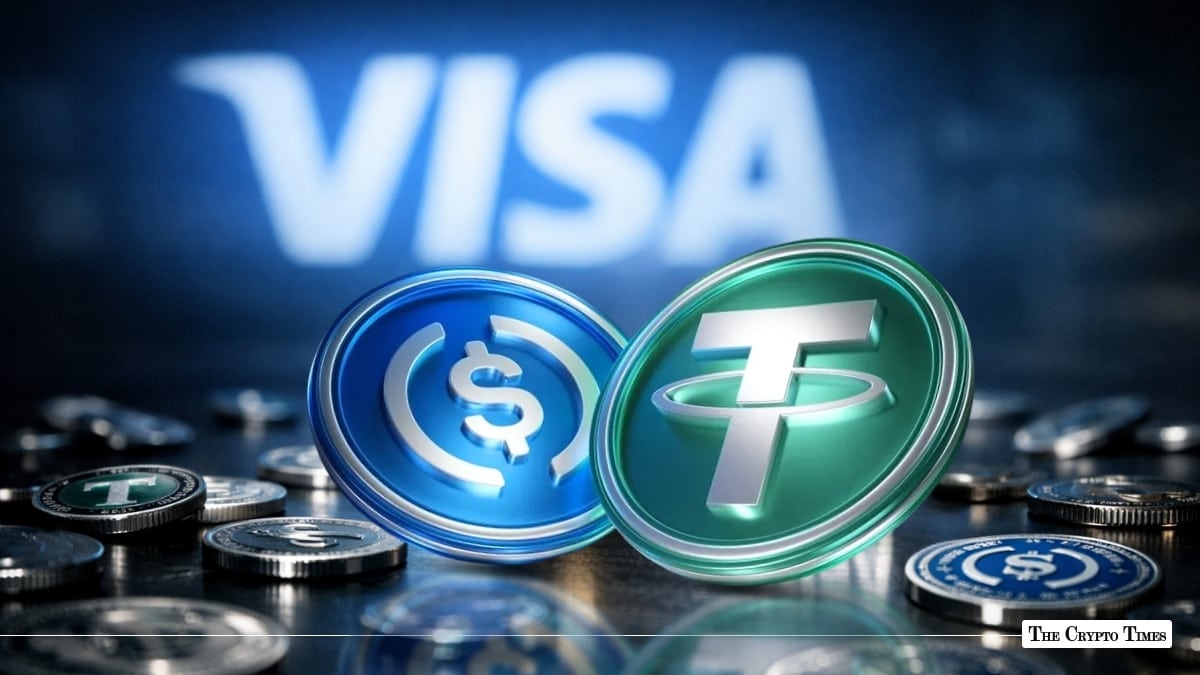
In 2025, stablecoins processed roughly $33 trillion in payments. For comparison, the global payments giant Visa processed about $15 trillion over the same period.
Yes, you read that right! Digital dollars running on blockchain rails moved more than double the volume of one of the world’s most recognizable financial networks.
Now, before the skeptics jump in: this doesn’t mean everybody suddenly started buying coffee with crypto last year. A large share of that volume comes from trading infrastructure, liquidity flows, and automated settlements between protocols. But even after filtering out the noise, stablecoins are rapidly becoming a financial utility layer—used by traders, businesses, payroll systems, and entire fintech stacks.
The Volume Reality Check
The gap between $15 trillion in traditional card payments and $33 trillion in stablecoins signals a steady shift toward a new settlement currency. This is one of those moments when the math in the code speaks louder than the branded plastic in your wallet.
Let’s be intellectually honest: blockchain is a playground for bots. Raw volume captures everything—arbitrage loops where $1,000 spins in circles 100 times per minute, flash loans, and wash trading. This is the ‘’noise.’’
But analytics from Artemis and Bloomberg still show stablecoins firmly ahead:
- USDC alone processed $18.3 trillion. Why does this matter? It reflects institutional capital, where manipulation is far less prevalent than in offshore alternatives.
- Organic Activity: Even applying the strictest “cleaning” filters from a16z leaves roughly $9 trillion in pure, real-world volume.
What does this mean in practice? If $9 trillion of organic volume is already competing with a payments giant built over 60 years, the question of “does this work?” is effectively settled. Even after adjustments, stablecoin infrastructure is capable of handling volumes that rival, if not surpass, any traditional payment networks.

How Stablecoins Move the Real Economy
Consider SWIFT—the interbank network connecting banks worldwide. It works, but high fees and multi-day settlement times are far from ideal.
Now compare that with stablecoins. The difference puts the $33 trillion figure into perspective.
In countries with unstable economies, companies are increasingly using stablecoins as a hedge against inflation. In 2025, hundreds of businesses across Latin America and Southeast Asia conducted daily payments in USDC or other dollar-pegged stablecoins. And the reason is simple: local currencies can lose 10–15% of their value annually, while dollar-backed stablecoins help preserve real purchasing power.
Stablecoins have also revolutionized remittances. Not long ago, sending money internationally meant high fees and long delays. In 2025, stablecoin-based platforms enabled near-instant transfers with fees under 1%, sometimes even zero. Millions of people gained access to faster, transparent, and reliable transfers, creating tangible economic impact.
The Macroeconomic Shift
Now imagine that same speed, transparency, and control applied to entire businesses, corporate treasuries, and global supply chains. That’s the real shift:
- B2B Dominance: Business-to-business (B2B) volumes are now overtaking retail. Suppliers, distributors, platforms – they’re all paying and receiving money in stablecoins. What once took days of reconciliation now happens automatically.
- Legacy Giants Adapting: Meanwhile, traditional players aren’t standing still. Visa and Mastercard are integrating stablecoin rails into their systems. It’s classic if you can’t beat ‘em, join ‘em—and in 2025, that shift is already underway.
- Corporate Treasuries: Finance teams are finally reclaiming control. Programmable payouts in stablecoins mean capital moves exactly when it should, tied to real activity rather than arbitrary schedules. Treasury departments now operate in near real-time, with visibility and predictability that was science fiction five years ago.

2026 Outlook: What’s Next?
The headline comparison—$33 trillion in stablecoins versus $15 trillion for Visa—points to a clear direction of travel. Money flows where friction is lowest.
With developments like the GENIUS Act and ongoing discussions around the CLARITY Act, one thing is becoming clear: this isn’t resistance—it’s adaptation. The message is simple—the dollar either goes digital or risks losing relevance.
This is Dollar 2.0.
For Fortune 500 giants, the hesitation is finally fading. With reserves increasingly backed 1:1 by law, corporate treasurers no longer fear lawyers; they fear staying stuck in a system where money takes three days to move.
That’s why, in this context, $33 trillion may soon look conservative. Stablecoins are becoming the native tongue of global capital. And it’s ironic but true: in 2026, the mathematics of a smart contract commands more trust than a banker’s signature.