In the crypto ecosystem, privacy and speed are very important needs for the smooth functioning of the system.
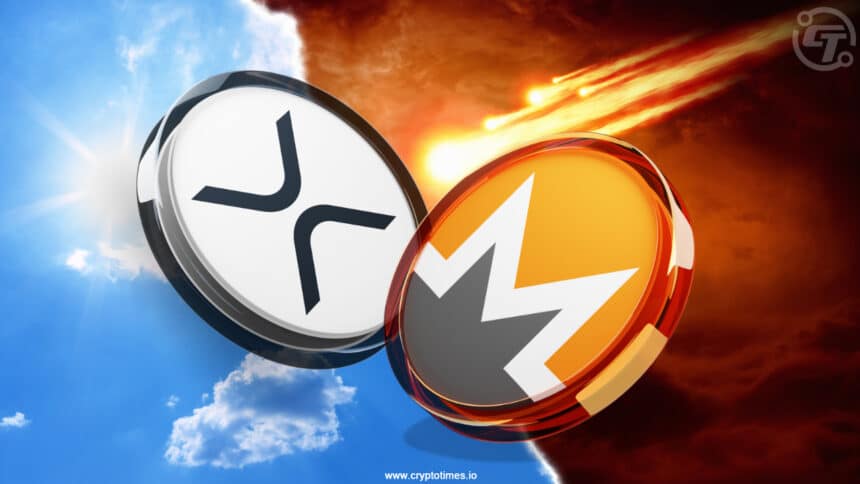
Monero (XMR) and Ripple’s XRP are the two coins that cater to this need, where one is developed to provide privacy while the other was designed to offer speed.
Though XMR and XRP are often compared to each other, they both remain crucial to the crypto ecosystem. In this article, we will look into the key differences between Monero and XRP. We will also discuss the use case and regulatory outlook of these altcoins.
Monero (XMR) Overview
Monero is a decentralized blockchain that was started in 2014 to allow people to have privacy in transactions. It is not a typical blockchain like Bitcoin, Ethereum, Solana, etc. that make network transactions public.
Monero employs technologies of advanced cryptography such as Ring Signatures, Stealth addresses, Ring Confidential Transactions (RingCT), etc. By leveraging such technology, Monero keeps the identities of the sending and receiving parties anonymous and thus the transactions are confidential by default.
For further context, XMR is the native token of Monero. It’s mined by using the RandomX Proof-of-Work (PoW) algorithm, which is designed for general-purpose CPUs to promote decentralization by giving access to anyone who wants to participate in the mining process.
Besides, Monero is a community-centric and community-driven project that has contributions from developers worldwide. It is an open-source blockchain that boosts continuous improvement and innovation in technology to offer strong privacy solutions for users.
Brief Look at Ripple’s XRP
XRP is the native token of XRP Ledger, which is an open-source decentralized blockchain launched in 2012. It is a pre-mined coin with a total supply of 100 billion tokens. XRP gained popularity due to its fast and low-cost transactions that usually settle in 3 to 5 seconds.
Also it’s important to note that the XRPL uses the Ripple Protocol Consensus Algorithm (RPCA), which provides access to independent validators to confirm transactions without the need for mining. Furthermore, XRP tokens are used as an intermediate currency for cross-border payments that expedite quick and affordable cash remittance services between different fiat currencies.
Primarily, financial institutions and payment providers use XRP to deliver international money transfer services effortlessly. The token’s integration with several financial institutions makes it a crucial part of the world’s payment infrastructure.
Key Differences Between Monero and XRP
| Feature | Monero (XMR) | XRP |
|---|---|---|
| Primary Focus | The main focus behind the development of Monero blockchain was to provide privacy and anonymity to users. | The pivotal goal behind developing XRP was to offer its users with fast and cheap cross-border transactions |
| Consensus Mechanism | It uses RandomX, a Proof-of-Work consensus mechanism. | It employs the unique Ripple Protocol Consensus mechanism. |
| Transaction Speed | It takes around 2 minutes to complete transactions | It provides very fast transaction speeds, completing transactions within 3–5 seconds. |
| Privacy Level | Monero is known for its high level of privacy, where the transactions are obfuscated by using advanced cryptographic technology. | XRP believes in a transparent ledger system. Hence, its privacy level is low as compared to XMR. |
| Token Supply Limit | It has no fixed limit on its token supply. | XRP tokens are pre-mined with a total supply limit of 100 billion tokens |
| User Base | It is mainly used by individuals and institutions whose main goal is privacy. | It is primarily used by banks and financial institutions that want fast transactions across borders. |
| Token Ranking by Market Cap | As of writing, XMR traded at $389.50 with a market cap of $7.17 billion and ranked 23rd on CoinMarketCap. | At press time, XRP was priced at $2.34 with a market cap of $137.62 billion with the 4th rank on CoinMarketCap. |
Comparing Use Cases of XMR and XRP
Monero is best for individuals who want to have full control over their financial privacy. It is mostly used in cases where censorship, surveillance, or tracking might be harmful. Mostly, it is used by individuals, journalists, NGOs, and organizations which have to deal with sensitive financial information.
XRP is developed for sending payments rapidly and conducting B2B transactions. It is adopted by institutions such as Santander and American Express, which highlights its real-world applications in the context of streamlining the global financial system.
Monero vs. XRP: Regulatory Outlook
Monero (XMR) continues to face regulatory problems because of high privacy. For example, Binance and Kraken exchanges have banned XMR in certain areas because of compliance issues. However, despite these challenges, the XMR has seen a growth of 182% in a year, which is fueled by the interest of users in privacy-related crypto assets.
XRP’s regulatory status has improved since the SEC decided to withdraw its legal action against Ripple, and it has caused a surge in the token’s value. Further, analysts are predicting that XRP is set to reach $5.50 by the end of 2025 due to its growing demand among financial institutions. At the same time, it is also part of the USA’s Strategic Crypto Reserve, which further legitimizes the asset.
Bottom Line
Monero and XRP serve different but very important roles in the crypto ecosystem. While Monero mainly focuses on user privacy, XRP is developed to provide users with speed and institutional use in cross-border transactions. Both are providing specific needs with unique technologies.
Nonetheless, regulatory clarity and user preference will play an important role in the future performance of these coins. As of now, the Ripple vs. SEC case isn’t over as Judge Analisa Torres recently rejected a motion for injunctive ruling. Also, XMR faces regulatory concerns as the U.S. lawmakers continue to question its legitimacy while the EU imposed a ban on privacy transactions and cryptocurrencies.
Also Read: Ethereum vs. Solana: Which Blockchain Wins DeFi Race?
Disclaimer:
Some elements of this content may have been enhanced with the help of our artificial intelligence (AI) assistants for purposes such as basic refinement, review, image generation, and translation to deliver high-quality news in a shorter time frame. However, all AI-assisted content is reviewed and approved by our team to ensure accuracy, fairness, and editorial integrity.