The Indian crypto market is highly organized today, with 49 exchanges now registered with the government (FIU). While this adds an important layer of security, buying crypto now requires navigating a few new verification steps.
Using UPI remains one of the fastest payment methods on Indian platforms. This guide walks you through the exact process of buying crypto on Mudrex via UPI. We cover how to handle direct deposits, complete the necessary “Penny Drop” verification to prove bank ownership, and ensure your funds reach your wallet smoothly without facing common issues like bank freezes.
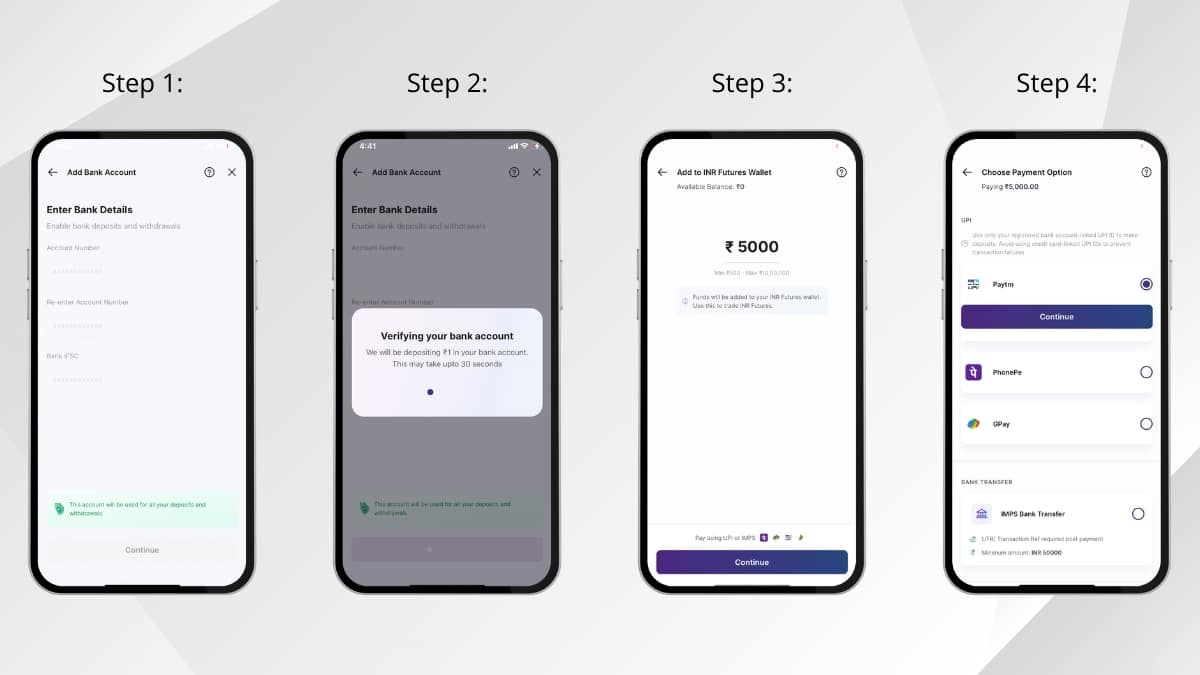
Phase 1: Verify Your Bank Account
Before depositing, you must complete the “Penny Drop” verification to link your bank account.
- Navigate to Settings: Open your Profile and select Bank Accounts.
- Enter Bank Details: Input your Account Number and IFSC code.
- Wait for Verification: The app will deposit ₹1 into your account to verify ownership.
- Confirm Status: Ensure a green Verified badge appears next to your bank details.
Phase 2: Deposit INR via Direct Deposit
This method functions like a standard merchant payment.
- Select Deposit: Click on Deposit INR from the home screen.
- Enter Amount: Type the exact INR amount you wish to add (e.g., ₹1000).
- Select UPI App: Tap the icon for your installed app (Google Pay, PhonePe, or Paytm).
- Verify Merchant Name: Confirm the “Paying to” name is a corporate entity (e.g., Mudrex Labs) once your UPI app opens.
- Authorize Payment: Enter your UPI PIN to complete the transfer.
Phase 3: Confirm the Transaction (UTR Submission)
If your balance does not update instantly after payment, follow these steps to sync the funds manually.
- Copy UTR Number: Open your UPI app transaction history and copy the 12-digit UTR/Reference Number.
- Submit Reference: Return to the Mudrex app, click Yes when prompted “Did you pay?”, and paste the 12-digit number.
- Wait for Refresh: Stay on the screen until your updated INR balance is visible.
Phase 4: Buy Cryptocurrency
Once your INR balance is credited, follow these steps to purchase your chosen asset.
- Open Markets: Tap on the Buy, Trade, or Coins section.
- Select Asset: Search for the cryptocurrency you want (e.g., Bitcoin, Ethereum, or USDT) and tap it.
- Enter INR Amount: Type the amount of INR you want to spend. The app will automatically calculate the crypto fraction you will receive.
- Choose Order Type: Select Market Order for an instant purchase at the current price.
- Review Details: Check the final price, fees, and the crypto amount shown on the summary screen.
- Confirm Purchase: Tap or swipe Buy to execute the order.
- Verify Portfolio: Go to your Wallet to confirm the crypto is credited to your balance.
How to Find Your UTR (12-Digit Reference Number)
This is the most common reason deposits fail. Here is where to find it in major apps:
| App | Where to look | Label |
|---|---|---|
| Google Pay | Tap transaction → Scroll down | “UPI Transaction ID” |
| PhonePe | “History” → Select Transaction | “UTR” (next to a copy icon) |
| Paytm | “Balance & History” → Select Txn | “UPI Ref No” (starts with 4, 5, or 6) |
| BHIM | Transaction Success Screen | “Txn ID” |
Essential 2026 Crypto Rules
- Rule 1: The 1% TDS (Tracking Tax) Every time you sell or trade crypto, the exchange takes 1% TDS from the total value. This is not an extra fee; it is a “tracking tax” that tells the government about the trade. You can claim this back or adjust it when you file your taxes.
- Rule 2: The 30% Profit Tax If you make a profit (e.g., you buy for ₹1,000 and sell for ₹1,200), you must pay 30% tax on that ₹200 gain.
- Rule 3: No “Loss” Adjustments In India, you cannot use a loss from one coin (like Bitcoin) to reduce the tax you owe on a profit from another coin (like Ethereum). You pay tax on every single winning trade.
- Rule 4: Mandatory Reporting (New for 2026) You must report every single crypto transaction “line-by-line” in your Schedule VDA when filing your Income Tax Return (ITR). Failing to report can now lead to a daily penalty of ₹200.
Safety Tips to Protect Your Money
- Avoid “Bank Freezes”: Only send money from a bank account that is in your own name. Never use a friend’s account or a business account to deposit into your personal crypto wallet.
- Use FIU-Registered Apps: Stick to platforms like Mudrex that are registered with the government. They handle your TDS automatically, which saves you from legal headaches later.
- Enable 2FA (Two-Factor Authentication): Do not rely on just a password. Use an app like Google Authenticator. This ensures that even if someone knows your password, they cannot steal your funds without the code on your phone.
- Verify the “Corporate” Name: When paying via UPI, always check that the receiver is a registered company (like Mudrex Labs). If the UPI name looks like a personal name (e.g., “Rahul123”), stop the payment immediately.
- Don’t Share Your “Seed Phrase”: If you use a private wallet, never type your 12-word seed phrase on any website or share it with “customer support.” No real company will ever ask for it.
Quick Start Checklist: Buy Crypto on Mudrex (2026)




Conclusion
In 2026, buying crypto in India has become a streamlined and secure process thanks to the integration of UPI and strict government oversight. By using FIU-registered platforms like Mudrex, you ensure that your trades are legal, your taxes (TDS) are handled automatically, and your bank account remains safe from fraud. Following the specific “Penny Drop” and UTR submission steps is the key to a smooth experience. Stay informed about the latest tax rules and always prioritize security to grow your digital wealth with confidence.
Frequently Asked Questions (FAQs)
Is it legal to buy crypto using UPI in India in 2026?
Yes, it is completely legal. However, you must use an exchange that is registered with the Financial Intelligence Unit (FIU) and follow the mandatory KYC (Know Your Customer) and “Penny Drop” verification rules.
Why do I need to enter a 12-digit UTR number?
The UTR (Unique Transaction Reference) acts as a digital receipt. If the banking system faces a delay, pasting this number into the Mudrex app allows the system to manually verify your payment and credit the funds to your wallet instantly.
What happens if the “Paying to” name is not a corporate entity?
Stop the transaction immediately. On registered platforms like Mudrex, your payment should always go to a verified business account (e.g., “Mudrex Labs”). Sending money to a personal name can lead to bank freezes or scams.
Can I use my friend’s bank account to deposit funds?
No. Your bank account name must exactly match the name on your Mudrex Profile/KYC. Using a third-party account will result in a failed transaction and may trigger a permanent block on your account.
How much tax do I pay on my crypto?
There are two main taxes: a 1% TDS is deducted automatically when you sell or trade, and a flat 30% tax is applied to your total profits at the end of the financial year.
Is there a limit on how much I can deposit via UPI?
Most banks have a standard daily UPI limit of ₹1 Lakh. For larger investments, you may need to use IMPS or break your deposit into smaller amounts over several days.
Also Read: A Step-by-Step Guide to Binance KYC Process for India Users
Disclaimer:
Some elements of this content may have been enhanced with the help of our artificial intelligence (AI) assistants for purposes such as basic refinement, review, image generation, and translation to deliver high-quality news in a shorter time frame. However, all AI-assisted content is reviewed and approved by our team to ensure accuracy, fairness, and editorial integrity.
Disclaimer:
The Crypto Times publishes news, analysis, and educational content for informational purposes only. We do not offer financial, investment, legal, or trading advice of any kind. All content on our website is intended to be neutral and fact-based. Readers should always do their own research, consult with licensed professionals, and evaluate risks independently.
The Crypto Times does not endorse or recommend any specific cryptocurrencies, tokens, projects, financial products, or investment strategies. We do not accept legal liability for any financial losses incurred as a result of reliance on information published by us.