In a move that’s already igniting fierce debate across the cryptocurrency world, longtime Bitcoin developer Paul Sztorc announced plans for a new Bitcoin hard fork called eCash, slated for launch in August 2026.
The project, detailed in an April 24 X post, would create a near-identical copy of Bitcoin’s core software while introducing significant upgrades aimed at scalability and functionality.
Holders of Bitcoin at the fork’s snapshot would receive an equal amount of eCash tokens on a 1:1 basis—meaning someone with 4.19 BTC would get the same in the new chain. The fork would use SHA-256 mining, start with a drastically lowered difficulty for easier early participation, and include tools to handle transaction replays.
At its heart is Sztorc’s long-pursued Drivechain technology (BIPs 300 and 301), which would activate several merged-mined Layer 2 networks focused on prediction markets, decentralized exchanges, NFTs, identity systems, and privacy features.
Sztorc, known for his work on LayerTwo Labs and frustration with Bitcoin’s conservative development pace, frames eCash as a “clean reboot” to overcome what he sees as governance gridlock and limited scalability on the main chain.
Unlike the 2017 Bitcoin Cash split, which centered on bigger blocks, this effort emphasizes competing L2s and avoids reusing the Bitcoin name. He has even said the fork could be halted if Bitcoin Core finally activates BIP 300/301.
Satoshi Nakamoto’s BTC haul in play
The most explosive element, however, is the plan to reassign up to half of the roughly 1.96 million BTC—worth approximately $86 billion and considered lost or untouched—attributed to Satoshi Nakamoto’s “Patoshi-pattern” wallets.
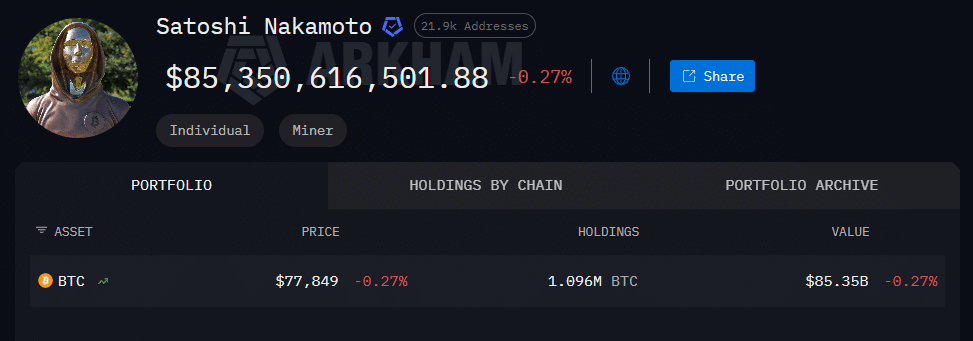
These would go to accredited investors to fund pre-launch development, a step Sztorc acknowledges as controversial but “necessary” to avoid an under-resourced project.
Critics have quickly labeled it theft, a dangerous precedent that undermines Bitcoin’s core principle of immutable ownership and “code is law.”
Its supporters see potential for real innovation and usability. Meanwhile detractors—including prominent Bitcoin voices—dismiss it as another doomed fork likely to spark miner wars and community fracture.
Name clash and community backlash
Adding to the tension is the name overlap with an existing smaller project: eCash (XEC), a 2021 rebrand of Bitcoin Cash ABC. That project’s community, led by Amaury Séchet, has voiced frustration over the confusion, noting their token already serves Lightning-based use cases like Cashu and Fedi. Sztorc has secured ecash.com and argues the term is generic, but the collision has fueled accusations of poor planning.
Sentiment on X appears overwhelmingly negative so far, with roughly 80-85% of top replies critical according to early scans. Many dismiss the project as yet another doomed fork destined for miner wars, low liquidity, and eventual irrelevance.
Need for another Bitcoin hard fork
Bitcoin has seen multiple hard forks since 2017—Bitcoin Cash, Bitcoin SV, and others—none of which have seriously challenged the original chain’s dominance. Skeptics argue this raises a fundamental question: Does Bitcoin truly need another fork?
While Drivechains could bring programmability and scalability that some believe the main chain lacks, Bitcoin maximalists counter that the network’s strength lies in its deliberate conservatism and battle-tested simplicity. They view eCash as solving problems that don’t require fracturing the community further.
Based on the current chatter, it seems potential scuffles loom large. A low initial difficulty could spark chaotic early mining and hash rate battles. Replay protection tools exist, but users risk confusion or lost funds during the split.
Moreover, regulatory scrutiny over the Satoshi coin reallocation could complicate matters, especially for accredited investors. And if adoption falters, the project risks becoming another footnote in Bitcoin’s long history of ambitious but failed challengers.
With code freeze planned 30 days before launch, the coming months will test whether this challenge to Bitcoin’s status quo gains traction—or fades into the long list of failed alternatives.
Also read: California Man Gets 70 Months for $263M “Cartoonish” Crypto RICO Fraud



![trade[XYZ] Launches Event Contracts on Hyperliquid Using HIP-4](https://www.cryptotimes.io/wp-content/uploads/2026/09/TradeXYZ-Launches-Events-on-Hyperliquid-for-Prediction-Markets--420x280.jpg)