Key Highlights
- PayPal added PYUSD access in 68 new countries, reaching a total of 70 (previously only US and UK). Users in emerging markets across South America, Africa, and Asia can now hold, send, receive, and earn up to 4% rewards on PYUSD balances.
- The rollout targets high-fee remittances and transfers in underserved regions. May Zabaneh highlighted opening access “where the pain is felt so high,” allowing users to keep dollar-equivalent value without forced local-currency conversions.
- PYUSD circulating supply and market cap exceed $4.1 billion (up more than 5× in the past year). Backed 1:1 by dollar reserves and Treasuries via Paxos, PYUSD gains traction through multi-chain support and real-world integrations like payouts.
PayPal has significantly broadened access to its PYUSD stablecoin, adding 68 new countries and bringing the total to 70 worldwide. The move extends the dollar-pegged token beyond its initial US and UK footprint into emerging markets across South America, Africa, and Asia.
Users in these newly supported regions can now hold, send, receive, and earn rewards on PYUSD balances directly in their PayPal wallets. The company continues to offer up to 4% rewards on holdings, a feature that was previously more restricted geographically—as noted in the official report on Fortune.
May Zabaneh, PayPal’s head of blockchain, crypto, and digital currencies, described the expansion as a targeted fix for longstanding issues in international payments. “We’re really opening up not only access—especially in places where they need it most—but also cross-border transfers and volume, where the pain is felt so high,” she said.
In many of these markets, traditional remittances carry steep fees and force conversions into volatile local currencies. PYUSD lets users preserve dollar-equivalent value while moving money faster and cheaper.
PYUSD’s rapid growth
PYUSD, fully backed by U.S. dollar deposits, short-term Treasuries, and similar cash equivalents through issuer Paxos, has seen explosive adoption. As of March 17, 2026, its circulating supply stands around 4.093 billion tokens—as per DeFiLlama data—translating to a market capitalization of roughly $4.1 billion, reflecting minor daily fluctuations around the $1 peg.
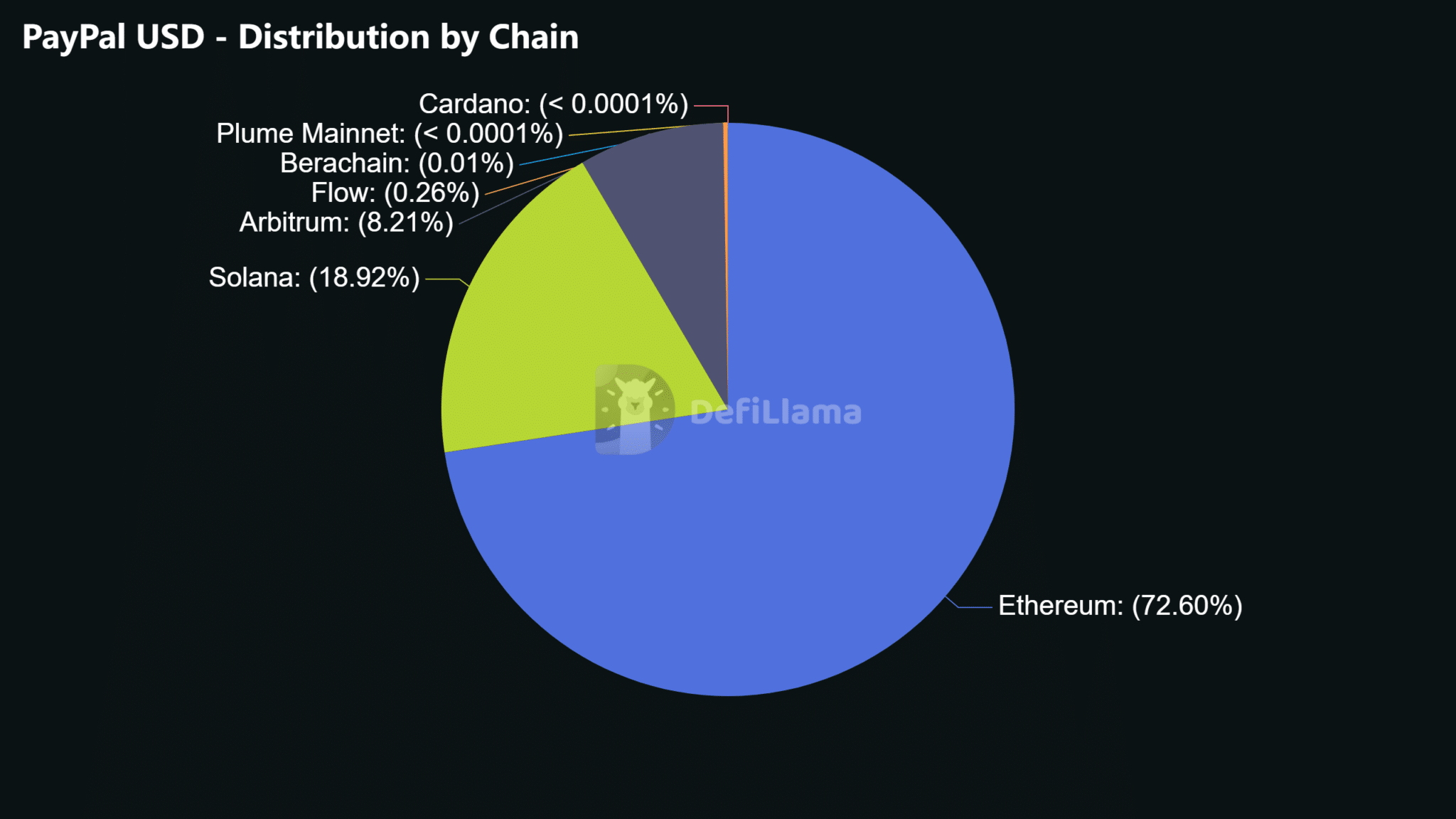
The supply has more than quintupled over the past year, driven by integrations on chains like Solana, Arbitrum, Stellar, and others via LayerZero for lower fees and quicker settlement. Its large chunk of supply currently sits on Ethereum, amounting to $2.972 billion, representing roughly 72.60% market share of its total supply.
As per CoinMarketCap data, PYUSD ranks sixth among top stablecoins by market cap, though it significantly trails behind giants like USDT and USDC.
Broader implications for users
The rollout introduces wallet-level earnings and a “balance-type concept” in supported accounts globally for the first time. In underbanked or high-inflation areas like Colombia, Uganda, Peru, or similar spots, this could offer a practical alternative to local savings accounts with dismal yields or currency risk.
PayPal’s vast network, spanning about 200 countries overall, gives PYUSD an edge in trust and usability. The stablecoin integrates seamlessly with Venmo and PayPal apps, making it less intimidating than pure blockchain options.
Critics point out PYUSD remains fully custodial and ecosystem-tied, lacking the decentralization of some competitors. Still, the expansion underscores PayPal’s strategy to position stablecoins as everyday tools rather than speculative assets.
Also read: Citigroup Slashes Bitcoin Forecast by $58K as Crypto Legislation Stalls