Key Highlights
- Centralized exchange Bitcoin reserves have fallen to around 2.7 million BTC as of March 2026, the lowest since 2019, driven by outflows to private wallets, ETFs, and corporate treasuries like Strategy.
- BTC price has recovered from February lows near $60K, now consolidating in the $67K–$71K range around $69K–$70K, with potential short squeezes above $72K if resistance breaks.
- Shrinking liquid supply on exchanges reduces immediate selling pressure and supports a structural bull case, though OTC deals, miner breakevens (~$64K–$65K), and macro risks could trigger sideways action or retests lower.
Bitcoin has clawed its way back toward $70,000 after dipping into the low $60,000s late last month, but the rebound feels tentative as price action continues to face rejection from within the $69,000 to $71,000 range.
While the fresh capital is expected to be ready entering the market, traders are watching current levels closely. A clean move higher could trigger short squeezes stacked just above $72,000, potentially adding fuel to the rally.
For now, though, the chart reflects consolidation in a $67,000–$71,000 band, shaped by fading geopolitical noise around energy markets and steady but not explosive institutional demand.

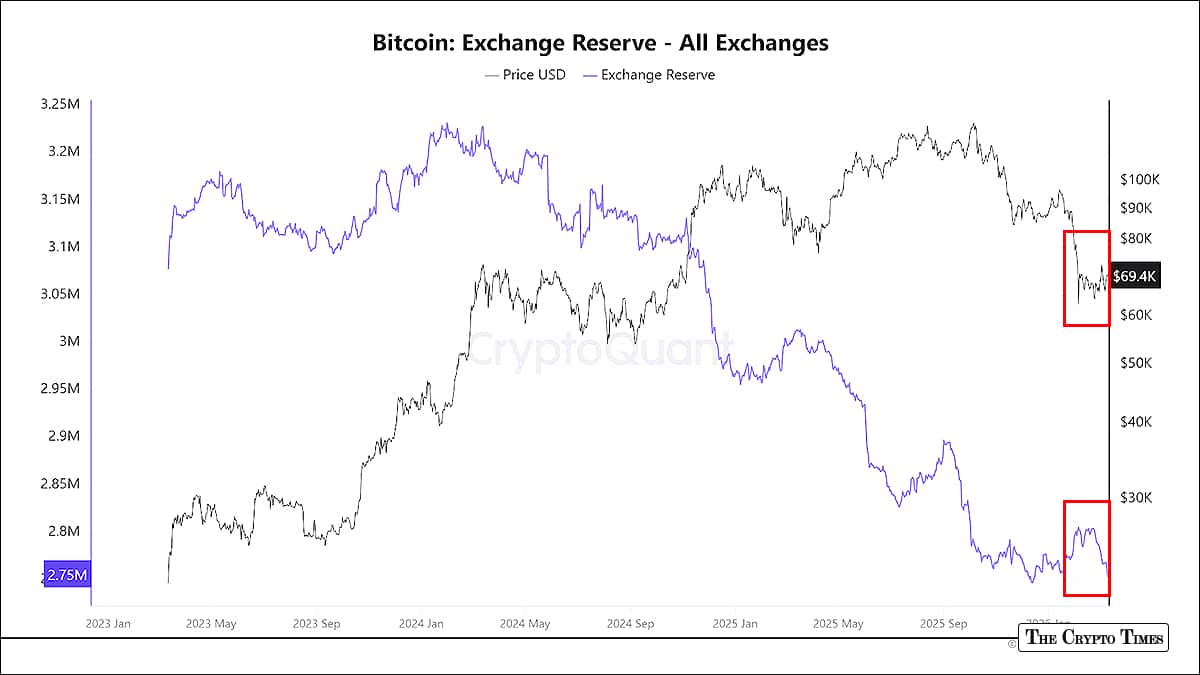
One on-chain signal stands out in this environment: exchange reserves have sunk to historic lows. Data compiled from CryptoQuant peg centralized exchange holdings between roughly 2.75 million BTC as of March 12, down sharply from over 3.2 million in 2024. That’s a contraction of nearly a million coins in under three years, even as more than 20 million BTC have already been mined out of the 21 million cap.

This drop in exchange balance comes as holders keep pulling coins off exchanges into private wallets for long-term custody setups. In addition, spot Bitcoin ETFs alone have absorbed hundreds of thousands since late 2023, while corporate treasuries like Strategy continue stacking.
In March alone, publicly listed companies took in nearly 350,000 BTC over the same stretch, and outflows spiked dramatically, with single-day withdrawals hitting 32,000 BTC on one occasion. Net flows turned consistently negative in recent weeks, a pattern that historically leans bullish because it shrinks the readily available float on trading venues.
When supply on platforms tightens like this, even moderate buying, whether from ETF inflows (which saw $568 million net last week) or whale accumulation, can push prices harder because there’s simply less coin sitting ready to meet bids.
However, lower exchange balances does not necessarily mean less immediate selling pressure because onchain and over-the-counter (OTC) deals still dominate markets.
The trend aligns with broader holder behavior: long-term addresses (those holding 155+ days) control around 14.5 million BTC, close to cycle peaks in some metrics, signaling conviction rather than distribution.
The movement further
Bitcoin entered March after a rough February flush to around $60,000, which reset leverage and flushed weak hands. The recovery has coincided with easing macro volatility, oil and Middle East tensions cooled enough to reduce risk-off flows, and consistent ETF buying that reversed earlier outflow streaks. Volume has stayed healthy (often north of $50 billion daily), not screaming euphoria but showing methodical participation rather than retail FOMO.
Still, risks linger. Miner breakeven sits near $64,000–$65,000 on electricity alone (full costs higher), so sustained dips below that could pressure hash rate or force sales. While macro events could swing sentiment fast, exchange reserves at record lows support the structural bull case.
This does not guarantee short-term direction as price can grind sideways or test lower supports, at $67,700 or even $63,700–$65,000 zones flagged by on-chain clusters, before any real leg up.
The takeaway from the exchange reserve picture is straightforward: the liquid supply available for trading keeps shrinking. In past cycles, similar contractions preceded stronger directional moves once catalysts aligned. Bitcoin isn’t screaming higher yet, but the fundamentals underneath the $70,000 handle look increasingly supply-constrained.
Whether that translates to $75,000+ or another retest lower depends on who blinks first, buyers stepping in aggressively or sellers finding new reasons to hit bids. For now, the tape says accumulation over distribution.
Also read: The 127,271 Bitcoin Hit: A $15B Bounty Caught in Cross-Border Fraud