Key Highlights
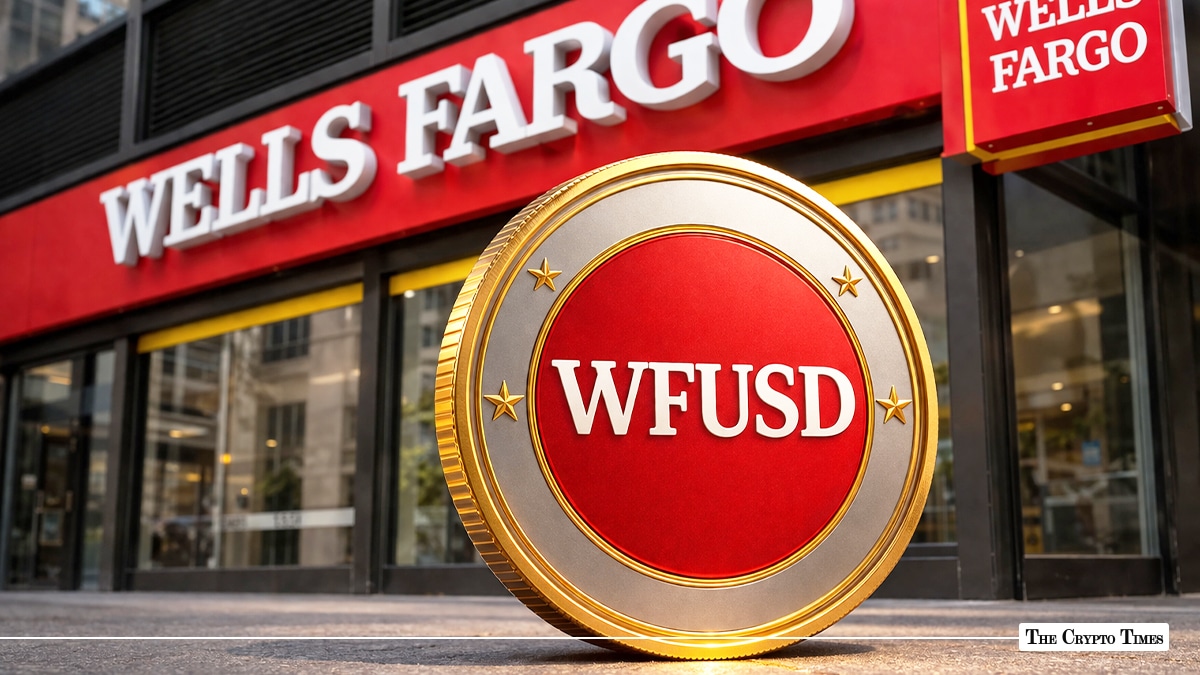
- Wells Fargo submitted a trademark application for “WFUSD” to the USPTO.
- The trademark covers a wide array of services, including cryptocurrency exchange, digital payment processing, blockchain verification, and digital wallet services.
- This move follows the GENIUS Act of July 2025, which provided the federal regulatory framework necessary for national banks to issue stablecoins and provide custody.
Wells Fargo & Company, a financial powerhouse with over $1.9 trillion in assets, has filed a trademark application for “WFUSD” with the United States Patent and Trademark Office. The filing covers a suite of cryptocurrency and digital asset services that include exchange operations, payment processing, digital wallet infrastructure, and blockchain-based transaction settlement.
The filing, which falls under International Classes 009, 036, and 042, represents the clearest signal yet that the bank intends to move beyond internal blockchain experiments and into the public stablecoin market.
The “USD” suffix in the trademark follows the naming convention established by the industry’s dominant players—Circle’s USDC and Tether’s USDT—and strongly suggests that Wells Fargo is developing a dollar-pegged digital asset.
If launched, WFUSD would place a bank with over $1.9 trillion in assets in direct competition with crypto-native stablecoin issuers, while also running alongside institutional blockchain products like JPMorgan’s JPM Coin.
From Internal Settlement to Public Infrastructure
Wells Fargo is not a newcomer to tokenized dollars. In 2019, the bank announced Wells Fargo Digital Cash, a proprietary tool built on R3’s Corda Enterprise blockchain for internal cross-border settlement between Wells Fargo branches. That system was closed-loop by design—it moved money within the bank’s own network and was never intended for customer-facing use.
The WFUSD filing represents a fundamentally different ambition. By trademarking a branded stablecoin and filing under service categories that include cryptocurrency exchange, digital asset transfer, and financial transaction settlement via distributed ledger technology, the bank is signaling that it no longer intends to keep its blockchain infrastructure behind the curtain. It wants a branded position in a global stablecoin market that now exceeds $310 billion in total circulation.
The GENIUS Act Changed the Math
The timing of the filing is inseparable from the regulatory landscape. The GENIUS Act, signed into law in July 2025, established the first comprehensive federal framework for payment stablecoins in the United States.
It permits subsidiaries of insured depository institutions to issue stablecoins with relatively minimal additional requirements—a provision that gives banks like Wells Fargo, JPMorgan, and Bank of America a structural advantage over non-bank issuers in terms of compliance infrastructure, regulatory relationships, and access to Federal Reserve accounts.
Before the GENIUS Act, the legal status of bank-issued stablecoins remained ambiguous enough to deter major institutions from filing public trademarks. That ambiguity has now been replaced by a clear licensing pathway. The Office of the Comptroller of the Currency’s guidance on crypto custody further cleared the runway, establishing that national banks can offer digital asset custody services as part of their core banking functions.
The Consortium Question
The WFUSD filing also raises questions about Wells Fargo’s relationship with a broader banking consortium. In May 2025, JPMorgan Chase, Bank of America, Citigroup, and Wells Fargo were in early-stage discussions to develop a joint stablecoin using infrastructure from Early Warning Services (the firm behind Zelle) and The Clearing House.
The WFUSD trademark suggests that while Wells Fargo may participate in shared settlement infrastructure, it intends to maintain a distinct branded identity in the digital asset space. The parallel is instructive: banks share the Zelle network today but retain their own customer interfaces and product branding. WFUSD could follow the same model—a proprietary consumer-facing product running on jointly developed rails.
What It Means for Crypto
For the crypto industry, the filing carries two implications that pull in opposite directions.
On one hand, a Wells Fargo stablecoin would represent the most significant institutional validation the stablecoin market has received. A regulated, FDIC-adjacent dollar token issued by one of the four largest U.S. banks would offer a level of counterparty trust that no crypto-native issuer can match. It could accelerate enterprise adoption of stablecoins for real-time B2B payments, cross-border settlement, and potentially even retail transactions integrated directly into existing Wells Fargo checking accounts.
On the other hand, bank-issued stablecoins represent an existential competitive threat to the firms that built this market. Tether, which lacks full audit transparency and faces compliance questions under the GENIUS Act’s requirements, is particularly exposed.
Circle’s USDC is better positioned but would still face pricing pressure from banks that can earn yield on reserves through their existing Treasury operations and pass lower fees to users. The current fight over whether platforms like Coinbase should be allowed to offer stablecoin yield to retail customers—a battle in which banks are lobbying aggressively for restrictions—foreshadows the competitive dynamics that a WFUSD launch would intensify.
Timeline and Outlook
Product rollout is expected no earlier than late 2026 or early 2027. Historical patterns show that major banks typically launch digital products 12–18 months after initial trademark filings, allowing time for technical stress-testing, regulatory sign-offs, and partnership negotiations with blockchain infrastructure providers.
The choice of underlying network—candidates include a private Ethereum deployment or Solana—has not been disclosed and will significantly shape WFUSD’s interoperability with the broader crypto ecosystem.
The industry is now watching for two signals: whether Wells Fargo announces a Layer-1 blockchain partnership and whether the joint banking consortium reveals its own shared infrastructure timeline. Both will determine whether WFUSD launches as a standalone product or as part of a coordinated push by Wall Street to reclaim the stablecoin market from the firms that invented it.