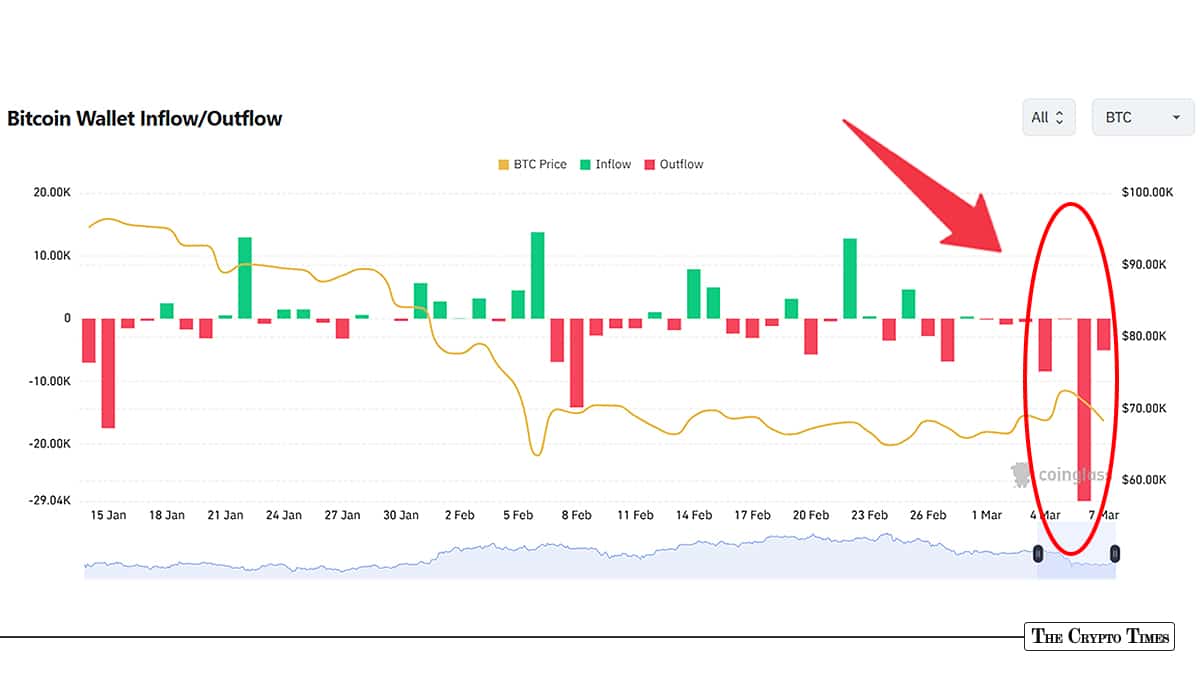
Key Highlights
- Bitcoin dipped to $68k on March 6—declining 3.7% on the day while wiping out much of the week’s rally toward $74,000.
- Short-term holders drove selling pressure, with on-chain spikes in exchange inflows reflecting profit realization near recent highs, while macro factors like Middle East uncertainty and softer U.S. jobs data fueled risk aversion.
- Despite the weakness, BTC stabilized above $68,000 support into the weekend, with signs of seller exhaustion among long-term holders and mixed but supportive ETF flows, setting up potential consolidation or a rebound if global sentiment improves.
Bitcoin’s volatile week culminated in a sharp pullback during Friday’s session on March 6, 2026, as the cryptocurrency shed gains accumulated earlier in the week amid lingering geopolitical tensions and profit-taking.
Bitcoin opened the day around $71,000 to $71,400 on major exchanges and futures markets, carrying momentum from a mid-week rally that briefly pushed it toward $74,000. This surge came on the back of a broader risk-asset rebound, with investors seemingly shrugging off escalation in the U.S.-Israel-Iran conflict that had earlier triggered oil price spikes and risk-off moves across markets.
By midday, however, selling pressure mounted. Bitcoin dipped into the high $67,000s before finding tentative support, closing the session around $68,200 to $68,400—a drop of roughly 3-4% from Thursday’s levels and marking a retreat from the week’s peak.
At the time of publishing, Bitcoin was trading at $67,967—down 3.77% in the past 24 hours.
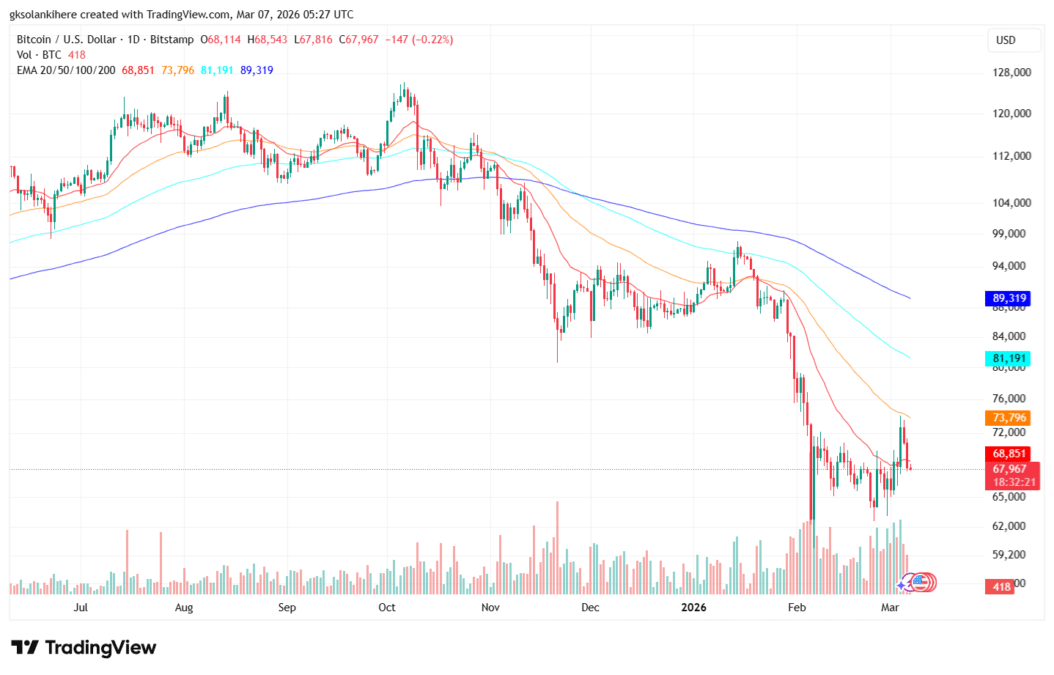
The move erased about $110 billion in Bitcoin’s market capitalization from recent highs, though the broader crypto market cap hovered near $2.4 trillion after a modest daily decline.
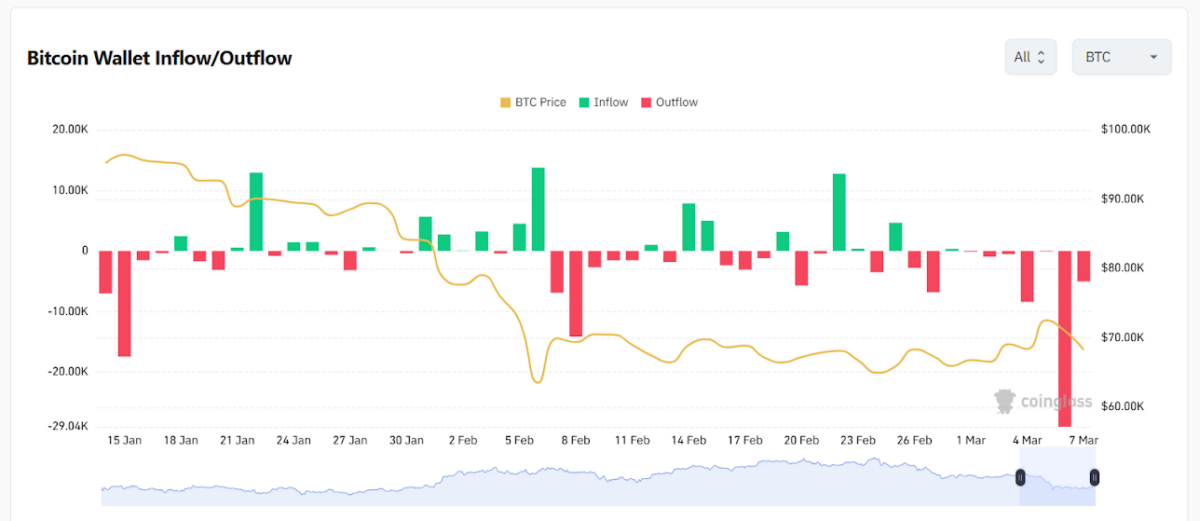
Short-term holders (STHs) appeared to drive much of the selling, cashing out profits near the $74,000 area after buying in lower during the prior dip. On-chain data from Coinglass highlighted spikes in exchange inflows (leaving external crypto wallets), consistent with distribution from newer participants sensitive to macro headlines.
Macro development driving volatility in Bitcoin
Geopolitical developments continued to weigh. While earlier hopes of de-escalation had fueled the rally, Bitcoin briefly crossed $73,000 mid-week, ongoing uncertainty in the Middle East kept risk premiums elevated. Meanwhile, oil prices remained firm and U.S. equities showed correlated softness which limited crypto’s ability to decouple.
Additionally, a softer-than-expected U.S. jobs report earlier in the week had already complicated the picture, reducing near-term Fed rate-cut expectations and pressuring risk assets. Bond yields ticked higher, signaling persistent inflation concerns that indirectly pressured Bitcoin, often viewed as a high-beta play.
Despite the Friday weakness, Bitcoin held above key support near $68,000, a level that has acted as both floor and ceiling in recent months. Some analysts noted signs of seller exhaustion, with long-term holders showing reduced net selling compared to earlier distribution phases. Institutional flows via ETFs remained mixed but supportive in patches.
As trading wrapped Friday, Bitcoin stabilized in the upper $68,000s into the weekend, setting the stage for potential consolidation or renewed tests of $70,000 resistance if macro conditions ease. The session underscored crypto’s continued sensitivity to global events, even as its correlation with equities showed flashes of decoupling during the week’s earlier rebound.
Also read: Binance Denies of Allowing $1.7B Transactions Linked to Iran