Key Highlights
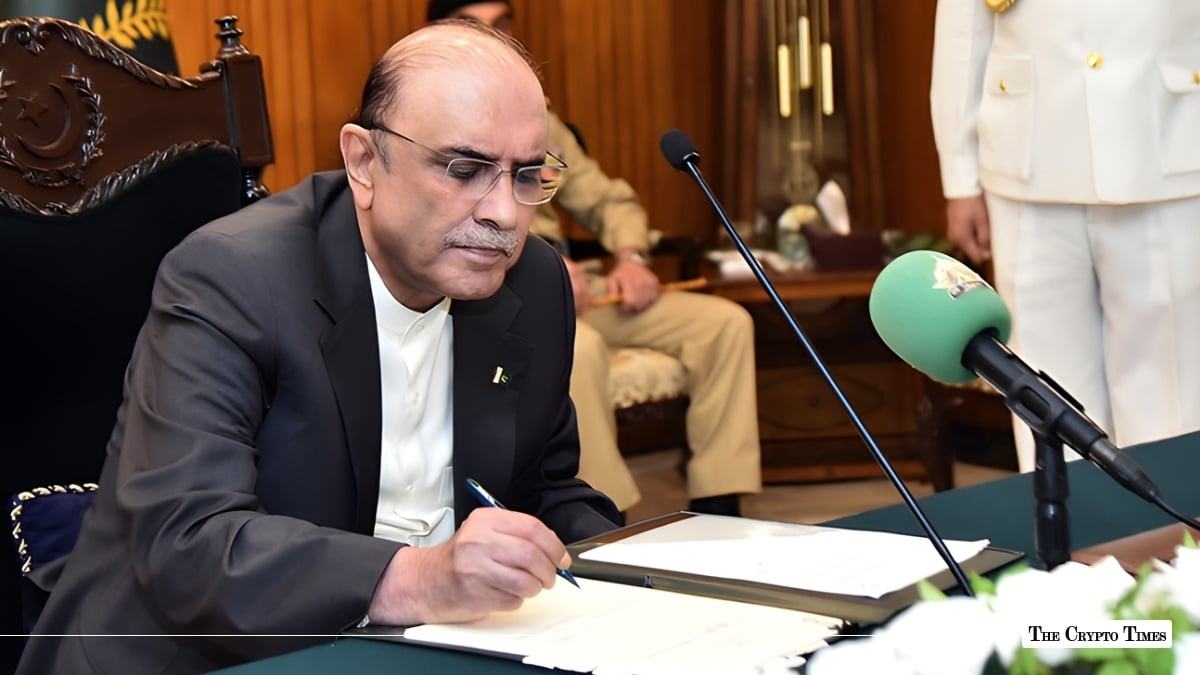
- President Asif Ali Zardari has signed the Virtual Assets Bill 2026 into law, completing Pakistan’s legislative journey from a crypto ban to full regulation.
- The law empowers PVARA to license and supervise exchanges, custodians, and token issuers, with penalties of up to five years in prison for unlicensed operators.
- Pakistan becomes one of the first emerging markets with a comprehensive crypto licensing framework that includes Shariah-compliant digital asset provisions.
Pakistan has officially legalized cryptocurrency. President Asif Ali Zardari signed the Virtual Assets Bill 2026 into law on Thursday. The presidential assent is the final step in a rapid legislative process that saw the bill clear the Senate on February 27 and the National Assembly on March 3, and it turns what was a largely unregulated gray market into a formally governed financial sector.
The move is arguably the most significant crypto policy shift in South Asia this year. Pakistan had banned cryptocurrency in 2018, citing financial risks. Now, less than two years after forming the Pakistan Crypto Council, the country has a full legal framework that gives its roughly 40 million crypto users rules, protections, and a path toward regulated trading.
What the law does
The Virtual Assets Bill 2026 establishes the Pakistan Virtual Assets Regulatory Authority (PVARA) as the country’s dedicated regulator for all things crypto.
PVARA will oversee the licensing and supervision of virtual asset exchanges, custody providers, token issuers, and other service providers. The authority is responsible for setting conduct of business requirements, enforcing customer protection safeguards, and implementing anti-money laundering (AML) and counter-terrorism financing compliance across the sector.
The bill was introduced in the National Assembly by Federal Minister for Parliamentary Affairs Dr. Tariq Fazal Chaudhry and passed by majority vote, as confirmed by Pakistan’s Associated Press.
Who sits on the regulatory board
PVARA’s governance structure brings together senior officials from across Pakistan’s financial system. The authority will be chaired by a federal government appointee and includes the Secretary of the Ministry of Finance, the Secretary of the Ministry of Law and Justice, the Governor of the State Bank of Pakistan, the Chairperson of the Securities and Exchange Commission of Pakistan (SECP), the Chairman of the National AML-CFT Authority, and the Chairperson of the Pakistan Digital Authority.
Two independent directors with expertise in virtual asset markets, digital technology, and digital finance will also be appointed by the federal government.
Penalties and Shariah-compliance
The legislation prescribes heavy penalties. Operating without a license can result in imprisonment of up to five years, a fine of up to Rs. 50 million, or both. Conducting an initial virtual asset offering in violation of the law may lead to up to three years in prison or a fine of up to Rs. 25 million. Provisions addressing market manipulation and insider trading have also been included.
In a notable provision, the law explicitly supports the development of Shariah-compliant virtual asset services. Given that Pakistan operates one of the world’s largest Islamic banking systems, this inclusion positions the country to cater to a segment of the market that most global crypto frameworks have so far ignored.
PVARA Chairman calls it a ‘defining moment’
PVARA Chairman Bilal Bin Saqib described the legislation as a turning point. He said the bill aims to convert years of largely unregulated activity into a structured, transparent, and investor-friendly ecosystem. Saqib, who was appointed PVARA chairman in December 2025, has been the face of Pakistan’s crypto push, appearing at global events including Consensus Hong Kong 2026 and Bitcoin Las Vegas.
Speaking at Consensus Hong Kong earlier this year, Saqib had framed the urgency behind Pakistan’s regulatory drive. He pointed to the country’s 40 million active crypto users who were previously trading with no rules, no protection, and no benefit flowing back to the state.
He described crypto as not a luxury for Pakistan but a necessity for its 100 million unbanked citizens.
The road to this point
The legislation provides statutory backing to PVARA, which had been established through the Virtual Assets Ordinance in July 2025. With the ordinance set to lapse in early March 2026, the bill’s passage ensures continuity of the authority’s regulatory mandate.
Pakistan’s regulatory journey has moved quickly. The government formed the Pakistan Crypto Council in early 2025, appointed Bilal Bin Saqib as its CEO, and later established PVARA.
In February 2026, PVARA launched a regulatory sandbox for virtual assets, creating a supervised environment for companies to test products including tokenization, stablecoins, and remittances. The Senate committee unanimously approved the draft Virtual Asset Act on February 25, and the full Senate passed it just two days later.
In parallel, PVARA has already issued No Objection Certificates (NOCs) to two global exchanges, Binance and HTX, allowing them to conduct preparatory activities in Pakistan under defined regulatory oversight while they work toward full licensing.
Pakistan’s broader crypto ambitions
The bill is one piece of a much larger puzzle. Pakistan has signaled ambitions that go well beyond regulating exchanges.
The country has announced plans for a strategic Bitcoin reserve, allocated 2,000 megawatts of surplus electricity for Bitcoin mining and AI data centers, and signed a memorandum of understanding with an affiliate of World Liberty Financial to explore stablecoin-based cross-border payments and tokenization of government bonds and treasury bills.
Binance Co-Founder Changpeng Zhao (CZ) has said that at the current pace of regulatory development, Pakistan could become one of the world’s leading crypto hubs within five years.
Pakistan is also exploring a rupee-backed stablecoin and a central bank digital currency (CBDC), with a prototype already being developed with support from the World Bank and IMF.
What happens next
With presidential assent secured, the focus now shifts to implementation. PVARA will need to finalize its licensing framework, process applications from exchanges and service providers, and begin enforcing the law’s provisions on market conduct, AML compliance, and investor protection.
For Pakistan’s millions of crypto users, the immediate change is clarity. What was previously a gray market with no formal protections is now a legally recognized financial sector. For exchanges looking to operate in the country, the path forward is a formal licensing process under PVARA, not informal NOCs or regulatory ambiguity.
For the broader region, Pakistan’s move adds pressure. India, which leads global crypto adoption but continues to operate without a comprehensive regulatory framework, now has a neighbor with a fully enacted crypto law that includes provisions it has not yet addressed, including Shariah-compliant services, a dedicated regulatory authority, and clear penalties for market abuse.
Also Read: Virtual Asset Act 2026: Pakistan Set to Legalize Crypto Trading