Key Highlights
- Bitcoin’s 2025 price swings masked deeper structural changes driven by long-term capital, regulation, and declining volatility.
- Institutional adoption and clearer U.S. regulation are reshaping Bitcoin’s role from speculative asset to financial infrastructure.
- Mining, collateral use, and developer policy shifts suggest Bitcoin is entering a more mature phase of market behavior.
Bitcoin’s push toward $120,000 in 2025 initially felt familiar. The market picked up momentum again, bullish stories started doing the rounds, and across trading desks, there was a growing belief that another post-halving run was taking shape. Then, October 10 hit.
A sudden flash crash tore through the market, liquidating leveraged positions within minutes and once again showing how quickly sentiment can flip.
Inside the industry, though, the response was unusually restrained.
Instead of setting off panic, the crash pushed the conversation in a different direction—away from price levels and toward what was actually happening beneath the surface of the market. The question many long-term participants began asking was not how high Bitcoin could go next, but whether it was still the same market at all.
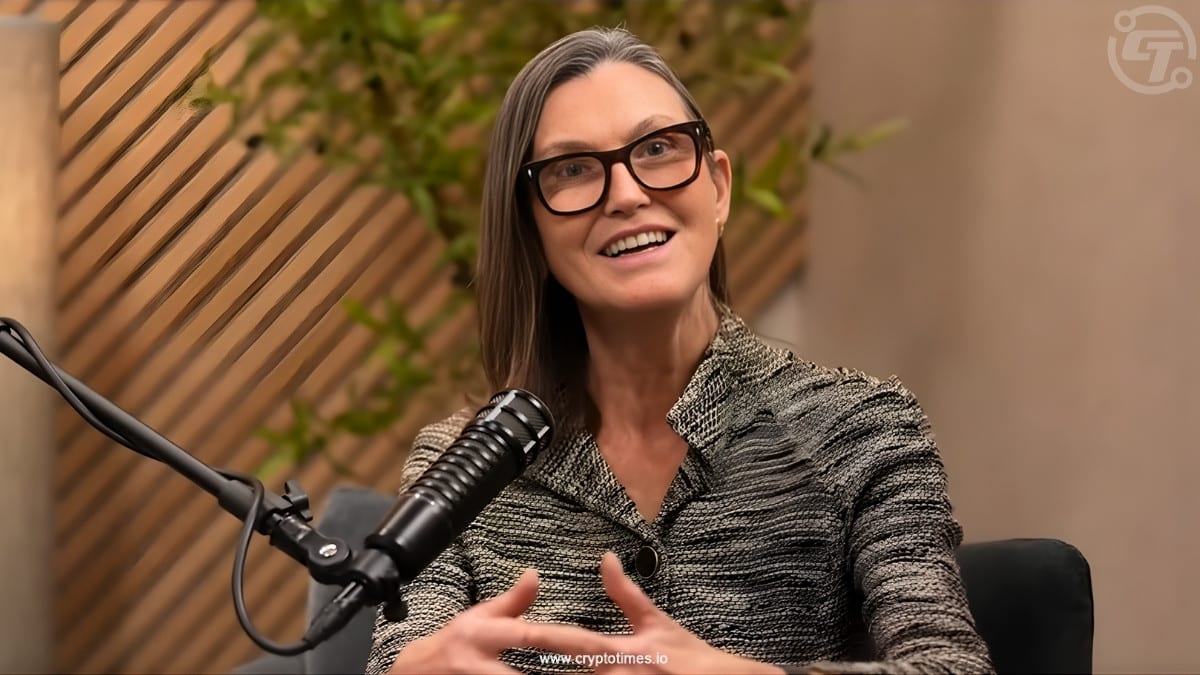
That question sat at the center of ARK Invest’s year-end Bitcoin Brainstorm discussion, where Cathie Wood and her team framed 2025 as something more than just another volatile year. According to Wood, the changes underway are big enough that Bitcoin may now be entering a fundamentally different era.
“I think 2025 is going to be like one era before that—and one era after that,” Wood said.
Volatility is still here, but it means something different now
Wood was clear that risk has not disappeared. She acknowledged that further downside remains possible and that leverage can still unwind unexpectedly. But the scale of that risk, she argued, has changed.
In earlier cycles, Bitcoin routinely suffered drawdowns of 50% to 70%, events that reset the market but also reinforced its reputation as an unstable asset. Today, Wood suggested, a decline closer to 30% would be interpreted very differently, not as a failure of the system, but as evidence that Bitcoin is maturing.
That shift, she said, reflects how the market itself has evolved. Bitcoin is no longer dominated by short-term speculative capital alone. Instead, it is increasingly held by entities with longer time horizons and balance-sheet-level conviction.
Why the four-year cycle is losing its grip
For more than a decade, Bitcoin’s price behavior followed a rhythm closely tied to its four-year halving cycle. Peaks, crashes, accumulation, and recovery became almost ritualistic. In 2025, that rhythm began to feel less reliable.
ARK analyst Lorenzo Valente pointed to the changing composition of Bitcoin holders as a key reason. The capital flowing into the market today is not primarily looking for quick exits. Public companies, institutional allocators, and long-term investors are approaching Bitcoin as a strategic asset rather than a trade.
“These are companies and people with a long-term vision,” Valente said. “They’re not here for six months or a year.”
As that type of capital becomes more dominant, extreme volatility becomes harder to sustain. The result is a market that still moves, but no longer collapses under its own weight in the same way.
2025 and the role of regulation
The market’s structural shift did not happen in isolation. It unfolded alongside one of the most consequential years for crypto regulation in the United States.
Progress on the GENIUS Act and the CLARITY Act helped establish clearer rules around stablecoins, market structure, and digital asset classification. While neither framework resolved every open question, both sent a signal that crypto, Bitcoin included, was moving out of regulatory limbo.
For institutions that had spent years watching from the sidelines, that clarity mattered. Bitcoin and Ethereum began to function less like regulatory risks and more like assets that could be integrated into existing financial systems.
Bitcoin as a reserve: Holding instead of selling
A key change discussed was how miners and infrastructure companies are handling their Bitcoin. Instead of selling it to pay for costs, many are now keeping their Bitcoin as a reserve. They borrow money using their Bitcoin as collateral, which lets them raise funds without selling the coins they hold.
This approach is helping companies pay for energy contracts, expand mining operations, and build new infrastructure. It shows a bigger shift: Bitcoin is no longer just a short-term trading asset. Companies are now using it as part of long-term planning, linking it more closely to real-world projects and business strategies.
Bitcoin’s quiet transformation into collateral
One of the most telling signs of that integration is how Bitcoin is being used. Instead of selling Bitcoin to cover costs, miners and infrastructure companies are increasingly choosing to borrow against it. The idea is simple: keep the Bitcoin, use it as collateral, and avoid exiting positions they still believe in.
That shift has started to change how these businesses operate. Bitcoin is no longer just something they hold or trade around market cycles. It is being used to finance power contracts, expand mining sites, and build out infrastructure, tying the asset more directly to physical projects and long-term planning.
Stablecoins took the transaction role, and Bitcoin took the rest
During the discussion, Wood acknowledged that stablecoins have taken on roles many once expected Bitcoin to fill, particularly in payments and remittances across emerging markets.
“Stablecoins are serving as the insurance policy that we thought Bitcoin would provide,” she said.
Rather than weakening Bitcoin’s relevance, Wood argued, this division of labor has clarified it. Stablecoins handle transactions. Bitcoin, increasingly, is held for what it represents: scarcity, neutrality, and independence from sovereign monetary systems.
A network still spreading, not concentrating
Concerns about mining centralization surfaced repeatedly over the past year, particularly as some large miners shifted infrastructure toward artificial intelligence and high-performance computing.
Several speakers challenged the view that Bitcoin mining is becoming more centralized. They said that as some of the largest mining firms shift resources toward artificial intelligence and high-performance computing, opportunities have emerged for smaller operators. Many of these newer mining operations rely on renewable or off-grid energy, allowing them to function outside traditional power markets.
In places with abundant hydroelectric and solar energy, particularly across parts of Africa, miners are increasingly using surplus power that would otherwise go unused. By turning that excess energy into Bitcoin, these operations are quietly expanding the network’s geographic spread, even as the industry itself becomes more mature and institutional.
Privacy, developers, and the line policymakers are drawing
Another theme that emerged was the treatment of developers and privacy tools. Legal cases involving wallet developers have raised alarms across the industry, but the tone from policymakers has begun to shift.
“We will no longer go after the people who create this technology,” one speaker noted. “We will go after the people who abuse the technology.”
That distinction, if upheld, could shape Bitcoin’s long-term role as open financial infrastructure rather than a tightly controlled product.
Why 2025 will be remembered differently
Looking back, 2025 may not stand out for how high Bitcoin traded or how sharply it corrected. Instead, it may be remembered as the year Bitcoin stopped behaving like a purely speculative asset and started acting like embedded financial infrastructure.
As Cathie Wood put it, the real story is not the price—but the transition underway beneath it.
Also Read: Bitcoin Bulls Busted on Their Predictions as BTC Closes 2025 at $87K