Key Highlights
- Hyperliquid leads in 24-hour fees, generating $964,700 and surpassing Tron, Solana, and Ethereum.
- Most activity occurs at the application level, with $1.22 million in fees and $219 million in DEX trading volume.
- HyperEVM, the network’s smart-contract layer, handles fewer but larger trades, recording 40,000 transactions and 1.25 million active addresses.
Hyperliquid has reclaimed its position as the top blockchain by fee generation over the past 24 hours, overtaking established networks such as Tron, Solana, and Ethereum to start 2026.
On-chain data from Artemis shows Hyperliquid recorded about $964,700 in fees, compared with $690,000 on Tron and $506,000 on Solana in 24 hours.
Other major chains showed varied activity: EdgeX around $481K, BNB Chain roughly $343K, Ethereum about $239K, and Bitcoin near $200K. Smaller chains like Osmosis, Base, Dogecoin, Cronos, Arbitrum, Sui, Polygon PoS, Avalanche C-Chain, Internet Computer, TON, and Stride each generated less than $100,000.
Fees on Hyperliquid come from fewer users but much larger trades. According to the most recent DefiLlama data, Hyperliquid’s Total Value Locked (TVL) across its DeFi ecosystem sits at about $1.42 billion, slightly down over the past day.
Application-level Activity
Applications built on Hyperliquid are where most economic activity occurs. In the past 24 hours, apps generated around $1.22 million in fees. Decentralized exchanges (DEXs) processed over $219.87 million in trading volume, with a seven-day total of $1.37 billion, up 5.47% from the previous week.
Perpetual futures (perps) dominate trading, with $2.24 billion in daily volume and $24.59 billion over the past seven days, despite a 14.46% weekly decline. Bridged liquidity on the network stands at $6.20 billion, reflecting the value users have moved from other chains to participate in Hyperliquid.
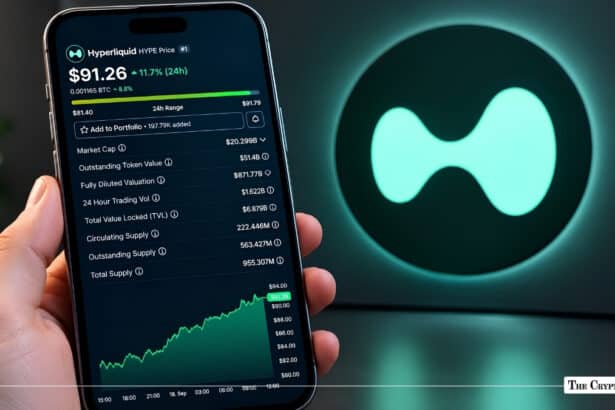
The network’s token, HYPE, trades near $24.60, with a market capitalization of $5.86 billion and a fully diluted valuation of around $23.67 billion. The value is down about 60% from its all-time high of $59 reached in September 2025.
Transactions and use cases
The number of transactions executed on the Hyperliquid blockchain is significantly lower compared to general-purpose blockchains.
To put this into context, Tron processes a network of 7 million transactions with the help of 72 million active addresses, while on the Solana network, there are 14 million transactions with approximately 380 million active addresses.
HyperEVM, the smart contract platform of Hyperliquid, had a mere 40,000 transactions, as well as 1.25 million active addresses.
Other blockchain platforms support millions of transactions, including smaller ones, involving payment, NFT, or game-related transactions. This is because Hyperliquid’s main concentration is on the trading of derivative products. Only a few traders transact here.
Hyperliquid has a market cap of about $5.8 billion with annualized revenue of around $530 million, giving it a market cap-to-revenue ratio of 11x. In comparison, larger chains like Tron and Solana have higher revenues and much bigger valuations, reflecting their larger scale and broader activity.
Why this matters
High fees and trading volumes represent actual economic activity, not mere network traffic. Perpetual trading of futures contributes the most to the revenue. Bridging liquidity increases the amount of money flowing through the network, promoting more liquid markets and smooth trade execution.
With fewer users, Hyperliquid still yields substantial fees due to larger and more frequent trade sizes. This indicates that dedicated networks can hold their ground against general-purpose blockchains on the basis of revenue alone, without necessarily having millions of users on a daily basis.
Also Read: Hyperliquid Labs Unstakes $31.2M Worth of HYPE Tokens for Team