Key Highlights
- Circle’s Nanopayments enables ultra-small USDC payments across 11 blockchains.
- The system groups transactions off-chain and settles them in batches on-chain, removing per-transaction gas fees.
- The x402 standard allows AI agents to pay for services automatically without accounts or cards.
Circle, the issuer of USDC, today launched its Nanopayments system on mainnet through its Circle Gateway infrastructure.
According to the official blog post, the system is designed for developers, AI agents, and automated software that need to send and receive very small USDC payments across 11 blockchains. Supported networks include Ethereum, Arbitrum, Base, Optimism, Polygon, Avalanche, Sei, Sonic, Unichain, HyperEVM, and World Chain.
The system supports transactions as low as $0.000001, making it suitable for use cases such as API calls, data access, computing power, and other pay-per-use services. AI agents can execute these payments automatically as part of their workflows, without requiring manual approval.
Fixing the issue of expensive microtransactions
Circle said the Nanopayments system is designed to address a key limitation in existing payment systems. Traditional payment rails often involve fixed transaction fees, making very small payments inefficient.
Even blockchain networks charge gas fees, and sometimes those fees are higher than the payment itself. Circle is solving this by removing per-transaction gas costs. It does this by grouping many transactions off-chain first.
After grouping them, the system settles them on-chain in batches. This means developers do not pay gas fees for every single transaction. Instead, the costs are handled in the background by Circle when the batch is settled.
x402 integration and payment flow
The system integrates the x402 open standard, allowing agents to transact without accounts or credit cards. Circle said the first process would be for an agent to request a service. After that, the service receives HTTP 402 payment instructions.
The agent signs an approval using an EIP-3009 and resubmits the request. The system checks and confirms the payment quickly using Circle’s API, and the service can be given immediately. Final settlement still happens later in batches, but the service does not need to wait.
Circle highlighted an early example where an autonomous robot dog used Nanopayments to pay for its own recharging in USDC, showing how machines could eventually handle real-world expenses independently.
The system also supports instant verification, meaning merchants can confidently deliver goods or services immediately after authorization without waiting for blockchain finality.
The infrastructure runs on Circle Gateway, which provides a unified USDC balance across supported blockchains. Developers can deposit USDC into a smart contract and access liquidity across chains in under 500 milliseconds. Nanopayments then processes transactions at scale while maintaining synchronized balances across networks.
Broader context
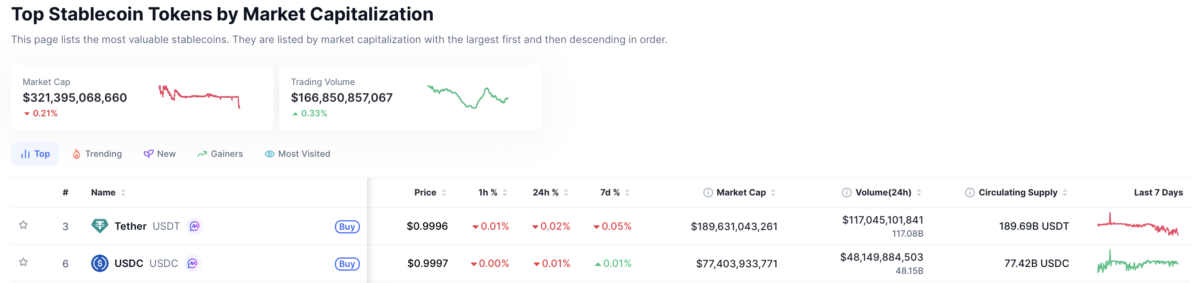
The launch aligns with broader growth in stablecoins, which now exceed $321 billion in total market capitalization. USDC remains the second-largest stablecoin with around $77 billion in circulation, according to data from CoinMarketCap.
Moreover, Circle has been expanding beyond USDC issuance with products like the Circle Payments Network for cross-border payments, Gateway for chain abstraction, and Arc, a Layer-1 blockchain focused on USDC activity.
Circle describes Nanopayments as “a payment primitive designed for an interoperable machine-scale economy,” meaning it is built to support a future where machines and apps can freely send money while working across different platforms and blockchains.
Also Read: Trust Wallet Adds Hyperliquid Perps with 0% Fees for 3 Months