Circle’s Chief Economist Gordon Liao has submitted an emergency governance proposal on Aave’s forum, urging a sharp recalibration of USDC interest rate parameters on Aave v3 Ethereum Core after the pool has sat pinned at near-100% utilization for four straight days. The proposal, filed as an ARFC on April 22, arrives in the wake of the KelpDAO exploit that has triggered a broader liquidity crunch across Aave’s core markets.
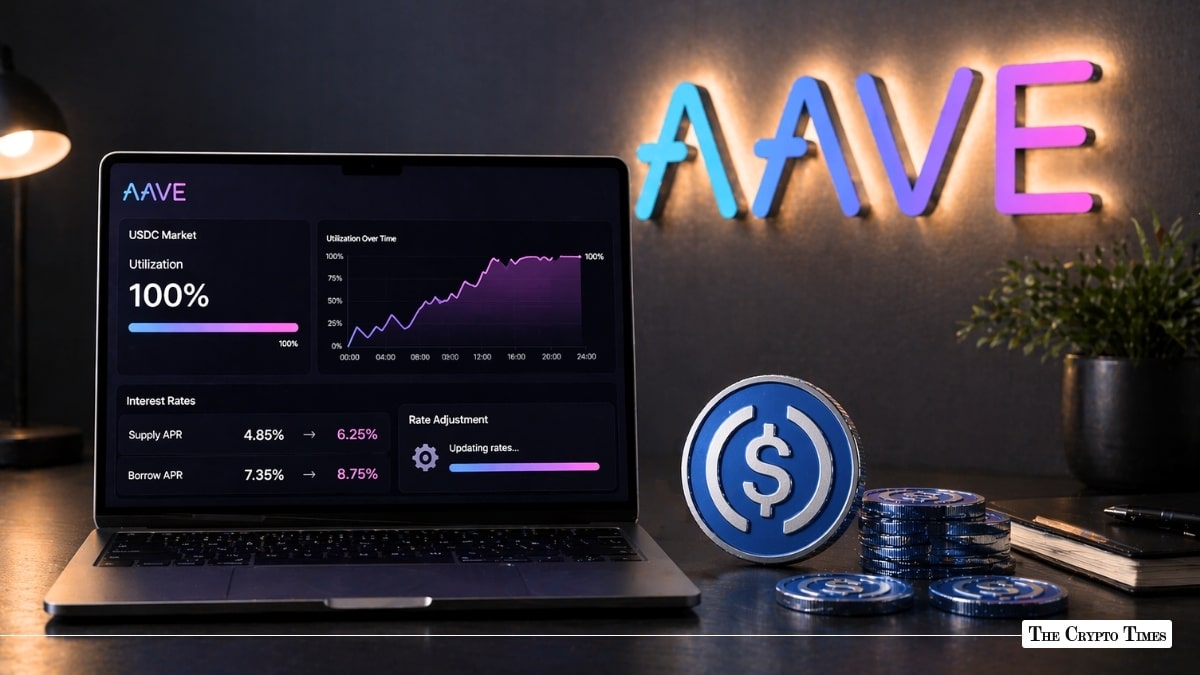
According to the proposal, USDC utilization on Aave v3 Ethereum Core has sat at 99.87%, with available liquidity below $3 million against a total supplied pool of roughly $1.89 billion.
The variable borrow rate has been flat at the post-kink ceiling of around 14% for the entire period, and pool supply has contracted by approximately $60 million in the last 24 hours—with repayments matched dollar-for-dollar by queued withdrawals. Liao argues the current rate is not clearing the market and that the pool is contracting rather than deleveraging.
What the Proposal Changes
The recalibration targets two core parameters of Aave’s kinked interest rate model:
- Slope 2 would move from roughly 10% to a target of 50%, with an interim risk steward step at 40%.
- Optimal utilization (U*) would drop from 92% to a target of 85%, with an interim step at 87%.
- Slope 1 (3.5%), base rate (0%), and reserve factor (10%) would all be held at current levels.
- Slope 2 Risk Oracle would be paused or floored for USDC during the incident and re-engaged once conditions normalize.
At the proposed target, a 100% utilization scenario would push the variable borrow rate to roughly 53.5% and the supply rate to around 48.2% — a level Liao argues is steep enough to attract new USDC deposits from sophisticated allocators “within hours” and force utilization back below the kink.
Why the Current Rate Isn’t Clearing
Liao’s reading is that the marginal-borrower mix on Aave has shifted since the April 18 rsETH incident. External reporting has flagged roughly $300 million in incremental borrow flow in the 72 hours following the exploit, dominated by what the proposal calls “trapped-liquidity extraction”—users whose collateral is stuck on frozen or LTV-zeroed markets borrowing stablecoins to exit via DEX.
These borrowers, the proposal argues, are “structurally rate-insensitive over short horizons.” A user accepting a potential double-digit headline loss to exit a stuck position treats a 14% borrow rate as a minor fee for bypassing the withdrawal queue—at that level, a week of carry costs roughly 27 basis points.
On the supply side, the current rate ceiling is competitive but not dominant because allocators are now pricing in observable illiquidity rather than the instantaneous liquidity Aave historically offered.
The active lever, in Liao’s view, is supply attraction rather than borrower deterrence. Lifting the rate ceiling into the 35–50% range, he argues, should pull in LP capital quickly, restoring the post-kink region as a functional price-discovery range.
Execution Path
The proposal recommends a two-step execution: first, a same-day Risk Steward action by LlamaRisk and Aave Labs to implement the interim parameters via the 2/2 multisig, followed by full governance ratification of the target values within five to seven days through the standard ARFC → Snapshot → on-chain vote pipeline. The 5-of-9 Protocol Emergency Guardian multisig is flagged as a contingency if stewards decline to act and conditions deteriorate further.
Follow-on proposals for USDC on Arbitrum, Base, Polygon, Avalanche, Optimism, and Linea may follow if those deployments show similar pinning, though Liao defers that call to LlamaRisk.
The proposal also notes that the DAO’s decision to flatten WETH’s IRM on April 20 — bringing Slope 2 down to 3% on Core — was pool-specific and complementary, not contradictory, to the USDC steepening now being proposed.
WETH was flattened to avoid rate-driven liquidations of stuck rsETH-backed positions during socialization; USDC, by contrast, is a healthy asset facing only withdrawal-side stress. As of press time, LlamaRisk and Aave Labs had not publicly responded to the proposal on the governance forum.
AAVE Price Reaction
The AAVE governance token was trading at roughly $91.99, down about 1.37% in the last 24 hours with a $338 million trading volume, according to CoinMarketCap, as the proposal went live, with the token’s market cap hovering near $1.41 billion. The token had earlier surged roughly 30% off its April 18 lows, when it briefly slumped into the mid-$80s in the immediate aftermath of the KelpDAO exploit, before stabilizing as Aave governance moved to contain the bad-debt exposure.
The muted reaction to Liao’s proposal suggests traders are treating the USDC parameter fix as a technical recalibration rather than a fresh stress event—a read consistent with Aave’s own framing that the USDC pool is a healthy asset facing withdrawal-side friction, not a solvency issue.
Aave’s TVL, however, has fallen from roughly $26.4 billion to about $17 billion since the rsETH incident, reflecting the scale of deposit rotation the protocol is still working through. How quickly supply returns to the USDC pool after the proposed rate steepening will likely be the more closely watched signal for AAVE holders over the coming week than the headline token price itself.
Also Read: Aave Founder Highlights Recovery Plans After $292M KelpDAO Exploit