Key Highlights
- Iran’s Central Bank bought $507 million in USDT to support the rial and manage international trade.
- Most USDT was first sent to Nobitex, but after a $90 million hack, funds were moved through bridges and exchanges.
- The purchases aimed to create a sanctions-proof system and inject dollar liquidity into the local market.
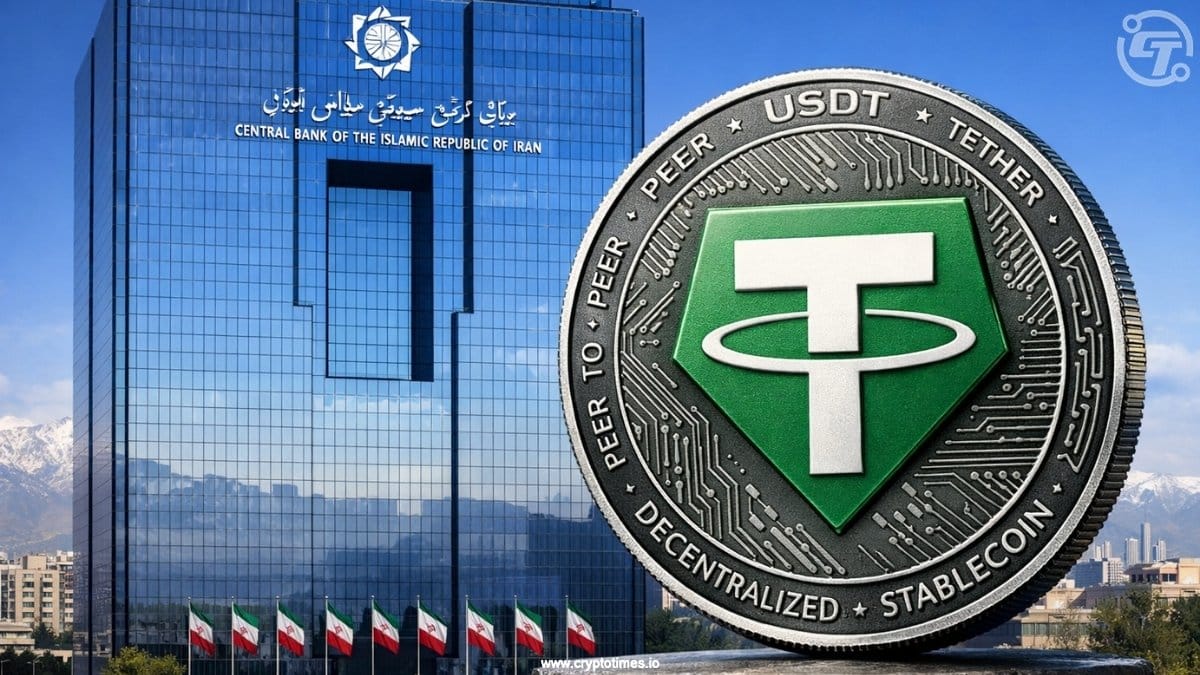
The Central Bank of Iran (CBI) purchased $507 million in Tether’s USDT stablecoin between April and May 2025, with payments made in UAE dirhams. The bank reportedly did this to support the Iranian rial, which recently fell to a record low, and to continue international trade even though Iran faces many sanctions.
According to UK-based blockchain research firm Elliptic, a network of cryptocurrency wallets was used by the CBI to systematically collect USDT. Elliptic co-founder Tom Robinson explained that leaked documents detail purchases made via an entity called Modex, which “may be a crypto broker that is willing to do business with the Iranian government.”
How the USDT was handled
Elliptic’s investigation mapped out the full wallet network, which showed a deliberate accumulation of USDT worth at least $507 million. The figure is considered a “lower bound,” as some wallets could not be attributed to the CBI with certainty. At first, most of the acquired USDT was initially sent to Iran’s largest cryptocurrency exchange, Nobitex, which allows users to store, trade, and sell digital assets for rials.
However, following a hack on June 18, 2025, that resulted in over $90 million being drained from Nobitex. After this, the CBI moved its USDT to a cross-chain bridge, changing the tokens from TRON-based USDT to Ethereum-based USDT. The stablecoins were then converted to other digital assets, moved to different blockchains, and sent to other exchanges. This process lasted until the end of 2025.
Iran moves to USDT and digital dollars
The main reason for CBI’s purchases appears to be stabilizing the Iranian rial and injecting US dollar liquidity into the local market. “The routing of funds to Nobitex indicates a strategy of injecting US dollar liquidity into the local market to prop up the rial,” Elliptic’s research noted. Beyond domestic intervention, Iran wanted a system that could work around sanctions, using USDT as “digital off-book eurodollar accounts” to store value outside of U.S. control.
Meanwhile, Tether froze around $37 million in wallets linked to the CBI in June 2025. Iran continues to face economic challenges, including domestic unrest and repeated sanctions, including UN sanctions over its nuclear program in September 2025. These conditions appear to have driven the country to explore digital assets for both domestic market support and international trade.
Also Read: Iran’s IRGC Quietly Shifted $1B Through UK Crypto Platforms