Key Highlights
- Bitcoin holdings on centralized exchanges climbed from ~2.723 million BTC in mid-January to ~2.761 million BTC by late February, for potential selling amid geopolitical uncertainty.
- Meanwhile long-term illiquid supply has reached multi-year highs, showing strong holder conviction, while spot Bitcoin ETFs recorded $787 million in net inflows last week.
- BTC fell to as low as $63,000 over the weekend amid U.S.-Israel strikes on Iran but recovered to trade near $66,250, trading sideways in a classic risk-off move rather than rallying as a safe haven, with analysts like QCP Capital noting the conflict’s early stage and historical patterns of quick rebounds.
The supply behavior of Bitcoin on centralized exchanges is offering conflicting signals to traders and analysts speculating on the largest cryptocurrency amid escalating conflict and volatility in the Middle East.
Bitcoin (BTC), often touted as a hedge against geopolitical chaos, has instead shown vulnerability, dipping as low as $63,000 over the past weekend before clawing back toward $66,000–$67,000 amid U.S.-Israel strikes on Iran and retaliatory actions. Adding to the fuel is on-chain data that paints a picture of rising selling pressure in recent weeks.
According to CryptoQuant, total Bitcoin reserves across exchanges have climbed from the historic low of 2.718 million on January 19 to roughly 2.761 million BTC by late February. Currently sitting at 2.748 million, the metric resembles mixed views from Bitcoin investors.
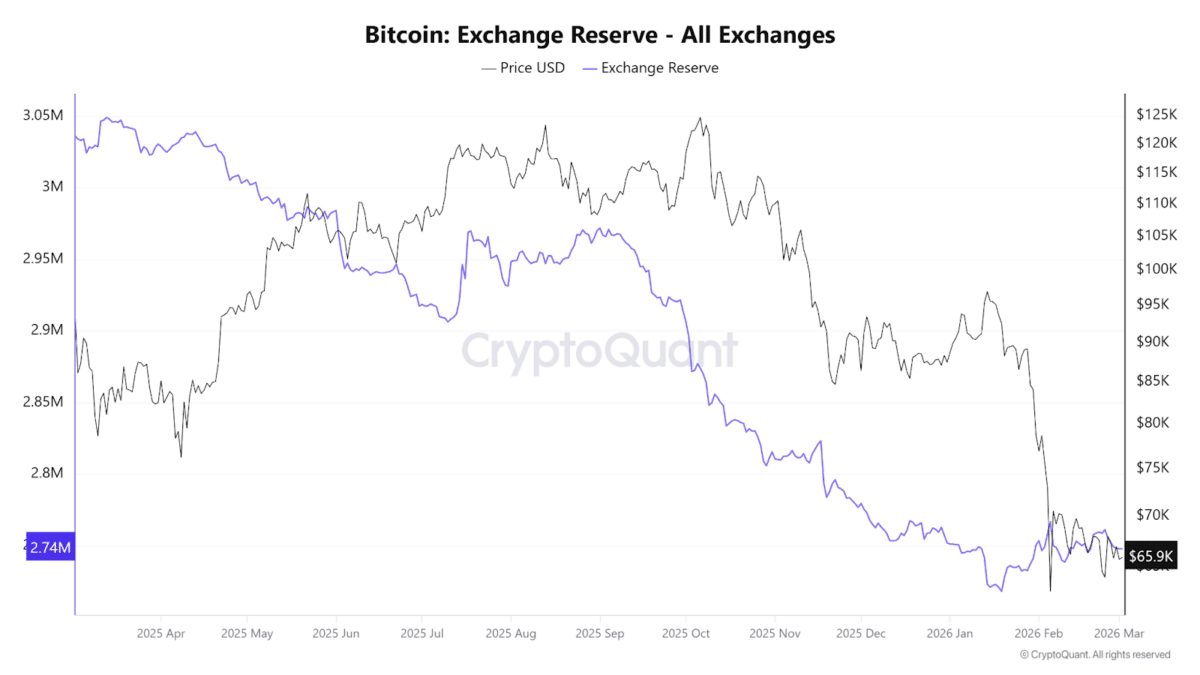
This recent uptick in exchange-held supply typically signals bearish dynamics as more coins are readily available for sale and can amplify downward moves when sentiment turns sour.
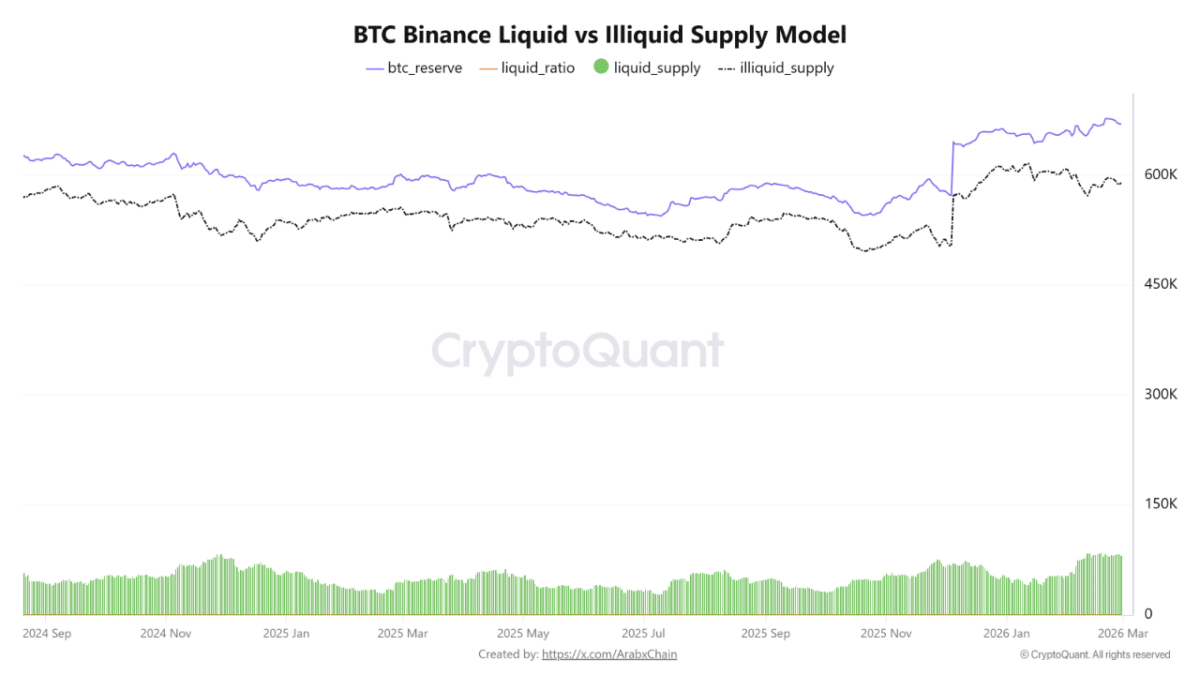
However, the picture is not uniformly grim as some metrics hint at underlying resilience. Illiquid supply held in long-term wallets has hit multi-year highs, pointing to strong holder conviction.
Additionally, exchange-traded fund (ETF) flows, a key institutional barometer, flipped positive recently after weeks of heavy outflows. As per SoSoValue data, spot Bitcoin ETFs saw nearly $787.31 million in net inflows last week, ending a five-week streak of redemptions that totaled billions.
Volatility in Bitcoin price amid global tension
Bitcoin’s price reaction to the Iran tensions has been telling. It initially plunged alongside equities in a classic risk-off move, rather than rallying like traditional safe havens such as gold. A brief spike to $69,000 later followed, with unconfirmed reports of high-profile casualties and uncertainty over prolonged conflict—coupled with oil price surges and potential Strait of Hormuz disruptions.
“It appears that the market was relatively well positioned for a volatile weekend given the warning signs throughout last week,” noted QCP Capital, a prominent Singapore-based digital asset trading firm in the cryptocurrency space, in their latest insight.
These mixed signals have left market observers divided. While rising exchange reserves point to near-term downside risks from increased liquidity for sellers, stubborn long-term holding and fresh ETF demand suggest the market isn’t in full capitulation.
“If we recall the previous US strike on Iran last June (also a weekend), BTC broke below $100k as the news broke only to trade back above on Monday, and subsequently rallied to a high of $123k a few weeks later,” QCP emphasized. The firm further stated, “The conflict is still in its early stages, and it’s premature to conclude whether it will remain contained or evolve into a broader regional confrontation involving other Gulf states.”
At the time of publishing, Bitcoin was trading near $66,250—reflecting cautious relief rather than euphoria. Currently, it is down 0.6% in the past 24 hours while trading volume sitting near $40 billion, as per CoinMarketCap data.
As geopolitical headlines dominate, Bitcoin’s path may hinge on whether fresh institutional buying can offset any further supply influx—or if broader risk aversion prevails.