Key Highlights
- Bitcoin tests $75K after post-election dip; traders watch key support as volatility and geopolitical risks linger.
- Weak momentum keeps BTC exposed; drops below $74K could trigger wider crypto selloffs, while $80K offers short-term relief.
- Industry voices and macro risks weigh in; CZ, Burry, and others warn emotions, liquidity, and deadlines could impact BTC further.
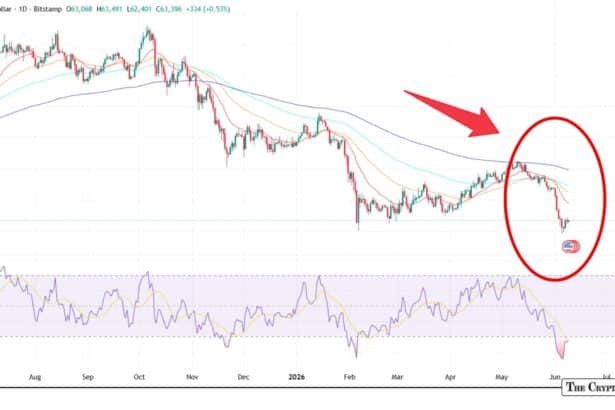
Bitcoin (BTC) is facing renewed volatility and dipping to the lowest level since post-election, testing key levels near $75,000. The selloff coincided with falling futures open interest and negative funding, showing that traders were deleveraging amid heightened uncertainty.
According to QCP Capital, Bitcoin dipped to about $72,900 before rebounding, signaling cautious optimism. As per the report, traders are keeping a close eye on $75,000, seeing it as a make-or-break level for Bitcoin’s next moves.
The recent drop happened just as the U.S. House approved a $1.2 trillion funding bill, ending the partial government shutdown. While this eased some immediate worries, investors are still cautious because the funding for Homeland Security only lasts until February 13, leaving another deadline on the horizon.
Besides, the rising geopolitical tensions have created another layer of uncertainty. Oil prices rose after the US shot down an Iranian drone near the USS Abraham Lincoln, though diplomacy headlines continue to cap big moves.
Bitcoin vulnerable amid weak momentum
QCP noted that while BTC stabilized above $74,500, downside risks persist. “Upside remains constrained near recent resistance levels,” analysts said, warning that sustained drops below $74,000 could trigger further liquidation-driven declines. Consequently, the broader crypto market may follow suit if BTC fails to hold key support.
Traders are closely watching potential institutional buying at $76,000. In addition, a reduction in geopolitical tensions and a dovish stance from the Federal Reserve may help support the market. Nevertheless, macro uncertainty and weak market momentum continue to pose risks to Bitcoin. QCP emphasized that if BTC breaks above $80,000, traders could experience temporary relief.
Macro risks add pressure
The U.S. political scene is also affecting risky assets beyond crypto. President Donald Trump’s nomination of Kevin Warsh as Fed Chair has brought back “reaction-function risk.” Warsh prefers faster balance sheet shrinkage, which could put pressure on short-term funding markets. As a result, any sudden shortage of reserves might create market stress. Additionally, investors are staying alert because budget standoffs can flare up quickly.
Analysts point to options market dynamics, which also show caution. Front-end implied volatility remains bid, despite a rebound in spot prices, and the term structure indicates mild backwardation.
Skew has also steepened, indicating a strong demand for crash protection. The current level around $75,000 is seen as a key level, and holding above this will help to rebuild confidence, while a break below it will only accelerate.
Community concerns and industry commentary
Market mood is also shaped by what industry leaders are saying. Binance Co-Founder Changpeng “CZ” Zhao in a broadcast on Binance’s social network, admitted, “A couple of weeks ago I was pretty positive about the bitcoin super cycle, but right now… I’m less confident.” He pointed to strong emotions in the crypto community and accusations against Binance over the October flash crash.
Similarly, Ark Invest CEO Cathie Wood in a Fox Business interview, spoke out about technical problems and liquidity issues, saying these factors helped trigger the record liquidation events that shook market stability.
Meanwhile, investor Michael Burry best known for his role in The Big Short, as cited by Business Insider, highlighted structural risks. He warned that BTC sliding below $70,000 could hurt institutions, restrict capital, and strain risk management. Deeper declines toward $50,000 might threaten miners and ripple into tokenized and physical metals markets.
Also Read: Nearly $500B Lost: Why Bitcoin Holders Are Panicking Right Now